• #rsisb
    Roll no 248
    Foundation level
    song no 25
    **The Physics of Everyday Life: How Science Affects Our World**

    Have you ever wondered why things move, fall, float, heat up, or make sounds? Physics is all around us! From walking and riding a bicycle to using smartphones , cooking food , playing sports , and traveling by car or airplane , science helps explain how our everyday world works.

    This topic takes you on an exciting journey through the fascinating physics behind ordinary experiences, making science simple, relatable, and fun!

    #Physics #EverydayPhysics #Science #Learning #Technology #Gravity
    #Motion #Energy #ScienceEducation #PhysicsInLife #ExploreScience #LearningIsFun
    #rsisb Roll no 248 Foundation level song no 25 🔬🌍 **The Physics of Everyday Life: How Science Affects Our World** ⚡✨ Have you ever wondered why things move, fall, float, heat up, or make sounds? 🤔🚗💨 Physics is all around us! From walking and riding a bicycle 🚲 to using smartphones 📱, cooking food 🍳, playing sports ⚽, and traveling by car or airplane ✈️, science helps explain how our everyday world works. 🎶 This topic takes you on an exciting journey through the fascinating physics behind ordinary experiences, making science simple, relatable, and fun! 🌟🧠 #Physics 🔬 #EverydayPhysics 🌍 #Science ✨ #Learning 📚 #Technology 📱 #Gravity 🌎 #Motion 🚀 #Energy ⚡ #ScienceEducation 🎓 #PhysicsInLife 🔭 #ExploreScience 🌟 #LearningIsFun 🎶
    0 Comentários 0 Compartilhamentos 735 Visualizações 6
  • #rsisb
    Roll no 248
    Foundation level
    Song no 24
    **Black Holes and Beyond: Exploring the Limits of Physics**

    Step into the mysterious universe of black holes, where gravity becomes incredibly powerful and the laws of physics are pushed to their limits! This song takes you on an exciting journey through space, exploring cosmic mysteries, spacetime, gravity, and the unanswered questions that continue to inspire scientists.

    Let the music carry you beyond the stars and into the deepest mysteries of the cosmos! Learn, wonder, and imagine what lies beyond our understanding.

    #BlackHoles #BeyondTheStars #Physics #Space #Astronomy #Cosmos #Science #Universe #Spacetime #Gravity #ScienceSong #CosmicMysteries #ExploreTheUniverse #LearningThroughMusic
    #rsisb Roll no 248 Foundation level Song no 24 🌌🕳️ **Black Holes and Beyond: Exploring the Limits of Physics** 🚀✨ Step into the mysterious universe of black holes, where gravity becomes incredibly powerful and the laws of physics are pushed to their limits! 🌠🔭 This song takes you on an exciting journey through space, exploring cosmic mysteries, spacetime, gravity, and the unanswered questions that continue to inspire scientists. 🪐⚡ 🎶 Let the music carry you beyond the stars and into the deepest mysteries of the cosmos! 🌌✨ Learn, wonder, and imagine what lies beyond our understanding. 🚀🔬 #BlackHoles 🕳️ #BeyondTheStars 🌟 #Physics 🔬 #Space 🌌 #Astronomy 🔭 #Cosmos 🪐 #Science 🎓 #Universe 🌠 #Spacetime ⏳ #Gravity ⚡ #ScienceSong 🎶 #CosmicMysteries 🚀 #ExploreTheUniverse 🔭 #LearningThroughMusic 🎵
    0 Comentários 0 Compartilhamentos 762 Visualizações 5
  • #rsisb
    Roll no 248
    Foudation level
    song no 23
    **Energy and Power: The Invisible Forces That Shape Our World**

    Energy and power are everywhere around us—even though we cannot always see them! From the sunlight that warms our planet to the electricity that lights our homes , energy makes life and technology possible.

    In this exciting topic, we explore how energy is transferred, how power measures the rate at which work is done, and how these invisible forces drive everything from machines to living organisms and modern technology .

    Let’s discover the science behind the forces that keep our world moving, working, and changing!

    #Energy #Power #Physics #Science #EnergyAndPower #STEM #Learning #ScienceEducation #Technology #PhysicsForStudents #ExploreScience #KnowledgeIsPower
    #rsisb Roll no 248 Foudation level song no 23 ⚡🌍 **Energy and Power: The Invisible Forces That Shape Our World** 🔋💡 Energy and power are everywhere around us—even though we cannot always see them! From the sunlight that warms our planet ☀️ to the electricity that lights our homes 💡, energy makes life and technology possible. In this exciting topic, we explore how energy is transferred, how power measures the rate at which work is done, and how these invisible forces drive everything from machines 🚗 to living organisms 🌱 and modern technology 🤖. Let’s discover the science behind the forces that keep our world moving, working, and changing! 🚀🔬 #Energy ⚡ #Power 💪 #Physics 🔬 #Science 🌍 #EnergyAndPower 🔋 #STEM 🚀 #Learning 📚 #ScienceEducation 🧠 #Technology 🤖 #PhysicsForStudents 🎓 #ExploreScience 🔎 #KnowledgeIsPower 💡
    0 Comentários 0 Compartilhamentos 499 Visualizações
  • Fondation Level Batch No 4
    Roll RSLC #42
    Task No #153
    Day #153

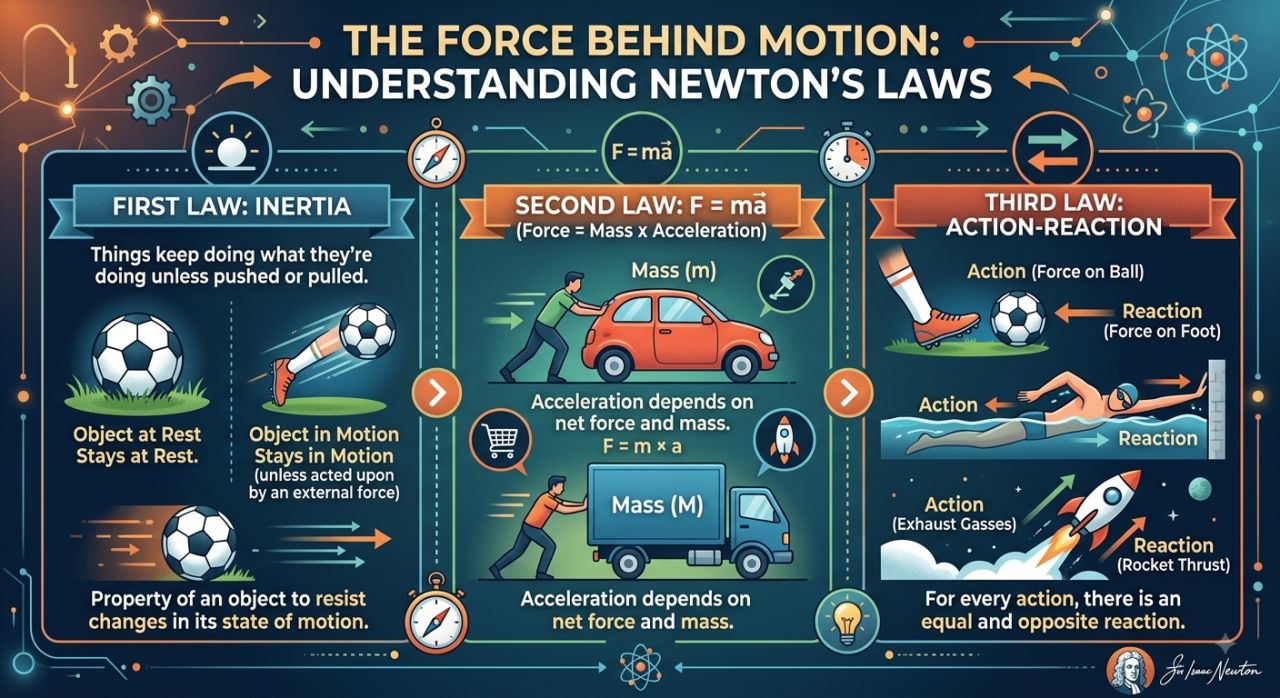
    One bright morning, Adam was playing in a park when he noticed a football resting quietly on the grass. He gently kicked the ball, and it suddenly began rolling across the field. Curious, Adam wondered why the ball had moved only after he kicked it. His teacher explained that this was connected to Newton?s First Law of Motion. An object remains at rest or keeps moving in the same way unless an external force changes its motion. Adam realized that even a simple kick could demonstrate an important scientific principle. From that moment, he became interested in discovering the forces behind everyday movement.

    Adam then decided to test how different objects responded to force. He pushed a light ball and a heavier ball with similar strength and noticed that the lighter ball moved more easily. His teacher explained Newton?s Second Law, which connects force, mass, and acceleration. Adam learned that applying more force can produce a greater change in an object?s motion. He also discovered that heavier objects usually need more force to achieve the same acceleration. Suddenly, pushing a bicycle, moving a box, or kicking a ball seemed much more interesting to him. He understood that forces were constantly influencing the world around him.

    Later, Adam threw a ball against a wall and watched it bounce back toward him. His teacher explained that this was an example of Newton?s Third Law of Motion. Whenever one object applies a force to another object, an equal and opposite force acts back. Adam realized that this principle could be seen when people walk, jump, swim, or ride a bicycle. When his feet pushed the ground backward, the ground pushed him forward. He also learned that rockets move upward by pushing gases downward at high speed. Newton?s Third Law suddenly made many everyday movements easier for Adam to understand.

    By the end of the day, Adam realized that Newton?s laws were much more than formulas in a science book. They were powerful principles that explained how objects move, stop, accelerate, and interact with one another. He could see examples of them in cars, bicycles, sports, falling objects, machines, and even rockets traveling into space. The world around him suddenly looked like a fascinating laboratory filled with invisible forces. Adam understood that physics helps us discover the rules behind ordinary events. From a simple football rolling across the grass to a spacecraft leaving Earth, Newton?s laws tell an amazing story about the force behind motion.

    #NewtonLaws #Physics #ForceAndMotion #NewtonianPhysics #ScienceEducation #PhysicsExplained #LearningScience
    Fondation Level Batch No 4 Roll RSLC #42 Task No #153 Day #153 One bright morning, Adam was playing in a park when he noticed a football resting quietly on the grass. He gently kicked the ball, and it suddenly began rolling across the field. Curious, Adam wondered why the ball had moved only after he kicked it. His teacher explained that this was connected to Newton?s First Law of Motion. An object remains at rest or keeps moving in the same way unless an external force changes its motion. Adam realized that even a simple kick could demonstrate an important scientific principle. From that moment, he became interested in discovering the forces behind everyday movement. Adam then decided to test how different objects responded to force. He pushed a light ball and a heavier ball with similar strength and noticed that the lighter ball moved more easily. His teacher explained Newton?s Second Law, which connects force, mass, and acceleration. Adam learned that applying more force can produce a greater change in an object?s motion. He also discovered that heavier objects usually need more force to achieve the same acceleration. Suddenly, pushing a bicycle, moving a box, or kicking a ball seemed much more interesting to him. He understood that forces were constantly influencing the world around him. Later, Adam threw a ball against a wall and watched it bounce back toward him. His teacher explained that this was an example of Newton?s Third Law of Motion. Whenever one object applies a force to another object, an equal and opposite force acts back. Adam realized that this principle could be seen when people walk, jump, swim, or ride a bicycle. When his feet pushed the ground backward, the ground pushed him forward. He also learned that rockets move upward by pushing gases downward at high speed. Newton?s Third Law suddenly made many everyday movements easier for Adam to understand. By the end of the day, Adam realized that Newton?s laws were much more than formulas in a science book. They were powerful principles that explained how objects move, stop, accelerate, and interact with one another. He could see examples of them in cars, bicycles, sports, falling objects, machines, and even rockets traveling into space. The world around him suddenly looked like a fascinating laboratory filled with invisible forces. Adam understood that physics helps us discover the rules behind ordinary events. From a simple football rolling across the grass to a spacecraft leaving Earth, Newton?s laws tell an amazing story about the force behind motion. #NewtonLaws #Physics #ForceAndMotion #NewtonianPhysics #ScienceEducation #PhysicsExplained #LearningScience
    0 Comentários 0 Compartilhamentos 622 Visualizações
  • Fondation Level Batch No 4
    Roll RSLC #42
    Task No #160
    Day #160

    One evening, Ayan sat by his window watching the golden sunlight fill his room.
    He wondered how light traveled from the Sun across the vastness of space.
    The next day, he asked his science teacher about the true nature of light.
    His teacher explained that light is much more mysterious than it appears.
    Scientists discovered that light can behave both like waves and tiny particles.
    This fascinating property is called the wave-particle duality of light.
    Ayan became curious and wanted to discover how this was possible.
    He began an exciting journey into the hidden world of light.
    His teacher explained that light can behave like waves moving through space.
    Light shows reflection, refraction, diffraction, and interference in different situations.
    Reflection allows light to bounce from surfaces such as mirrors and shiny objects.
    Refraction causes light to change direction when it passes through different materials.
    Interference happens when light waves meet and interact with one another.
    These properties help explain rainbows, colors, reflections, and many other phenomena.
    Ayan realized that everyday sights could reveal important scientific secrets.
    He became even more fascinated by the mysterious behavior of light.
    Then Ayan learned that light can also behave like tiny particles called photons.
    Each photon carries energy and can interact with matter in different ways.
    This particle-like behavior helps scientists understand the photoelectric effect.
    Ayan found it amazing that light could appear as both a wave and a particle.
    His teacher explained that this strange behavior is a key idea in quantum physics.
    The quantum world does not always follow the rules we experience every day.
    Light became a perfect example of nature?s surprising complexity.
    Ayan realized that science often reveals things we cannot understand at first.
    That evening, Ayan looked at the sunlight outside with completely new eyes.
    He imagined photons traveling through space and waves carrying energy across the universe.
    He understood that something as ordinary as sunlight could hold incredible mysteries.
    The experience taught him that science is not only about learning known facts.
    It is also about asking questions and searching for answers beyond what we can see.
    Ayan felt inspired to explore more mysteries hidden throughout the universe.
    From that day forward, every beam of light reminded him of his discovery.
    He learned that even the simplest things can contain the greatest scientific wonders.


    #NatureOfLight #LightWaves #LightParticles #Photon #QuantumPhysics #ScienceExploration #PhysicsFacts
    Fondation Level Batch No 4 Roll RSLC #42 Task No #160 Day #160 One evening, Ayan sat by his window watching the golden sunlight fill his room. He wondered how light traveled from the Sun across the vastness of space. The next day, he asked his science teacher about the true nature of light. His teacher explained that light is much more mysterious than it appears. Scientists discovered that light can behave both like waves and tiny particles. This fascinating property is called the wave-particle duality of light. Ayan became curious and wanted to discover how this was possible. He began an exciting journey into the hidden world of light. His teacher explained that light can behave like waves moving through space. Light shows reflection, refraction, diffraction, and interference in different situations. Reflection allows light to bounce from surfaces such as mirrors and shiny objects. Refraction causes light to change direction when it passes through different materials. Interference happens when light waves meet and interact with one another. These properties help explain rainbows, colors, reflections, and many other phenomena. Ayan realized that everyday sights could reveal important scientific secrets. He became even more fascinated by the mysterious behavior of light. Then Ayan learned that light can also behave like tiny particles called photons. Each photon carries energy and can interact with matter in different ways. This particle-like behavior helps scientists understand the photoelectric effect. Ayan found it amazing that light could appear as both a wave and a particle. His teacher explained that this strange behavior is a key idea in quantum physics. The quantum world does not always follow the rules we experience every day. Light became a perfect example of nature?s surprising complexity. Ayan realized that science often reveals things we cannot understand at first. That evening, Ayan looked at the sunlight outside with completely new eyes. He imagined photons traveling through space and waves carrying energy across the universe. He understood that something as ordinary as sunlight could hold incredible mysteries. The experience taught him that science is not only about learning known facts. It is also about asking questions and searching for answers beyond what we can see. Ayan felt inspired to explore more mysteries hidden throughout the universe. From that day forward, every beam of light reminded him of his discovery. He learned that even the simplest things can contain the greatest scientific wonders. #NatureOfLight #LightWaves #LightParticles #Photon #QuantumPhysics #ScienceExploration #PhysicsFacts
    0 Comentários 0 Compartilhamentos 829 Visualizações
  • Fondation Level Batch No 4
    Roll RSLC #42
    Task No #174
    Day #174

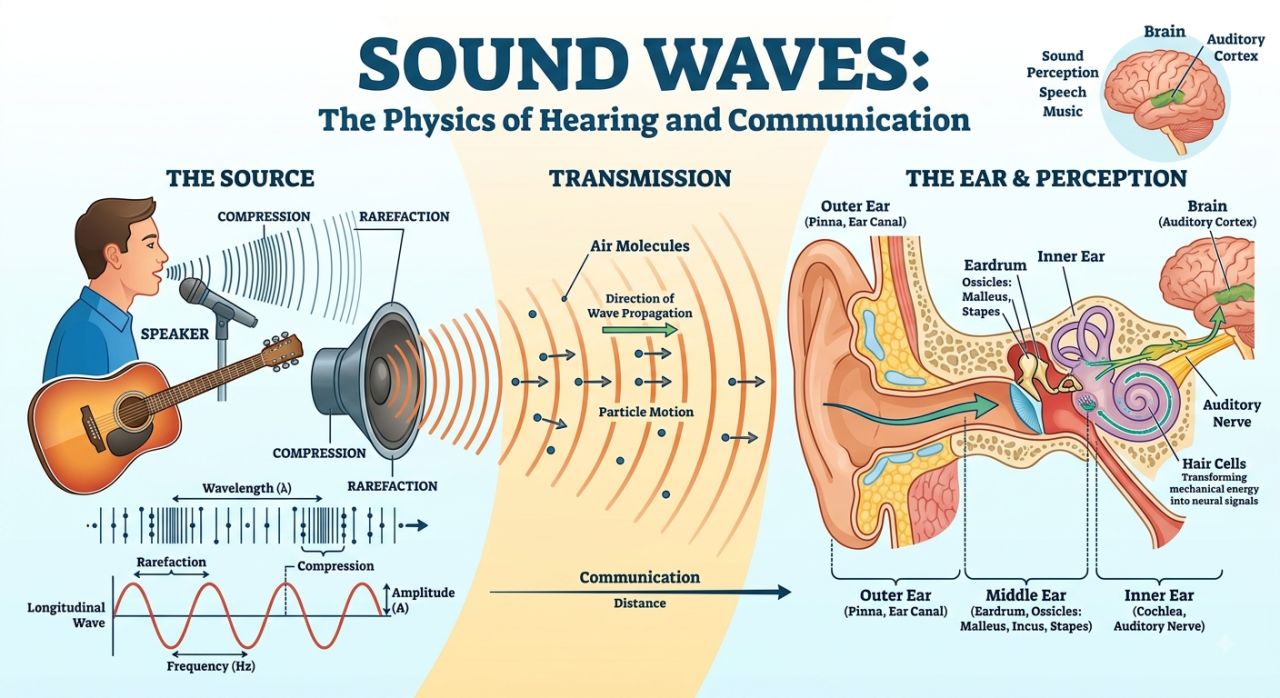
    Sound is an important part of our daily lives, traveling from one place to another in the form of waves.
    When an object vibrates, it causes surrounding particles to move and produces sound.
    These waves eventually reach our ears and allow us to hear different sounds.

    Our ears convert sound waves into electrical signals that the brain can understand.
    The frequency of a sound determines its pitch, while its intensity affects how loud it seems.
    This makes hearing a fascinating combination of physics and the human body.

    Sound is not only important for hearing but also for communication.
    We use our voices, music, phones, and many technologies to send information through sound.
    Sound waves allow messages to travel through different materials and reach their destination.

    The world of sound shows us how closely science is connected to everyday life.
    Behind every word, melody, and noise is a fascinating system of vibrations and waves.
    Understanding sound waves brings us closer to understanding hearing, communication, and the wonders of physics.

    ???? ????? ?????? ????? ?? ??? ??? ??? ??? ?? ????? ?? ???? ??? ??? ???? ???
    ?? ???? ??? ?????? ???? ???? ?? ?? ?????? ?? ???? ???? ???? ??? ??? ???? ???? ???
    ??? ????? ????? ????? ?? ???? ?? ???? ????? ?????? ???? ??? ??? ???? ????

    ??? ???? ?? ????? ?? ???? ????? ??? ????? ???? ??? ????? ???? ?????? ???
    ???? ?? ????????? ???? ??? ???? ?? ?? ??? ???? ?? ????? ????? ????? ???
    ??? ????? ????? ??????? ??? ?????? ??? ?? ??? ???? ????? ?????? ???

    ???? ??? ???? ?? ??? ???? ???? ????? ?? ?????? ????? ??? ???
    ?? ?????? ??????? ??? ???? ??? ????? ???? ?? ????? ???? ?? ????? ??????? ?? ??? ??????? ???? ????
    ???? ?? ????? ????? ??? ????? ????? ?? ??? ?? ??????? ????? ???? ????

    ???? ?? ???? ???? ?????? ?? ?? ????? ????? ?????? ????? ?? ???? ???? ??? ???? ???
    ?? ???? ?? ??? ??? ?? ???? ?? ????? ?????? ??? ????? ?? ??? ????? ???? ????? ???
    ????? ???? ?? ?????? ???? ?????? ????? ??? ?????? ?? ??? ????? ?? ???? ?? ???? ???

    #SoundWaves #PhysicsOfSound #HearingScience #ScienceExplained #WavePhysics #Communication #Physics
    Fondation Level Batch No 4 Roll RSLC #42 Task No #174 Day #174 Sound is an important part of our daily lives, traveling from one place to another in the form of waves. When an object vibrates, it causes surrounding particles to move and produces sound. These waves eventually reach our ears and allow us to hear different sounds. Our ears convert sound waves into electrical signals that the brain can understand. The frequency of a sound determines its pitch, while its intensity affects how loud it seems. This makes hearing a fascinating combination of physics and the human body. Sound is not only important for hearing but also for communication. We use our voices, music, phones, and many technologies to send information through sound. Sound waves allow messages to travel through different materials and reach their destination. The world of sound shows us how closely science is connected to everyday life. Behind every word, melody, and noise is a fascinating system of vibrations and waves. Understanding sound waves brings us closer to understanding hearing, communication, and the wonders of physics. ???? ????? ?????? ????? ?? ??? ??? ??? ??? ?? ????? ?? ???? ??? ??? ???? ??? ?? ???? ??? ?????? ???? ???? ?? ?? ?????? ?? ???? ???? ???? ??? ??? ???? ???? ??? ??? ????? ????? ????? ?? ???? ?? ???? ????? ?????? ???? ??? ??? ???? ???? ??? ???? ?? ????? ?? ???? ????? ??? ????? ???? ??? ????? ???? ?????? ??? ???? ?? ????????? ???? ??? ???? ?? ?? ??? ???? ?? ????? ????? ????? ??? ??? ????? ????? ??????? ??? ?????? ??? ?? ??? ???? ????? ?????? ??? ???? ??? ???? ?? ??? ???? ???? ????? ?? ?????? ????? ??? ??? ?? ?????? ??????? ??? ???? ??? ????? ???? ?? ????? ???? ?? ????? ??????? ?? ??? ??????? ???? ???? ???? ?? ????? ????? ??? ????? ????? ?? ??? ?? ??????? ????? ???? ???? ???? ?? ???? ???? ?????? ?? ?? ????? ????? ?????? ????? ?? ???? ???? ??? ???? ??? ?? ???? ?? ??? ??? ?? ???? ?? ????? ?????? ??? ????? ?? ??? ????? ???? ????? ??? ????? ???? ?? ?????? ???? ?????? ????? ??? ?????? ?? ??? ????? ?? ???? ?? ???? ??? #SoundWaves #PhysicsOfSound #HearingScience #ScienceExplained #WavePhysics #Communication #Physics
    0 Comentários 0 Compartilhamentos 569 Visualizações
  • #rsisb
    Roll No.240
    Story Post No.24
    Foundation Level

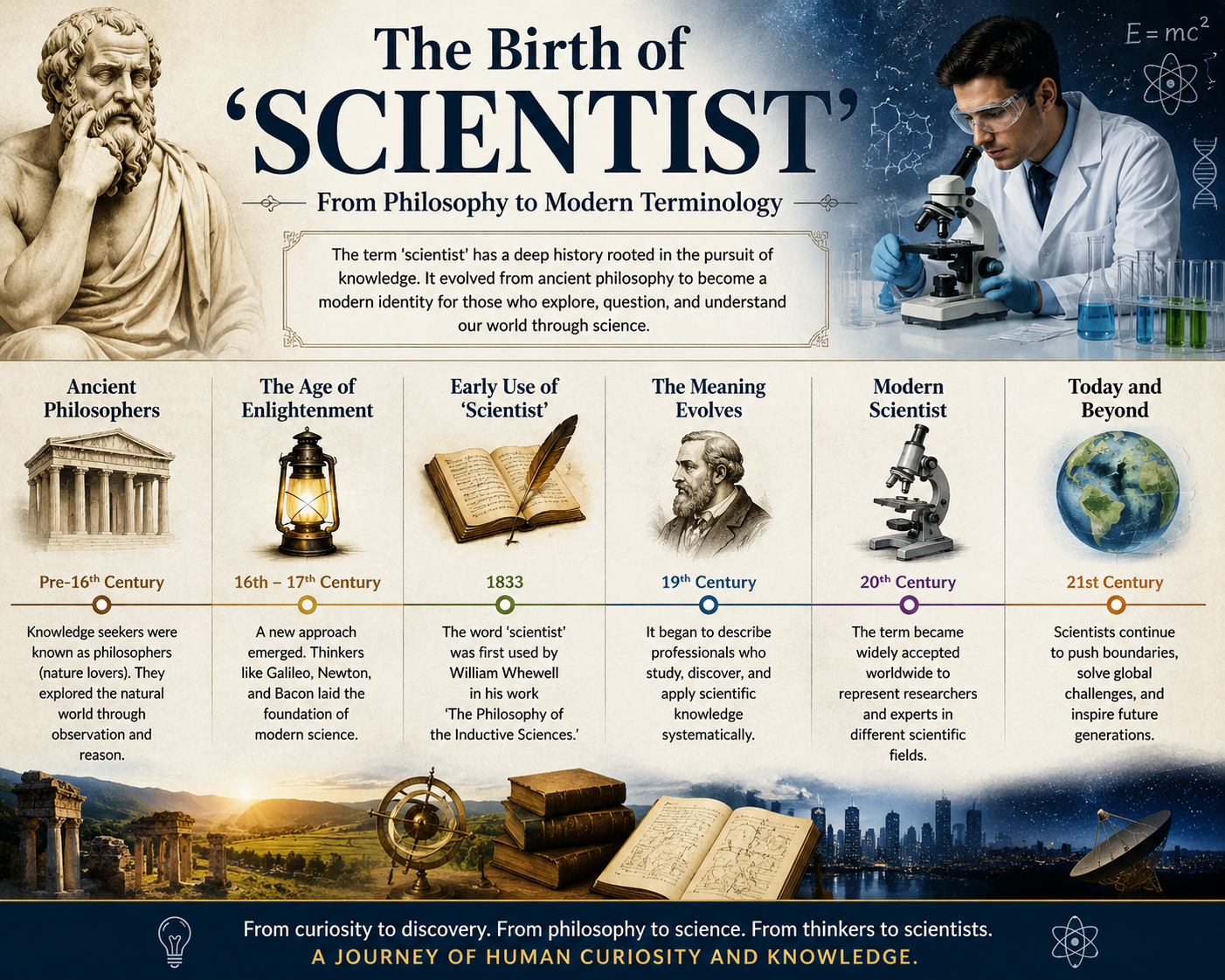
    The word “scientist” may sound like a modern term, but the journey behind it is connected to centuries of human curiosity, philosophy, observation, experimentation, and the search for knowledge.

    Long before the word “scientist” became common, people who studied the natural world were often known as philosophers, scholars, natural philosophers, mathematicians, and thinkers. They asked important questions about nature, the universe, life, matter, motion, and the world around them.

    From the thinkers of the ancient world to the scholars of the Renaissance and the Scientific Revolution, humans continued developing new ways to understand nature. Observation became more important, experiments became more systematic, and evidence gradually became a central part of scientific inquiry.

    During the 18th and 19th centuries, many different branches of knowledge began becoming more specialized. Physics, chemistry, biology, astronomy, geology, and other fields developed their own methods, discoveries, and communities of researchers.

    A major moment in terminology came in the 19th century, when the word “scientist” was introduced as a useful name for people engaged in scientific study. The term is widely associated with William Whewell, who used it in 1833. This helped provide a new, unified word for researchers working across different areas of science.

    The evolution of this word reflects something bigger than language. It represents the changing way humanity organized knowledge and recognized scientific work. The transition from “natural philosopher” to “scientist” shows how science gradually became a distinct and organized field of study.

    Today, scientists work in laboratories, universities, hospitals, observatories, research centers, engineering facilities, and many other places around the world. They investigate everything from tiny cells and molecules to distant galaxies and the origins of the universe.

    Modern science continues to grow through curiosity, evidence, teamwork, technology, and a willingness to ask difficult questions. Every discovery begins with someone wondering, “Why?”, “How?”, or “What if?”

    The story of the word “scientist” reminds us that human knowledge is always evolving. What began with simple curiosity and philosophical questioning gradually developed into the powerful and diverse scientific world we know today.

    From thinkers to researchers. From philosophy to science. From questions to discoveries.

    Science is not only about finding answers—it is also about continuing to ask better questions.

    A journey from curiosity to discovery, and from philosophy to modern science.

    #TheBirthOfScientist #Scientist #HistoryOfScience #ScienceHistory #ScientificRevolution #Philosophy #NaturalPhilosophy #WilliamWhewell #1833 #ModernScience #ScienceEducation #ScientificTerminology #Science #Scientists #Research #Discovery #Curiosity #Knowledge #Learning #Education #STEM #Physics #Chemistry #Biology #Astronomy #Geology #Innovation #Experimentation #ScientificThinking #CriticalThinking #HumanKnowledge #HistoryOfKnowledge #ScienceJourney #FromPhilosophyToScience #ScienceFacts #EducationalContent #LearningJourney #ExploreScience #DiscoverScience

    Rehan School Islamabad Campus
    Asma Shaheen EducationWali
    Irum Asim
    Saima Happinesswali

    #rsisb Roll No.240 Story Post No.24 Foundation Level The word “scientist” may sound like a modern term, but the journey behind it is connected to centuries of human curiosity, philosophy, observation, experimentation, and the search for knowledge. 🧠🔎 Long before the word “scientist” became common, people who studied the natural world were often known as philosophers, scholars, natural philosophers, mathematicians, and thinkers. 🏛️📜 They asked important questions about nature, the universe, life, matter, motion, and the world around them. From the thinkers of the ancient world to the scholars of the Renaissance and the Scientific Revolution, humans continued developing new ways to understand nature. 🌌🌍📖 Observation became more important, experiments became more systematic, and evidence gradually became a central part of scientific inquiry. 🔬🧪✨ During the 18th and 19th centuries, many different branches of knowledge began becoming more specialized. Physics, chemistry, biology, astronomy, geology, and other fields developed their own methods, discoveries, and communities of researchers. 🧬⚗️🌠 A major moment in terminology came in the 19th century, when the word “scientist” was introduced as a useful name for people engaged in scientific study. The term is widely associated with William Whewell, who used it in 1833. 📜🔬 This helped provide a new, unified word for researchers working across different areas of science. The evolution of this word reflects something bigger than language. It represents the changing way humanity organized knowledge and recognized scientific work. 🌟📚 The transition from “natural philosopher” to “scientist” shows how science gradually became a distinct and organized field of study. Today, scientists work in laboratories, universities, hospitals, observatories, research centers, engineering facilities, and many other places around the world. 🌍🧪🔭 They investigate everything from tiny cells and molecules to distant galaxies and the origins of the universe. 🧬🦠🌌 Modern science continues to grow through curiosity, evidence, teamwork, technology, and a willingness to ask difficult questions. 💡🤝🚀 Every discovery begins with someone wondering, “Why?”, “How?”, or “What if?” The story of the word “scientist” reminds us that human knowledge is always evolving. What began with simple curiosity and philosophical questioning gradually developed into the powerful and diverse scientific world we know today. 🌱➡️🔬➡️🌍 ✨ From thinkers to researchers. From philosophy to science. From questions to discoveries. ✨ Science is not only about finding answers—it is also about continuing to ask better questions. 🔎💡 🌟 A journey from curiosity to discovery, and from philosophy to modern science. 🌟 #TheBirthOfScientist #Scientist #HistoryOfScience #ScienceHistory #ScientificRevolution #Philosophy #NaturalPhilosophy #WilliamWhewell #1833 #ModernScience #ScienceEducation #ScientificTerminology #Science #Scientists #Research #Discovery #Curiosity #Knowledge #Learning #Education #STEM #Physics #Chemistry #Biology #Astronomy #Geology #Innovation #Experimentation #ScientificThinking #CriticalThinking #HumanKnowledge #HistoryOfKnowledge #ScienceJourney #FromPhilosophyToScience #ScienceFacts #EducationalContent #LearningJourney #ExploreScience #DiscoverScience 🔬📚🧠🌍✨🔭🧪🚀💡🌟 Rehan School Islamabad Campus Asma Shaheen EducationWali Irum Asim Saima Happinesswali
    0 Comentários 0 Compartilhamentos 2396 Visualizações
  • #rsisb
    Roll no.247
    canva post .31
    Foundation leve

    **The Physics of Everyday Life: How Science Affects Our World**

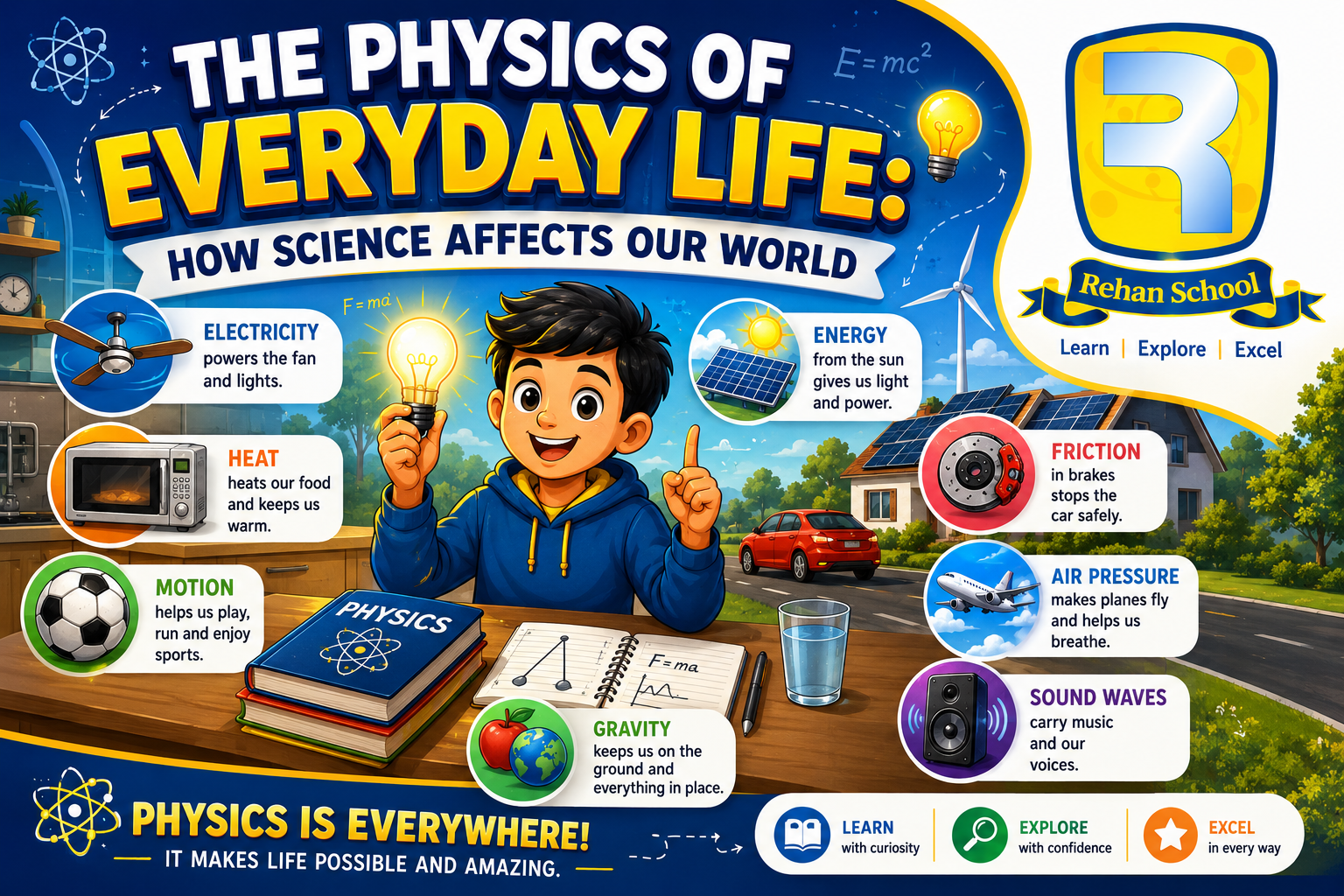
    Have you ever wondered why a ball falls when you drop it, how a bicycle stays balanced, why a car moves forward, how a fan produces airflow, or how your smartphone communicates with the world around you? All of these everyday experiences are connected to **physics**—the science that helps us understand how the universe works.

    **“The Physics of Everyday Life: How Science Affects Our World”** is an exciting journey into the science behind the ordinary things we see and use every day. From the moment we wake up and switch on a light to the time we travel, study, play, cook, communicate, and relax, physics is constantly working around us.

    **Energy and Electricity:**
    Electricity powers our homes, schools, computers, appliances, and countless modern technologies. Understanding energy helps us see how electrical power is generated, transferred, and transformed into useful forms.

    **Motion and Forces:**
    Whenever something moves, forces are involved. Walking, running, cycling, driving, throwing a ball, or opening a door can all be explained through concepts such as force, motion, friction, and acceleration.

    **Heat and Temperature:**
    From boiling water to cooling food in a refrigerator , heat transfer plays an important role in our daily lives. Physics explains why different materials heat up and cool down at different rates.

    **Light and Sound:**
    The colors we see, the sounds we hear, the mirrors we use, and the cameras in our phones are all connected to fascinating physical principles.

    **Gravity and the Natural World:**
    Gravity keeps us on Earth and influences everything from falling objects to the movement of planets and satellites.

    **Technology and Modern Life:**
    Physics is also behind many technologies we depend on, including smartphones, computers, medical equipment, transportation systems, satellites, and communication devices.

    The most amazing lesson is that **physics is not only something we study in textbooks—it is happening all around us.** When we understand the science behind everyday events, ordinary experiences become opportunities for discovery.

    This topic encourages curiosity, observation, critical thinking, experimentation, and a deeper appreciation for the world around us. It reminds us that asking **“Why?”** can be the beginning of an exciting scientific journey.

    Whether you are a student, teacher, science enthusiast, or simply someone curious about how things work, exploring everyday physics can help you look at the world from a completely new perspective.

    **Observe. Question. Experiment. Discover. Learn.**
    Because science is not far away—it is part of **every moment of our everyday lives!**

    #Physics #EverydayPhysics #Science #PhysicsInEverydayLife #ScienceEducation #STEM #STEMEducation #LearnScience #ScienceEverywhere #PhysicsExplained #ScienceAndTechnology #EverydayScience #LearningIsFun #Curiosity #Discovery #Education #Students #Teachers #ScientificThinking #Experiments #Energy #Motion #Gravity #Electricity #Light #Sound #Technology #Innovation #ExploreScience #KnowledgeIsPower
    #rsisb Roll no.247 canva post .31 Foundation leve 🌍⚛️ **The Physics of Everyday Life: How Science Affects Our World** 🔬✨ Have you ever wondered why a ball falls when you drop it, how a bicycle stays balanced, why a car moves forward, how a fan produces airflow, or how your smartphone communicates with the world around you? 🤔📱🚗 All of these everyday experiences are connected to **physics**—the science that helps us understand how the universe works. 🌌🔭 **“The Physics of Everyday Life: How Science Affects Our World”** is an exciting journey into the science behind the ordinary things we see and use every day. From the moment we wake up and switch on a light 💡 to the time we travel, study, play, cook, communicate, and relax, physics is constantly working around us. ⚡ **Energy and Electricity:** Electricity powers our homes, schools, computers, appliances, and countless modern technologies. Understanding energy helps us see how electrical power is generated, transferred, and transformed into useful forms. 🚗 **Motion and Forces:** Whenever something moves, forces are involved. Walking, running, cycling, driving, throwing a ball, or opening a door can all be explained through concepts such as force, motion, friction, and acceleration. 🏃‍♂️⚽🚲 🌡️ **Heat and Temperature:** From boiling water ☕ to cooling food in a refrigerator ❄️, heat transfer plays an important role in our daily lives. Physics explains why different materials heat up and cool down at different rates. 💡 **Light and Sound:** The colors we see, the sounds we hear, the mirrors we use, and the cameras in our phones are all connected to fascinating physical principles. 🌈👂📷 🌍 **Gravity and the Natural World:** Gravity keeps us on Earth and influences everything from falling objects to the movement of planets and satellites. 🪐🌎 📱 **Technology and Modern Life:** Physics is also behind many technologies we depend on, including smartphones, computers, medical equipment, transportation systems, satellites, and communication devices. 🚀💻📡 The most amazing lesson is that **physics is not only something we study in textbooks—it is happening all around us.** 📚✨ When we understand the science behind everyday events, ordinary experiences become opportunities for discovery. This topic encourages curiosity, observation, critical thinking, experimentation, and a deeper appreciation for the world around us. 🔬🧠🌟 It reminds us that asking **“Why?”** can be the beginning of an exciting scientific journey. Whether you are a student, teacher, science enthusiast, or simply someone curious about how things work, exploring everyday physics can help you look at the world from a completely new perspective. 🌎💫 🔭 **Observe. Question. Experiment. Discover. Learn.** Because science is not far away—it is part of **every moment of our everyday lives!** ⚛️❤️ #Physics #EverydayPhysics #Science #PhysicsInEverydayLife #ScienceEducation #STEM #STEMEducation #LearnScience #ScienceEverywhere #PhysicsExplained #ScienceAndTechnology #EverydayScience #LearningIsFun #Curiosity #Discovery #Education #Students #Teachers #ScientificThinking #Experiments #Energy #Motion #Gravity #Electricity #Light #Sound #Technology #Innovation #ExploreScience #KnowledgeIsPower 🌍🔬⚡🚀📚✨

    0 Comentários 0 Compartilhamentos 2515 Visualizações
  • #rsisb
    Roll No.269
    Foundation Level
    Story Post No.25

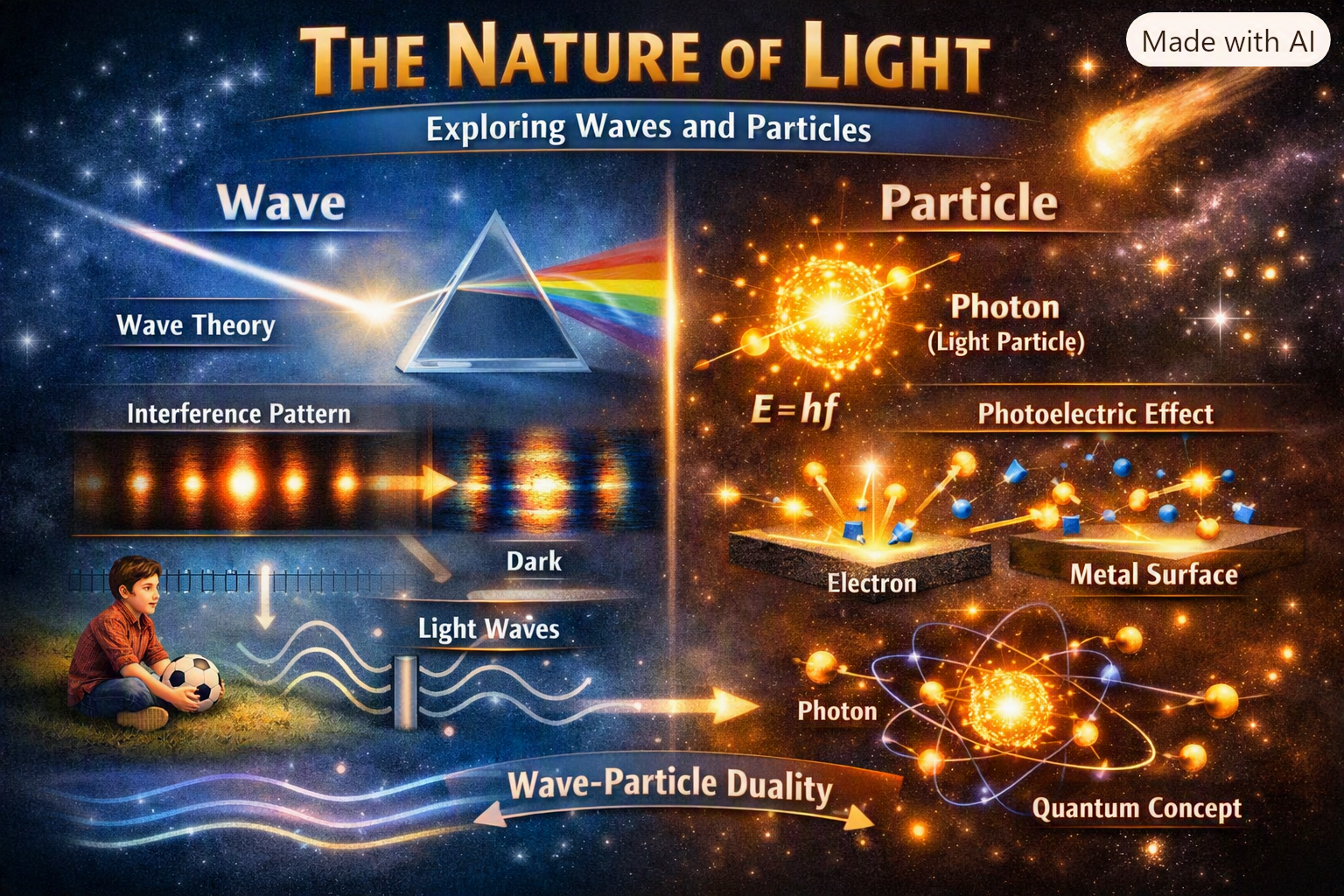
    **The Nature of Light: Exploring Waves and Particles**

    Light is one of the most fascinating phenomena in the universe. We see it every day, but have you ever wondered what light really is and how it travels? In this video, we explore the amazing nature of light and discover how it can behave both as a **wave and as a particle**.

    We will learn about the wave properties of light, including reflection, refraction, interference, and diffraction. We will also explore the particle nature of light and understand how photons help explain the behavior of light at a microscopic level.

    The wave-particle duality of light is one of the most interesting ideas in modern physics. It shows us that nature can behave in ways that are very different from our everyday experiences.

    From sunlight and rainbows to lasers, cameras, and modern technology , light plays an important role in our daily lives and in scientific discoveries.

    Join us as we explore the fascinating world of **light, waves, particles, and quantum physics**. Keep learning, stay curious, and discover the science behind the light around us!

    #Light #Physics #LightWaves #WaveParticleDuality #Particles #Photons #QuantumPhysics #Optics #Science #PhysicsFacts #ScienceEducation #Learning #Reflection #Refraction #Interference #Diffraction #ElectromagneticWaves #ScientificDiscovery #Technology #SpaceScience #Knowledge #Curiosity #StudentLife #RehanSchool #LearnAndGrow
    #rsisb Roll No.269 Foundation Level Story Post No.25 💡 **The Nature of Light: Exploring Waves and Particles** 🌈🔬 Light is one of the most fascinating phenomena in the universe. 🌟 We see it every day, but have you ever wondered what light really is and how it travels? 🤔 In this video, we explore the amazing nature of light and discover how it can behave both as a **wave and as a particle**. We will learn about the wave properties of light, including reflection, refraction, interference, and diffraction. 🌊✨ We will also explore the particle nature of light and understand how photons help explain the behavior of light at a microscopic level. 🔬⚡ The wave-particle duality of light is one of the most interesting ideas in modern physics. It shows us that nature can behave in ways that are very different from our everyday experiences. 🌌🧠 From sunlight and rainbows 🌈 to lasers, cameras, and modern technology 📷💻, light plays an important role in our daily lives and in scientific discoveries. Join us as we explore the fascinating world of **light, waves, particles, and quantum physics**. Keep learning, stay curious, and discover the science behind the light around us! 🚀📚✨ #Light 💡 #Physics 🔬 #LightWaves 🌊 #WaveParticleDuality ⚛️ #Particles #Photons ⚡ #QuantumPhysics 🌌 #Optics 👓 #Science 📚 #PhysicsFacts 🧠 #ScienceEducation 🎓 #Learning 📖 #Reflection ✨ #Refraction 🌈 #Interference 🔬 #Diffraction 🌊 #ElectromagneticWaves ⚡ #ScientificDiscovery 🔍 #Technology 💻 #SpaceScience 🚀 #Knowledge 💡 #Curiosity 🤔 #StudentLife 🎓 #RehanSchool 🏫 #LearnAndGrow 🌱
    0 Comentários 0 Compartilhamentos 1980 Visualizações
  • #rsisb
    Roll No.269
    Foundation Level
    Story Post No.24


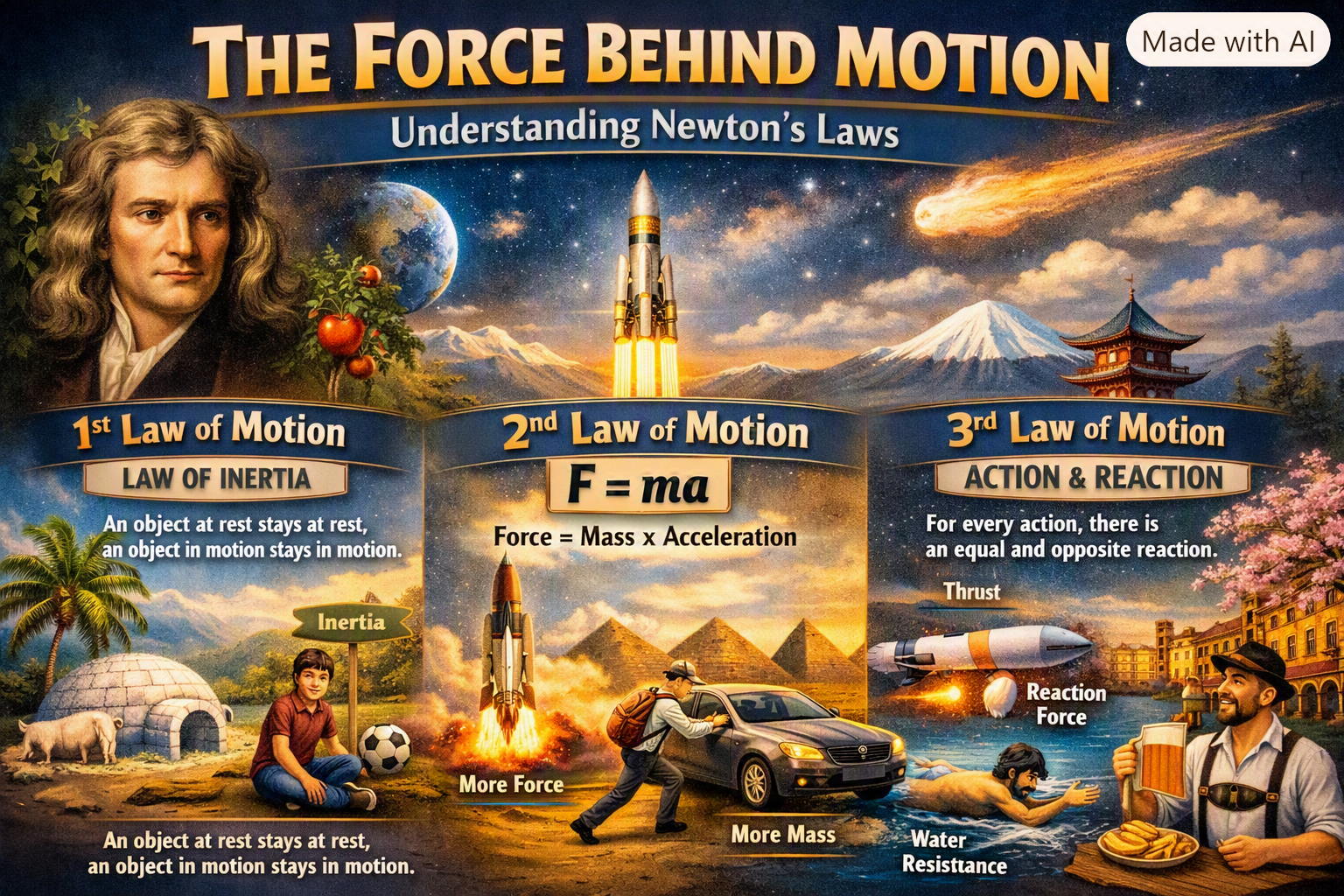
    **The Force Behind Motion: Understanding Newton’s Laws**

    Have you ever wondered why objects move, stop, or change direction? The answer lies in one of the most important ideas in physics: **force and motion**.

    In this video, we explore **Newton’s Three Laws of Motion** and understand how they explain the movement of objects in our everyday lives. From a ball rolling on the ground to a car accelerating and a rocket launching into space , Newton’s laws help us understand the forces behind motion.

    We will learn how objects behave when forces act on them, how force and acceleration are connected, and why every action has an equal and opposite reaction. These simple but powerful laws are the foundation of many concepts in physics and engineering.

    This topic shows us that physics is not just about formulas—it is all around us! From sports and transportation to machines and space exploration, Newton’s laws help explain the world we see every day.

    Join us as we explore the fascinating **force behind motion** and discover how Newton’s laws shape our understanding of the physical world.

    #NewtonLaws #Newton #Physics #ForceAndMotion #Motion #Science #PhysicsFacts #NewtonLawsOfMotion #Force #Acceleration #Gravity #Mechanics #ScienceEducation #Learning #Education #ScientificDiscovery #PhysicsExperiment #SpaceScience #Engineering #Knowledge #Curiosity #StudentLife #ScienceFacts #RehanSchool #LearnAndGrow
    #rsisb Roll No.269 Foundation Level Story Post No.24 ⚡ **The Force Behind Motion: Understanding Newton’s Laws** 🚀🔬 Have you ever wondered why objects move, stop, or change direction? 🤔 The answer lies in one of the most important ideas in physics: **force and motion**. In this video, we explore **Newton’s Three Laws of Motion** and understand how they explain the movement of objects in our everyday lives. From a ball rolling on the ground ⚽ to a car accelerating 🚗 and a rocket launching into space 🚀, Newton’s laws help us understand the forces behind motion. We will learn how objects behave when forces act on them, how force and acceleration are connected, and why every action has an equal and opposite reaction. ⚖️💡 These simple but powerful laws are the foundation of many concepts in physics and engineering. This topic shows us that physics is not just about formulas—it is all around us! 🌍 From sports and transportation to machines and space exploration, Newton’s laws help explain the world we see every day. Join us as we explore the fascinating **force behind motion** and discover how Newton’s laws shape our understanding of the physical world. 🔬📚✨ #NewtonLaws ⚡ #Newton #Physics 🔬 #ForceAndMotion 🚀 #Motion #Science 📚 #PhysicsFacts 💡 #NewtonLawsOfMotion #Force 💪 #Acceleration 🏎️ #Gravity 🌍 #Mechanics 🔧 #ScienceEducation 🎓 #Learning 📖 #Education 🧠 #ScientificDiscovery 🔍 #PhysicsExperiment 🧪 #SpaceScience 🚀 #Engineering ⚙️ #Knowledge 💡 #Curiosity 🤔 #StudentLife 🎓 #ScienceFacts 🌎 #RehanSchool 🏫 #LearnAndGrow 🌱
    0 Comentários 0 Compartilhamentos 1528 Visualizações
Páginas Impulsionadas