• #rsisb
    Roll no.247
    song .26
    Foundation level

    **Dissecting Frogs: A Gateway to Human Anatomy**

    Studying frog anatomy can provide students with a fascinating introduction to the structure and organization of living organisms. Through careful anatomical study, students can learn how different organs are arranged, how body systems work together, and how scientists use observation to understand life.

    Frogs are commonly studied in biology because their basic body organization shares important similarities with other vertebrates. Exploring their anatomy can help learners recognize major structures such as the heart, lungs, digestive organs, and reproductive organs, while also developing an understanding of how these systems perform different functions.

    **From Frog Anatomy to Human Anatomy**

    Learning about a frog's internal organization can help students build foundational knowledge that makes human anatomy easier to understand. By comparing different vertebrate body plans, learners can discover both similarities and differences in organs, tissues, and body systems. This comparison encourages curiosity and strengthens scientific thinking.

    **Learning Through Observation**

    Anatomical studies teach more than just the names of organs. They encourage students to observe carefully, record information, ask questions, and connect physical structures with biological functions. These skills are valuable in biology, medicine, veterinary science, and many other scientific fields.

    **Science, Respect, and Responsibility**

    Biology education should always be approached with respect for living organisms and with appropriate safety, ethical, and educational guidelines. Modern classrooms may also use models, diagrams, videos, simulations, and digital anatomy tools to provide meaningful learning experiences.

    **Conclusion**

    “Dissecting Frogs: A Gateway to Human Anatomy” represents more than an anatomy lesson—it is an opportunity to explore the fascinating organization of life. By studying structures, comparing body systems, and asking scientific questions, students can develop a deeper appreciation for biology and the remarkable complexity of living organisms.

    #DissectingFrogs #FrogAnatomy #HumanAnatomy #Biology #ScienceEducation #AnatomyStudy #BiologyLearning #ScienceExperiment #LearningThroughScience #VertebrateAnatomy #LifeScience #ScienceStudents #EducationalJourney #ExploreBiology #ScientificThinking #AnatomyAndPhysiology #STEMEducation #ScienceExploration #BiologyProject #LearningIsFun
    #rsisb Roll no.247 song .26 Foundation level πŸΈπŸ”¬ **Dissecting Frogs: A Gateway to Human Anatomy** πŸ§¬πŸ«€ Studying frog anatomy can provide students with a fascinating introduction to the structure and organization of living organisms. Through careful anatomical study, students can learn how different organs are arranged, how body systems work together, and how scientists use observation to understand life. πŸ”πŸ“š 🐸 Frogs are commonly studied in biology because their basic body organization shares important similarities with other vertebrates. Exploring their anatomy can help learners recognize major structures such as the heart, lungs, digestive organs, and reproductive organs, while also developing an understanding of how these systems perform different functions. πŸ«€πŸ« 🧠 **From Frog Anatomy to Human Anatomy** Learning about a frog's internal organization can help students build foundational knowledge that makes human anatomy easier to understand. By comparing different vertebrate body plans, learners can discover both similarities and differences in organs, tissues, and body systems. This comparison encourages curiosity and strengthens scientific thinking. πŸ”¬βœ¨ πŸ“– **Learning Through Observation** Anatomical studies teach more than just the names of organs. They encourage students to observe carefully, record information, ask questions, and connect physical structures with biological functions. These skills are valuable in biology, medicine, veterinary science, and many other scientific fields. πŸ§ͺπŸ‘©‍πŸ”¬πŸ‘¨‍πŸ”¬ 🌱 **Science, Respect, and Responsibility** Biology education should always be approached with respect for living organisms and with appropriate safety, ethical, and educational guidelines. Modern classrooms may also use models, diagrams, videos, simulations, and digital anatomy tools to provide meaningful learning experiences. πŸŒπŸ’š ✨ **Conclusion** “Dissecting Frogs: A Gateway to Human Anatomy” represents more than an anatomy lesson—it is an opportunity to explore the fascinating organization of life. By studying structures, comparing body systems, and asking scientific questions, students can develop a deeper appreciation for biology and the remarkable complexity of living organisms. πŸΈπŸ”¬πŸ§¬πŸŒŸ #DissectingFrogs #FrogAnatomy #HumanAnatomy #Biology #ScienceEducation #AnatomyStudy #BiologyLearning #ScienceExperiment #LearningThroughScience #VertebrateAnatomy #LifeScience #ScienceStudents #EducationalJourney #ExploreBiology #ScientificThinking #AnatomyAndPhysiology #STEMEducation #ScienceExploration #BiologyProject #LearningIsFun πŸΈπŸ”¬πŸ“šπŸ§¬πŸ«€πŸ«βœ¨
    0 Commenti 0 condivisioni 2638 Views 6
  • #rsisb
    Roll no.247
    song .25
    Foundation level

    **Learning Through Layers: The Importance of Animal Anatomy Studies**

    Animal anatomy is a fascinating field that helps us understand how living organisms are built, how their body systems work, and how different parts work together to support life. From the smallest bones and muscles to complex organs and body systems, studying anatomy gives us a deeper appreciation of the incredible organization found in living creatures.

    **Learning Through Layers** means exploring the body step by step. By studying structures from the outside to the inside, students can understand how muscles, bones, organs, tissues, and other systems are connected. Each layer reveals something new and helps turn scientific ideas into a clearer picture.

    Animal anatomy studies are also important because they develop observation, critical thinking, and scientific reasoning. Students learn to identify structures, compare different animals, ask questions, and understand how body structures relate to their functions.

    Comparing the anatomy of different animals can also teach us about adaptation and diversity. Animals may have different body shapes and structures because they live in different environments and have different ways of surviving. This makes anatomy an exciting bridge between **biology, evolution, ecology, and the study of life itself.**

    Most importantly, anatomy encourages curiosity. Instead of simply memorizing names, learners can ask: **Why is this structure shaped this way? What does it do? How does it work with other parts of the body?** These questions transform learning into exploration.

    Studying animal anatomy reminds us that every living creature has a remarkable internal design. Through careful observation, scientific study, and responsible learning, we can better understand the diversity and complexity of life around us.

    **Explore. Observe. Question. Discover. Learn through every layer of life!**

    #AnimalAnatomy #AnatomyStudies #Biology #ScienceLearning #LearningThroughLayers #AnimalScience #LifeScience #BiologyStudents #ScienceEducation #EducationalJourney #ExploreScience #ScientificLearning #Curiosity #CriticalThinking #Observation #NatureAndScience #AnimalBiology #STEMEducation #LearningIsFun #DiscoverScience #KnowledgeIsPower #ScienceExploration
    #rsisb Roll no.247 song .25 Foundation level πŸΎπŸ”¬ **Learning Through Layers: The Importance of Animal Anatomy Studies** πŸ§¬πŸ“š Animal anatomy is a fascinating field that helps us understand how living organisms are built, how their body systems work, and how different parts work together to support life. 🌍❀️ From the smallest bones and muscles to complex organs and body systems, studying anatomy gives us a deeper appreciation of the incredible organization found in living creatures. πŸ¦΄πŸ«€πŸ« πŸ” **Learning Through Layers** means exploring the body step by step. By studying structures from the outside to the inside, students can understand how muscles, bones, organs, tissues, and other systems are connected. Each layer reveals something new and helps turn scientific ideas into a clearer picture. 🧠✨ πŸ“– Animal anatomy studies are also important because they develop observation, critical thinking, and scientific reasoning. Students learn to identify structures, compare different animals, ask questions, and understand how body structures relate to their functions. πŸ•πŸˆπŸ¦…πŸΈ 🌱 Comparing the anatomy of different animals can also teach us about adaptation and diversity. Animals may have different body shapes and structures because they live in different environments and have different ways of surviving. This makes anatomy an exciting bridge between **biology, evolution, ecology, and the study of life itself.** πŸŒŽπŸ”¬ πŸ’‘ Most importantly, anatomy encourages curiosity. Instead of simply memorizing names, learners can ask: **Why is this structure shaped this way? What does it do? How does it work with other parts of the body?** These questions transform learning into exploration. πŸš€πŸ“š πŸΎπŸ”¬ Studying animal anatomy reminds us that every living creature has a remarkable internal design. Through careful observation, scientific study, and responsible learning, we can better understand the diversity and complexity of life around us. 🌟🧬 ✨ **Explore. Observe. Question. Discover. Learn through every layer of life!** πŸ“šπŸ”πŸΎ #AnimalAnatomy #AnatomyStudies #Biology #ScienceLearning #LearningThroughLayers #AnimalScience #LifeScience #BiologyStudents #ScienceEducation #EducationalJourney #ExploreScience #ScientificLearning #Curiosity #CriticalThinking #Observation #NatureAndScience #AnimalBiology #STEMEducation #LearningIsFun #DiscoverScience #KnowledgeIsPower #ScienceExploration πŸΎπŸ”¬πŸ§¬πŸ“šπŸŒβœ¨
    0 Commenti 0 condivisioni 1768 Views 5
  • #rsisb
    Roll no.247
    song .23
    Foundation level

    **The Story of Elements: From Carbon to Gold**

    The world around us is made from a fascinating collection of chemical elements, each with its own unique properties, history, and role in nature. From the carbon in living organisms to the gold found deep within the Earth, every element tells a remarkable story about how our universe works.

    **Carbon** is one of the most important elements for life. It forms the foundation of countless molecules, including those that make up living things. Carbon can also appear in very different forms, from soft graphite to brilliant diamond.

    As we explore the periodic table, we discover elements with completely different characteristics. Oxygen helps living organisms release energy. Iron is essential in many biological processes and has shaped human civilization through tools and technology. Copper has been used for thousands of years and remains important in electrical systems.

    And then there is **gold**—a rare, beautiful, and chemically fascinating element. Its resistance to corrosion and distinctive appearance have made it valuable throughout human history. But gold is more than something beautiful; it also has important scientific and technological applications.

    This journey from **carbon to gold** reminds us that the periodic table is not simply a list of symbols. It is a story of matter, stars, planets, life, discovery, and human curiosity. Every element contributes a small but important piece to the incredible story of our universe.

    Learning about elements helps us understand what everything is made of—from our bodies and oceans to rocks, stars, and modern technology. The deeper we explore chemistry, the more we discover that even the smallest building blocks of matter can tell enormous stories.

    **Explore the periodic table. Discover the elements. Understand the matter that makes our world!**

    #TheStoryOfElements #CarbonToGold #Elements #Chemistry #PeriodicTable #Science #ChemistryEducation #ScienceExploration #ChemicalElements #Carbon #Gold #Matter #Atoms #Molecules #ScienceLearning #STEM #STEMEducation #YoungScientists #ExploreScience #LearnChemistry #ScienceIsAmazing #Universe #Discovery #Education #Knowledge #Curiosity #FutureScientists
    #rsisb Roll no.247 song .23 Foundation level 🌟πŸ§ͺ **The Story of Elements: From Carbon to Gold** πŸͺ™βœ¨ The world around us is made from a fascinating collection of chemical elements, each with its own unique properties, history, and role in nature. πŸŒπŸ”¬ From the carbon in living organisms to the gold found deep within the Earth, every element tells a remarkable story about how our universe works. πŸŒŒβš›οΈ πŸ–€ **Carbon** is one of the most important elements for life. It forms the foundation of countless molecules, including those that make up living things. 🌱🧬 Carbon can also appear in very different forms, from soft graphite to brilliant diamond. πŸ’Ž As we explore the periodic table, we discover elements with completely different characteristics. Oxygen helps living organisms release energy. 🌬️πŸ”₯ Iron is essential in many biological processes and has shaped human civilization through tools and technology. βš™οΈπŸ—οΈ Copper has been used for thousands of years and remains important in electrical systems. πŸ”Œβš‘ And then there is **gold**—a rare, beautiful, and chemically fascinating element. πŸͺ™βœ¨ Its resistance to corrosion and distinctive appearance have made it valuable throughout human history. But gold is more than something beautiful; it also has important scientific and technological applications. πŸ”¬πŸ’» This journey from **carbon to gold** reminds us that the periodic table is not simply a list of symbols. It is a story of matter, stars, planets, life, discovery, and human curiosity. 🌌⭐🌍 Every element contributes a small but important piece to the incredible story of our universe. πŸ”¬πŸ“š Learning about elements helps us understand what everything is made of—from our bodies and oceans to rocks, stars, and modern technology. The deeper we explore chemistry, the more we discover that even the smallest building blocks of matter can tell enormous stories. βš›οΈπŸŒŸ πŸš€ **Explore the periodic table. Discover the elements. Understand the matter that makes our world!** πŸ§ͺ🌍✨ #TheStoryOfElements #CarbonToGold #Elements #Chemistry #PeriodicTable #Science #ChemistryEducation #ScienceExploration #ChemicalElements #Carbon #Gold #Matter #Atoms #Molecules #ScienceLearning #STEM #STEMEducation #YoungScientists #ExploreScience #LearnChemistry #ScienceIsAmazing #Universe #Discovery #Education #Knowledge #Curiosity #FutureScientists πŸ§ͺβš›οΈπŸŒŒπŸ”¬πŸ“šβœ¨
    0 Commenti 0 condivisioni 2138 Views 8
  • #rsisb
    Roll no.214
    Foundation level
    Storyn post no.18
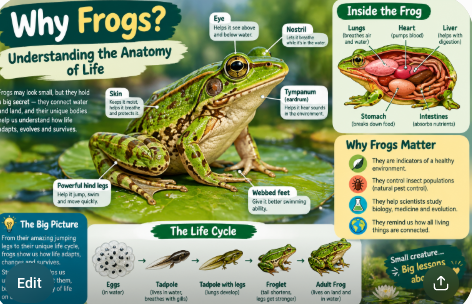
    Discover the amazing world of frogs and learn how their unique body structure helps them survive in nature! From their powerful legs and sensitive eyes to their lungs, skin, heart, and digestive system, every part of a frog’s body has an important role. This topic helps us understand how living organisms are designed, how their organs work together, and how nature creates incredible systems of life.
    Learn • Explore • Discover • Understand
    #Frogs #FrogAnatomy #AnatomyOfLife #Biology #Science #AnimalScience #LifeScience #Nature #Learning #Education #BiologyStudents #ScienceExploration #AmazingNature #AnimalAnatomy
    #rsisb Roll no.214 Foundation level Storyn post no.18 Discover the amazing world of frogs and learn how their unique body structure helps them survive in nature! πŸ”¬πŸ«€ From their powerful legs and sensitive eyes to their lungs, skin, heart, and digestive system, every part of a frog’s body has an important role. 🌱✨ This topic helps us understand how living organisms are designed, how their organs work together, and how nature creates incredible systems of life. 🧬🌍 πŸ“š Learn • πŸ”¬ Explore • 🐸 Discover • 🌿 Understand #Frogs #FrogAnatomy #AnatomyOfLife #Biology #Science #AnimalScience #LifeScience #Nature #Learning #Education #BiologyStudents #ScienceExploration #AmazingNature #AnimalAnatomy πŸΈπŸ”¬πŸŒΏπŸ“šβœ¨
    0 Commenti 0 condivisioni 1435 Views
  • Fondation Level Batch No 4
    Roll RSLC #42
    Task No #139
    Day #139

    # Exploring Life?s Mechanisms Through Experimentation

    Sara was a curious young student who loved discovering how life worked. One day, while studying in her school laboratory, she looked through a microscope and became fascinated by the tiny cells she saw moving beneath the lens. She wondered how something so small could perform such important tasks and keep living organisms alive. Instead of simply memorizing facts from her textbook, Sara decided to investigate through experiments. She carefully planned her work, recorded her observations, and began searching for answers to the mysteries hidden inside living cells.

    At first, Sara?s experiments did not go as planned. Some results were confusing, while others were completely different from what she expected. She became disappointed and thought about giving up, but her teacher encouraged her to look at every mistake as an opportunity to learn. Sara repeated her experiments, checked her measurements, and carefully studied her observations. Gradually, she discovered that cells respond to changes in their environment and that many different processes work together to keep life functioning. Each experiment, even the unsuccessful ones, taught her something valuable.

    As Sara continued her research, she realized that life is a complex system filled with countless interactions. Cells communicate, produce energy, transport materials, grow, repair damage, and respond to their surroundings. She understood that scientific discovery requires more than intelligence; it requires patience, curiosity, careful observation, and the courage to learn from failure. The more she experimented, the more questions she developed, and each question encouraged her to explore even deeper into the fascinating mechanisms of life.

    When Sara finally completed her project, she presented her findings to her classmates. She explained that her greatest discovery was not a single scientific fact, but the understanding that every experiment has something to teach us. Success can give us answers, while failure can show us a better path toward them. Sara left the laboratory with a new appreciation for science and a stronger belief in herself.

    **Moral: Never be afraid of failure, because every mistake can become a lesson, and every lesson can bring you one step closer to discovery.**

    #LifeScience #ScientificResearch #Experimentation #Biology #ScienceExploration #LifeMechanisms #ScientificDiscovery
    Fondation Level Batch No 4 Roll RSLC #42 Task No #139 Day #139 # Exploring Life?s Mechanisms Through Experimentation Sara was a curious young student who loved discovering how life worked. One day, while studying in her school laboratory, she looked through a microscope and became fascinated by the tiny cells she saw moving beneath the lens. She wondered how something so small could perform such important tasks and keep living organisms alive. Instead of simply memorizing facts from her textbook, Sara decided to investigate through experiments. She carefully planned her work, recorded her observations, and began searching for answers to the mysteries hidden inside living cells. At first, Sara?s experiments did not go as planned. Some results were confusing, while others were completely different from what she expected. She became disappointed and thought about giving up, but her teacher encouraged her to look at every mistake as an opportunity to learn. Sara repeated her experiments, checked her measurements, and carefully studied her observations. Gradually, she discovered that cells respond to changes in their environment and that many different processes work together to keep life functioning. Each experiment, even the unsuccessful ones, taught her something valuable. As Sara continued her research, she realized that life is a complex system filled with countless interactions. Cells communicate, produce energy, transport materials, grow, repair damage, and respond to their surroundings. She understood that scientific discovery requires more than intelligence; it requires patience, curiosity, careful observation, and the courage to learn from failure. The more she experimented, the more questions she developed, and each question encouraged her to explore even deeper into the fascinating mechanisms of life. When Sara finally completed her project, she presented her findings to her classmates. She explained that her greatest discovery was not a single scientific fact, but the understanding that every experiment has something to teach us. Success can give us answers, while failure can show us a better path toward them. Sara left the laboratory with a new appreciation for science and a stronger belief in herself. **Moral: Never be afraid of failure, because every mistake can become a lesson, and every lesson can bring you one step closer to discovery.** #LifeScience #ScientificResearch #Experimentation #Biology #ScienceExploration #LifeMechanisms #ScientificDiscovery
    0 Commenti 0 condivisioni 1918 Views
  • Fondation Level Batch No 4
    Roll RSLC #42
    Task No #160
    Day #160

    One evening, Ayan sat by his window watching the golden sunlight fill his room.
    He wondered how light traveled from the Sun across the vastness of space.
    The next day, he asked his science teacher about the true nature of light.
    His teacher explained that light is much more mysterious than it appears.
    Scientists discovered that light can behave both like waves and tiny particles.
    This fascinating property is called the wave-particle duality of light.
    Ayan became curious and wanted to discover how this was possible.
    He began an exciting journey into the hidden world of light.
    His teacher explained that light can behave like waves moving through space.
    Light shows reflection, refraction, diffraction, and interference in different situations.
    Reflection allows light to bounce from surfaces such as mirrors and shiny objects.
    Refraction causes light to change direction when it passes through different materials.
    Interference happens when light waves meet and interact with one another.
    These properties help explain rainbows, colors, reflections, and many other phenomena.
    Ayan realized that everyday sights could reveal important scientific secrets.
    He became even more fascinated by the mysterious behavior of light.
    Then Ayan learned that light can also behave like tiny particles called photons.
    Each photon carries energy and can interact with matter in different ways.
    This particle-like behavior helps scientists understand the photoelectric effect.
    Ayan found it amazing that light could appear as both a wave and a particle.
    His teacher explained that this strange behavior is a key idea in quantum physics.
    The quantum world does not always follow the rules we experience every day.
    Light became a perfect example of nature?s surprising complexity.
    Ayan realized that science often reveals things we cannot understand at first.
    That evening, Ayan looked at the sunlight outside with completely new eyes.
    He imagined photons traveling through space and waves carrying energy across the universe.
    He understood that something as ordinary as sunlight could hold incredible mysteries.
    The experience taught him that science is not only about learning known facts.
    It is also about asking questions and searching for answers beyond what we can see.
    Ayan felt inspired to explore more mysteries hidden throughout the universe.
    From that day forward, every beam of light reminded him of his discovery.
    He learned that even the simplest things can contain the greatest scientific wonders.


    #NatureOfLight #LightWaves #LightParticles #Photon #QuantumPhysics #ScienceExploration #PhysicsFacts
    Fondation Level Batch No 4 Roll RSLC #42 Task No #160 Day #160 One evening, Ayan sat by his window watching the golden sunlight fill his room. He wondered how light traveled from the Sun across the vastness of space. The next day, he asked his science teacher about the true nature of light. His teacher explained that light is much more mysterious than it appears. Scientists discovered that light can behave both like waves and tiny particles. This fascinating property is called the wave-particle duality of light. Ayan became curious and wanted to discover how this was possible. He began an exciting journey into the hidden world of light. His teacher explained that light can behave like waves moving through space. Light shows reflection, refraction, diffraction, and interference in different situations. Reflection allows light to bounce from surfaces such as mirrors and shiny objects. Refraction causes light to change direction when it passes through different materials. Interference happens when light waves meet and interact with one another. These properties help explain rainbows, colors, reflections, and many other phenomena. Ayan realized that everyday sights could reveal important scientific secrets. He became even more fascinated by the mysterious behavior of light. Then Ayan learned that light can also behave like tiny particles called photons. Each photon carries energy and can interact with matter in different ways. This particle-like behavior helps scientists understand the photoelectric effect. Ayan found it amazing that light could appear as both a wave and a particle. His teacher explained that this strange behavior is a key idea in quantum physics. The quantum world does not always follow the rules we experience every day. Light became a perfect example of nature?s surprising complexity. Ayan realized that science often reveals things we cannot understand at first. That evening, Ayan looked at the sunlight outside with completely new eyes. He imagined photons traveling through space and waves carrying energy across the universe. He understood that something as ordinary as sunlight could hold incredible mysteries. The experience taught him that science is not only about learning known facts. It is also about asking questions and searching for answers beyond what we can see. Ayan felt inspired to explore more mysteries hidden throughout the universe. From that day forward, every beam of light reminded him of his discovery. He learned that even the simplest things can contain the greatest scientific wonders. #NatureOfLight #LightWaves #LightParticles #Photon #QuantumPhysics #ScienceExploration #PhysicsFacts
    0 Commenti 0 condivisioni 2516 Views
  • #rsisb
    roll no.247
    song no. 4
    Foundation level

    **The Physics of Everyday Life: How Science Affects Our World**

    Have you ever wondered why a ball falls to the ground, how a car moves, why a rainbow appears in the sky, or how your smartphone communicates with the world? The answer lies in **physics**—the science that helps us understand how the world around us works!

    Physics is not only found in laboratories and textbooks. It is present in almost every moment of our daily lives. From the simple act of walking to riding a bicycle , cooking food , turning on a light , listening to music , and using the internet , physics is working quietly behind the scenes.

    In this fascinating topic, **“The Physics of Everyday Life: How Science Affects Our World,”** we explore the amazing scientific principles that shape our everyday experiences. We discover how **gravity, motion, force, energy, heat, sound, light, electricity, magnetism, and waves** influence the things we do every day.

    **Motion and Force:**
    When a car accelerates, brakes, or turns, physics explains what is happening. Newton’s laws help us understand how forces affect objects and why seat belts are so important for safety. πŸ›ž

    **Electricity and Energy:**
    Every time we switch on a light, charge a device, or use a household appliance, we are using electrical energy. Physics helps us understand how electricity travels and how it can be transformed into useful forms of energy.

    **Light and Vision:**
    The colors we see, reflections in mirrors, shadows, lenses, cameras, and even rainbows can all be explained through the behavior of light.

    **Sound and Communication:**
    When we speak, listen to music, or make a phone call, sound waves and vibrations are involved. Physics explains how these waves travel and how technology allows us to communicate across enormous distances.

    **Heat and Temperature:**
    Why does ice melt? Why does hot tea cool down? Why do refrigerators keep food cold? Physics helps explain the movement and transfer of thermal energy.

    **Gravity and Our Planet:**
    Gravity keeps us on the ground, holds the Moon in orbit, and helps keep planets moving through space. Without gravity, our world would be completely different!

    **Physics and Modern Technology:**
    Modern technology depends heavily on physics. Smartphones, computers, satellites, medical equipment, cameras, transportation systems, and renewable-energy technologies all rely on scientific principles.

    Learning physics can change the way we look at the world. Instead of seeing ordinary events as simple or mysterious, we begin to recognize the fascinating science behind them. Every movement, sound, light source, electrical device, and changing temperature becomes an opportunity to ask questions and discover something new.

    **Physics encourages curiosity.**
    It teaches us to observe carefully, ask meaningful questions, test ideas, solve problems, and understand the evidence around us. It shows us that science is not just a school subject—it is a powerful way of understanding our world.

    Whether you are a student, science enthusiast, technology lover, or simply curious about how things work, exploring everyday physics can make ordinary experiences much more exciting.

    **The next time you walk, ride, cook, listen, see, switch on a light, or look at the stars, remember: physics is happening all around you!**

    #Physics #EverydayPhysics #Science #PhysicsInEverydayLife #ScienceEverywhere #LearnPhysics #ScienceEducation #STEM #STEMEducation #ScienceExploration #PhysicsLovers #ScienceFacts #LearningIsFun #Curiosity #Technology #Energy #Gravity #Motion #Force #Light #Sound #Electricity #Magnetism #Waves #Heat #Education #Knowledge #ExploreScience #AmazingScience #DiscoverPhysics
    #rsisb roll no.247 song no. 4 Foundation level πŸŒβš›οΈ **The Physics of Everyday Life: How Science Affects Our World** πŸ”¬βœ¨ Have you ever wondered why a ball falls to the ground, how a car moves, why a rainbow appears in the sky, or how your smartphone communicates with the world? πŸ€”πŸ“±πŸŒˆ The answer lies in **physics**—the science that helps us understand how the world around us works! βš›οΈπŸŒŽ Physics is not only found in laboratories and textbooks. It is present in almost every moment of our daily lives. From the simple act of walking 🚢 to riding a bicycle 🚲, cooking food 🍳, turning on a light πŸ’‘, listening to music 🎡, and using the internet 🌐, physics is working quietly behind the scenes. In this fascinating topic, **“The Physics of Everyday Life: How Science Affects Our World,”** we explore the amazing scientific principles that shape our everyday experiences. πŸŒŸπŸ”¬ We discover how **gravity, motion, force, energy, heat, sound, light, electricity, magnetism, and waves** influence the things we do every day. πŸš— **Motion and Force:** When a car accelerates, brakes, or turns, physics explains what is happening. Newton’s laws help us understand how forces affect objects and why seat belts are so important for safety. πŸ›žβš™οΈ πŸ’‘ **Electricity and Energy:** Every time we switch on a light, charge a device, or use a household appliance, we are using electrical energy. Physics helps us understand how electricity travels and how it can be transformed into useful forms of energy. πŸ”‹βš‘ 🌈 **Light and Vision:** The colors we see, reflections in mirrors, shadows, lenses, cameras, and even rainbows can all be explained through the behavior of light. πŸ‘€πŸŒˆπŸ”¦ 🎡 **Sound and Communication:** When we speak, listen to music, or make a phone call, sound waves and vibrations are involved. Physics explains how these waves travel and how technology allows us to communicate across enormous distances. πŸŽ§πŸ“žπŸ“‘ πŸ”₯ **Heat and Temperature:** Why does ice melt? Why does hot tea cool down? Why do refrigerators keep food cold? Physics helps explain the movement and transfer of thermal energy. β˜•β„οΈπŸ”₯ 🌍 **Gravity and Our Planet:** Gravity keeps us on the ground, holds the Moon in orbit, and helps keep planets moving through space. πŸŒŽπŸŒ™πŸͺ Without gravity, our world would be completely different! πŸ“± **Physics and Modern Technology:** Modern technology depends heavily on physics. Smartphones, computers, satellites, medical equipment, cameras, transportation systems, and renewable-energy technologies all rely on scientific principles. πŸš€πŸ’»πŸ“‘πŸ”¬ Learning physics can change the way we look at the world. Instead of seeing ordinary events as simple or mysterious, we begin to recognize the fascinating science behind them. Every movement, sound, light source, electrical device, and changing temperature becomes an opportunity to ask questions and discover something new. 🧠✨ πŸ”Ž **Physics encourages curiosity.** It teaches us to observe carefully, ask meaningful questions, test ideas, solve problems, and understand the evidence around us. It shows us that science is not just a school subject—it is a powerful way of understanding our world. πŸ“šπŸ”¬πŸŒŸ Whether you are a student, science enthusiast, technology lover, or simply curious about how things work, exploring everyday physics can make ordinary experiences much more exciting. πŸŒŸβš›οΈ ✨ **The next time you walk, ride, cook, listen, see, switch on a light, or look at the stars, remember: physics is happening all around you!** πŸŒŒπŸ’‘πŸš²πŸ”­ #Physics #EverydayPhysics #Science #PhysicsInEverydayLife #ScienceEverywhere #LearnPhysics #ScienceEducation #STEM #STEMEducation #ScienceExploration #PhysicsLovers #ScienceFacts #LearningIsFun #Curiosity #Technology #Energy #Gravity #Motion #Force #Light #Sound #Electricity #Magnetism #Waves #Heat #Education #Knowledge #ExploreScience #AmazingScience #DiscoverPhysics βš›οΈπŸ”¬πŸŒβœ¨πŸ“šπŸš€
    0 Commenti 0 condivisioni 5337 Views 4
  • #rsisb
    Roll no.247
    Foundation level

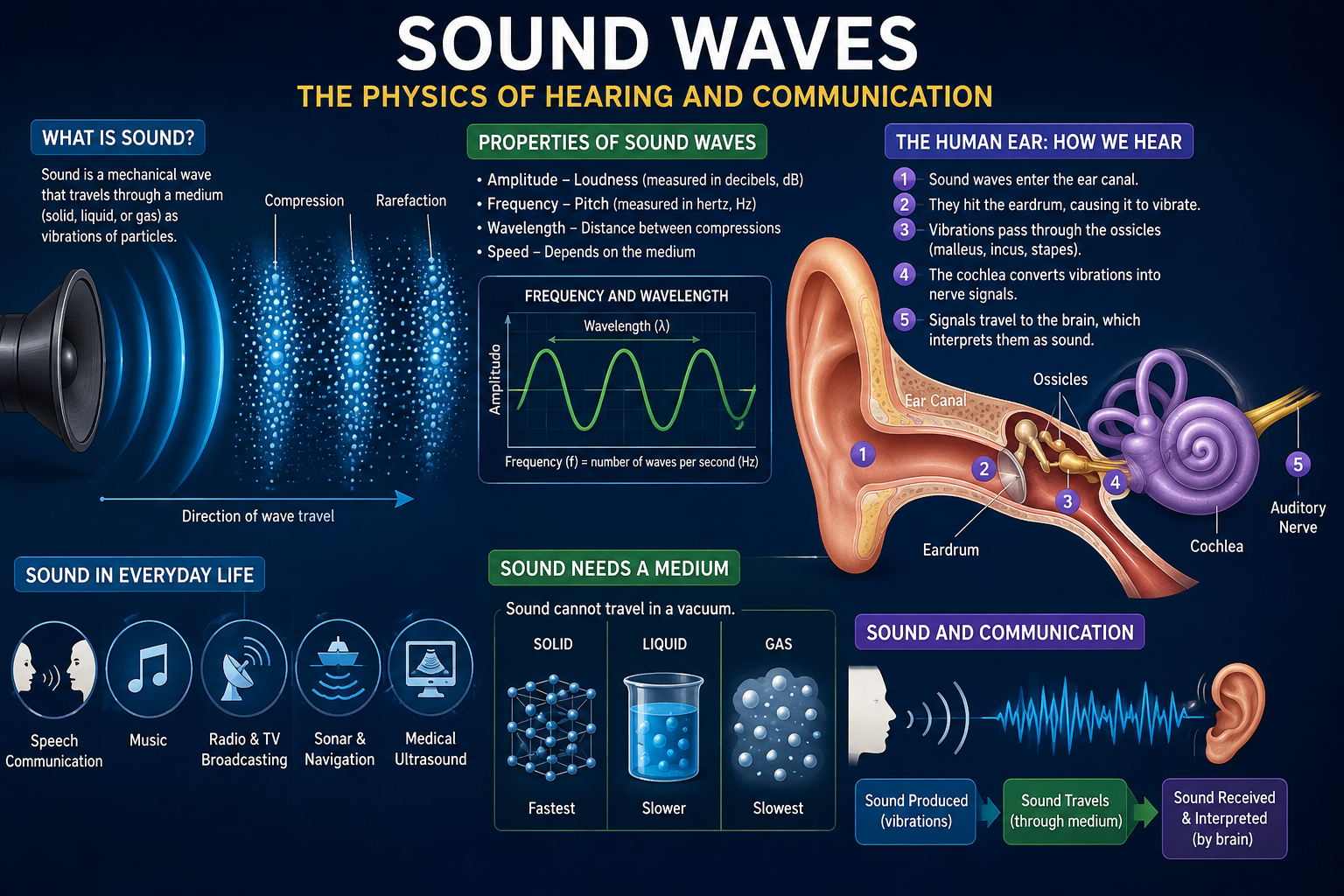
    # Sound Waves: The Physics of Hearing and Communication

    Have you ever wondered how a sound travels from one place to another? How does a musical instrument produce beautiful melodies? How can we hear someone speaking from across a room? The fascinating answer lies in the science of **sound waves!**

    In this exciting exploration of **“Sound Waves: The Physics of Hearing and Communication,”** we dive into the amazing world of sound and discover the physics behind one of the most important ways humans experience and understand the world around them.

    Sound is a form of energy that travels through a medium such as air, water, or solids. When an object vibrates, it causes nearby particles to vibrate, creating a wave that carries energy from one location to another. These vibrations eventually reach our ears, allowing our brains to recognize sounds.

    We’ll explore important concepts such as **frequency, wavelength, amplitude, speed, and pitch**. Understanding these properties helps explain why some sounds are high or low, loud or soft.

    The journey of sound into the human ear is equally fascinating! Sound waves enter the ear and cause tiny structures to vibrate. These vibrations are transformed into electrical signals that travel to the brain, where they are interpreted as meaningful sounds. This incredible process allows us to enjoy music , understand speech , recognize familiar sounds , and communicate with people around us.

    Communication depends heavily on sound. From everyday conversations to public speaking, telephone calls, radio broadcasts, and educational videos, sound allows information to travel between people. Modern technology also uses the principles of sound waves in microphones, speakers, headphones, medical imaging, and many other applications.

    This topic is a wonderful opportunity for students, science lovers, and curious minds to connect **physics with everyday life**. Instead of thinking of sound as something we simply hear, we can understand it as a physical phenomenon involving vibrations, energy, waves, and the remarkable human hearing system.

    **In this learning journey, you can discover:**
    What sound waves are
    How vibrations create sound
    How sound travels through different materials
    The relationship between frequency and pitch
    How amplitude affects loudness
    How the human ear detects sound
    How the brain interprets sound signals
    How sound enables communication
    How microphones and speakers work
    Everyday applications of sound-wave technology

    **Sound is everywhere!** From the gentle sound of rain to birds singing , from the voices of our friends to the music we enjoy , sound surrounds us every day. By understanding its physics, we gain a deeper appreciation for the invisible waves that connect our world.

    So get ready to listen, learn, explore, and discover the fascinating science behind the sounds we hear every day!

    **Learn the science. Understand the waves. Discover the power of sound!**

    #SoundWaves #Physics #Science #PhysicsOfSound #Hearing #Communication #Waves #SoundPhysics #ScienceEducation #PhysicsEducation #LearnScience #STEM #STEMEducation #HumanEar #Frequency #Amplitude #Wavelength #Pitch #Vibrations #ScienceForStudents #EducationalVideo #Learning #ScienceExploration #Technology #Acoustics #SoundAndCommunication #Curiosity #Knowledge #Education #ExploreScience
    #rsisb Roll no.247 Foundation level # πŸ”Š Sound Waves: The Physics of Hearing and Communication 🎧🌊 Have you ever wondered how a sound travels from one place to another? πŸ€”πŸ”Š How does a musical instrument produce beautiful melodies? 🎡 How can we hear someone speaking from across a room? πŸ—£οΈπŸ‘‚ The fascinating answer lies in the science of **sound waves!** 🌊✨ In this exciting exploration of **“Sound Waves: The Physics of Hearing and Communication,”** we dive into the amazing world of sound and discover the physics behind one of the most important ways humans experience and understand the world around them. πŸŒπŸ”¬ Sound is a form of energy that travels through a medium such as air, water, or solids. πŸŒ¬οΈπŸ’§πŸͺ¨ When an object vibrates, it causes nearby particles to vibrate, creating a wave that carries energy from one location to another. These vibrations eventually reach our ears, allowing our brains to recognize sounds. πŸ§ πŸ‘‚πŸ’‘ We’ll explore important concepts such as **frequency, wavelength, amplitude, speed, and pitch**. πŸ“šπŸ“ Understanding these properties helps explain why some sounds are high or low, loud or soft. πŸŽΆπŸ”‰πŸ”Š The journey of sound into the human ear is equally fascinating! πŸ‘‚βœ¨ Sound waves enter the ear and cause tiny structures to vibrate. These vibrations are transformed into electrical signals that travel to the brain, where they are interpreted as meaningful sounds. 🧠⚑ This incredible process allows us to enjoy music 🎼, understand speech πŸ—£οΈ, recognize familiar sounds πŸ‘‹, and communicate with people around us. ❀️🌎 Communication depends heavily on sound. From everyday conversations to public speaking, telephone calls, radio broadcasts, and educational videos, sound allows information to travel between people. πŸ“žπŸ“»πŸŽ™οΈ Modern technology also uses the principles of sound waves in microphones, speakers, headphones, medical imaging, and many other applications. πŸ’»πŸŽ§πŸ”¬ This topic is a wonderful opportunity for students, science lovers, and curious minds to connect **physics with everyday life**. πŸŒŸπŸ“– Instead of thinking of sound as something we simply hear, we can understand it as a physical phenomenon involving vibrations, energy, waves, and the remarkable human hearing system. πŸŒŠβš›οΈπŸ‘‚ 🎯 **In this learning journey, you can discover:** πŸ”Ή What sound waves are πŸ”Ή How vibrations create sound πŸ”Ή How sound travels through different materials πŸ”Ή The relationship between frequency and pitch πŸ”Ή How amplitude affects loudness πŸ”Ή How the human ear detects sound πŸ”Ή How the brain interprets sound signals πŸ”Ή How sound enables communication πŸ”Ή How microphones and speakers work πŸ”Ή Everyday applications of sound-wave technology 🌈 **Sound is everywhere!** From the gentle sound of rain 🌧️ to birds singing 🐦, from the voices of our friends πŸ—£οΈ to the music we enjoy 🎡, sound surrounds us every day. By understanding its physics, we gain a deeper appreciation for the invisible waves that connect our world. 🌍🌊✨ So get ready to listen, learn, explore, and discover the fascinating science behind the sounds we hear every day! πŸ”ŠπŸŽ§πŸ”¬πŸ“š πŸ’‘ **Learn the science. Understand the waves. Discover the power of sound!** πŸŒŠπŸ”Šβœ¨ #SoundWaves #Physics #Science #PhysicsOfSound #Hearing #Communication #Waves #SoundPhysics #ScienceEducation #PhysicsEducation #LearnScience #STEM #STEMEducation #HumanEar #Frequency #Amplitude #Wavelength #Pitch #Vibrations #ScienceForStudents #EducationalVideo #Learning #ScienceExploration #Technology #Acoustics #SoundAndCommunication #Curiosity #Knowledge #Education #ExploreScience πŸ”¬πŸ“šπŸŒπŸŽ§πŸ”Šβœ¨
    0 Commenti 0 condivisioni 6197 Views
  • #rsisb
    roll no.247
    Foundation level

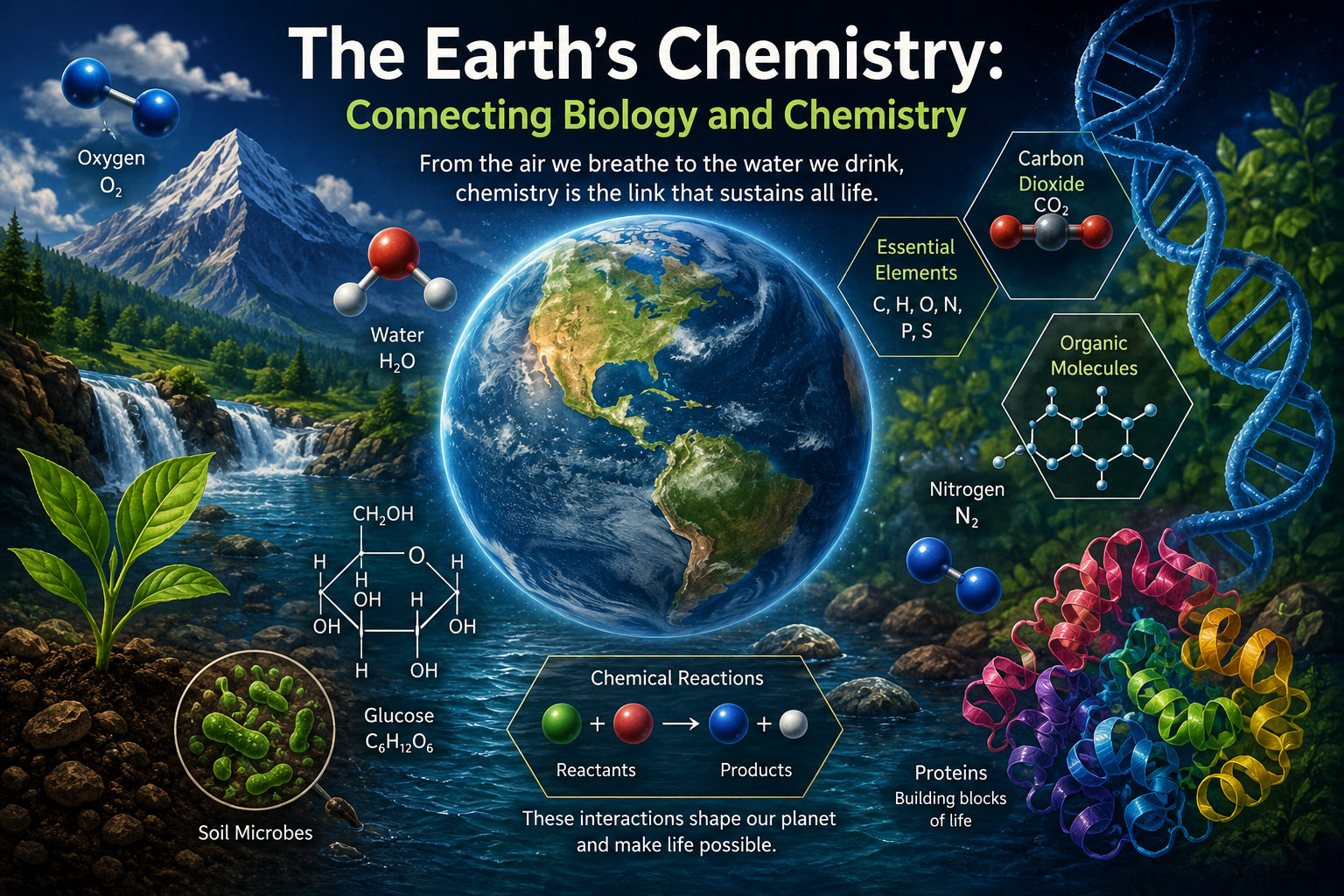
    **The Earth's Chemistry: Connecting Biology and Chemistry**

    Our Earth is a remarkable laboratory where chemistry and biology work together every moment! From the air we breathe to the water we drink, from the soil that supports plants to the cells that make up living organisms, chemistry is at the heart of life.

    **Chemistry makes life possible.** Plants use chemical reactions during photosynthesis to transform sunlight, water, and carbon dioxide into energy-rich food while releasing oxygen. This amazing process supports ecosystems and provides the oxygen needed by countless living organisms.

    **Biology and chemistry are deeply connected.** Every living cell depends on chemical substances such as proteins, carbohydrates, fats, DNA, water, minerals, and gases. These molecules interact through countless chemical reactions that allow organisms to grow, repair themselves, reproduce, and respond to their environment.

    Water is another perfect example of this connection. It helps transport nutrients, regulate temperature, support chemical reactions, and maintain ecosystems. Oceans, rivers, lakes, and groundwater are all part of Earth's interconnected chemical and biological systems.

    The **carbon cycle, nitrogen cycle, and oxygen cycle** demonstrate how matter continuously moves between the atmosphere, soil, water, and living organisms. Plants absorb carbon dioxide, animals obtain nutrients by consuming plants or other organisms, and decomposers return important elements to the environment.

    Even the soil beneath our feet is full of chemistry and biology. Minerals, microorganisms, organic matter, water, and air interact to create an environment where plants can grow. Healthy ecosystems depend on these delicate chemical relationships.

    Understanding Earth's chemistry helps us better understand climate, pollution, agriculture, ecosystems, human health, and the future of our planet. By studying how chemical substances interact with living systems, scientists can discover better ways to protect nature and use Earth's resources responsibly.

    **The big lesson:** Chemistry explains many of the processes that make biology possible, while biology shows us how those chemical processes come together to create living systems. Together, they tell an incredible story about our planet and life itself.

    Keep exploring, keep questioning, and keep discovering the fascinating science hidden all around us!

    #EarthsChemistry #Chemistry #Biology #EarthScience #Science #ScienceEducation #ChemistryAndBiology #LifeOnEarth #EnvironmentalScience #Photosynthesis #CarbonCycle #NitrogenCycle #OxygenCycle #Ecosystems #Nature #ScienceLovers #LearningScience #STEM #STEMEducation #ScienceExploration #OurPlanet #AmazingScience #Biochemistry #PlanetEarth #Education
    #rsisb roll no.247 Foundation level 🌍πŸ§ͺ **The Earth's Chemistry: Connecting Biology and Chemistry** 🧬🌱 Our Earth is a remarkable laboratory where chemistry and biology work together every moment! 🌎✨ From the air we breathe to the water we drink, from the soil that supports plants to the cells that make up living organisms, chemistry is at the heart of life. πŸ”¬πŸ’š 🌿 **Chemistry makes life possible.** Plants use chemical reactions during photosynthesis to transform sunlight, water, and carbon dioxide into energy-rich food while releasing oxygen. β˜€οΈπŸŒ± This amazing process supports ecosystems and provides the oxygen needed by countless living organisms. 🧬 **Biology and chemistry are deeply connected.** Every living cell depends on chemical substances such as proteins, carbohydrates, fats, DNA, water, minerals, and gases. These molecules interact through countless chemical reactions that allow organisms to grow, repair themselves, reproduce, and respond to their environment. πŸ”¬πŸ§« πŸ’§ Water is another perfect example of this connection. It helps transport nutrients, regulate temperature, support chemical reactions, and maintain ecosystems. Oceans, rivers, lakes, and groundwater are all part of Earth's interconnected chemical and biological systems. 🌊🐟 🌎 The **carbon cycle, nitrogen cycle, and oxygen cycle** demonstrate how matter continuously moves between the atmosphere, soil, water, and living organisms. Plants absorb carbon dioxide, animals obtain nutrients by consuming plants or other organisms, and decomposers return important elements to the environment. πŸ”„πŸŒΏπŸ¦  🌱 Even the soil beneath our feet is full of chemistry and biology. Minerals, microorganisms, organic matter, water, and air interact to create an environment where plants can grow. Healthy ecosystems depend on these delicate chemical relationships. 🌾🌍 πŸ”¬ Understanding Earth's chemistry helps us better understand climate, pollution, agriculture, ecosystems, human health, and the future of our planet. By studying how chemical substances interact with living systems, scientists can discover better ways to protect nature and use Earth's resources responsibly. πŸ’‘πŸŒ³ ✨ **The big lesson:** Chemistry explains many of the processes that make biology possible, while biology shows us how those chemical processes come together to create living systems. Together, they tell an incredible story about our planet and life itself. 🌍❀️πŸ§ͺ🧬 πŸ“š Keep exploring, keep questioning, and keep discovering the fascinating science hidden all around us! πŸ”Žβœ¨ #EarthsChemistry #Chemistry #Biology #EarthScience #Science #ScienceEducation #ChemistryAndBiology #LifeOnEarth #EnvironmentalScience #Photosynthesis #CarbonCycle #NitrogenCycle #OxygenCycle #Ecosystems #Nature #ScienceLovers #LearningScience #STEM #STEMEducation #ScienceExploration #OurPlanet #AmazingScience #Biochemistry #PlanetEarth #Education
    0 Commenti 0 condivisioni 6394 Views
  • #rsisb
    Roll no 248
    Foundation level
    song no 12
    **Dissecting Frogs: A Gateway to Human Anatomy**

    Frog dissection is a classic biology activity that helps students explore the fascinating world of anatomy. By studying the arrangement and function of organs, students can better understand how different body systems work together.

    This topic connects classroom learning with real biological structures and encourages curiosity, careful observation, scientific thinking, and respect for living organisms. Through anatomy, we can discover similarities and differences between frogs and humans and gain a deeper appreciation for the complexity of life.

    **Explore. Observe. Learn. Discover the science of life!**

    #FrogDissection #HumanAnatomy #Biology #ScienceLearning #Anatomy #LifeScience #BiologyStudents #ScientificLearning #ScienceEducation #ExploreScience #Curiosity #Learning #Education #Nature #AnimalAnatomy #STEM #ScienceExploration
    #rsisb Roll no 248 Foundation level song no 12 πŸΈπŸ”¬ **Dissecting Frogs: A Gateway to Human Anatomy** πŸ§¬πŸ«€ Frog dissection is a classic biology activity that helps students explore the fascinating world of anatomy. πŸΈπŸ“š By studying the arrangement and function of organs, students can better understand how different body systems work together. πŸ”¬βœ¨ This topic connects classroom learning with real biological structures and encourages curiosity, careful observation, scientific thinking, and respect for living organisms. 🧠🌱 Through anatomy, we can discover similarities and differences between frogs and humans and gain a deeper appreciation for the complexity of life. 🌍❀️ πŸ”Ž **Explore. Observe. Learn. Discover the science of life!** 🐸🧬✨ #FrogDissection #HumanAnatomy #Biology #ScienceLearning #Anatomy #LifeScience #BiologyStudents #ScientificLearning #ScienceEducation #ExploreScience #Curiosity #Learning #Education #Nature #AnimalAnatomy #STEM #ScienceExploration πŸΈπŸ”¬πŸ§¬πŸ“šβœ¨
    0 Commenti 0 condivisioni 2859 Views 3
Pagine in Evidenza