• #rsisb
    Roll no.247
    song . 9
    Foundation level

    **Cellular Symphony: The Intricate Dance of Life’s Building Blocks**

    Life is an extraordinary masterpiece, and at its heart lies the incredible world of the **cell**—the fundamental building block of every living organism. From the tiniest microorganisms to the complex human body, cells work together in a beautifully coordinated system that makes life possible.

    In **“Cellular Symphony: The Intricate Dance of Life’s Building Blocks,”** we explore the fascinating universe hidden within cells. Discover how the cell membrane protects and communicates, how the nucleus stores genetic information, how mitochondria help provide energy, and how proteins and other molecular components perform countless essential tasks.

    Just like musicians in a symphony orchestra, each cellular component has a unique role. No single part works completely alone. Instead, organelles, molecules, and genetic instructions interact continuously, creating an amazing biological harmony. From energy production and cellular communication to growth, repair, and reproduction, every process contributes to the larger story of life.

    We’ll also take a closer look at **DNA**, the remarkable molecule that carries the instructions needed for life. How does DNA store information? How do cells use those instructions to create proteins? And how do cells coordinate their activities with such incredible precision? These questions reveal just how sophisticated even the smallest living systems can be.

    This journey into cellular biology is an opportunity to appreciate the complexity and beauty of life from a completely new perspective. Whether you are a student, science enthusiast, educator, or simply curious about how living things work, this exploration can help make the microscopic world easier to understand and appreciate.

    **Every cell tells a story.**
    **Every molecule has a purpose.**
    **Every process contributes to life.**
    **Together, they create the symphony of existence.**

    Join us as we zoom into the microscopic world and uncover the remarkable cooperation that takes place inside living cells. From the structure of cellular organelles to the flow of genetic information, this is a fascinating journey through one of nature’s greatest achievements—the living cell.

    **Educational • Scientific • Inspiring • Fascinating**
    Explore. Discover. Learn. Be Inspired.

    #CellularSymphony #CellBiology #Cells #Biology #Science #ScienceEducation #MolecularBiology #DNA #Genetics #LifeScience #HumanBody #MicroscopicWorld #BiologyLovers #ScienceLovers #STEM #STEMEducation #LearnScience #ScientificDiscovery #Nature #Life #Education #Knowledge #ScienceExplained #AmazingScience #CellularLife #Organelle #GeneticInformation #BiologicalScience #ExploreScience #ScienceJourney
    #rsisb Roll no.247 song . 9 Foundation level 🧬✨ **Cellular Symphony: The Intricate Dance of Life’s Building Blocks** πŸ”¬πŸŒ± Life is an extraordinary masterpiece, and at its heart lies the incredible world of the **cell**—the fundamental building block of every living organism. 🧫🌍 From the tiniest microorganisms to the complex human body, cells work together in a beautifully coordinated system that makes life possible. In **“Cellular Symphony: The Intricate Dance of Life’s Building Blocks,”** we explore the fascinating universe hidden within cells. πŸ”¬βœ¨ Discover how the cell membrane protects and communicates, how the nucleus stores genetic information, how mitochondria help provide energy, and how proteins and other molecular components perform countless essential tasks. ⚑🧬 Just like musicians in a symphony orchestra, each cellular component has a unique role. 🎻🎢 No single part works completely alone. Instead, organelles, molecules, and genetic instructions interact continuously, creating an amazing biological harmony. From energy production and cellular communication to growth, repair, and reproduction, every process contributes to the larger story of life. 🌱❀️ We’ll also take a closer look at **DNA**, the remarkable molecule that carries the instructions needed for life. πŸ§¬πŸ“– How does DNA store information? How do cells use those instructions to create proteins? And how do cells coordinate their activities with such incredible precision? These questions reveal just how sophisticated even the smallest living systems can be. This journey into cellular biology is an opportunity to appreciate the complexity and beauty of life from a completely new perspective. πŸŒŽπŸ” Whether you are a student, science enthusiast, educator, or simply curious about how living things work, this exploration can help make the microscopic world easier to understand and appreciate. πŸ”¬ **Every cell tells a story.** 🧬 **Every molecule has a purpose.** ⚑ **Every process contributes to life.** 🌱 **Together, they create the symphony of existence.** Join us as we zoom into the microscopic world and uncover the remarkable cooperation that takes place inside living cells. From the structure of cellular organelles to the flow of genetic information, this is a fascinating journey through one of nature’s greatest achievements—the living cell. 🌟🧫 πŸŽ“ **Educational • Scientific • Inspiring • Fascinating** πŸ”¬ Explore. 🧬 Discover. 🌱 Learn. ✨ Be Inspired. #CellularSymphony #CellBiology #Cells #Biology #Science #ScienceEducation #MolecularBiology #DNA #Genetics #LifeScience #HumanBody #MicroscopicWorld #BiologyLovers #ScienceLovers #STEM #STEMEducation #LearnScience #ScientificDiscovery #Nature #Life #Education #Knowledge #ScienceExplained #AmazingScience #CellularLife #Organelle #GeneticInformation #BiologicalScience #ExploreScience #ScienceJourney πŸ”¬πŸ§¬πŸŒ±βœ¨
    0 Reacties 0 aandelen 1634 Views 7
  • #rsisb
    Roll No.240
    Image With Chatgpt No.6
    Foundation Level

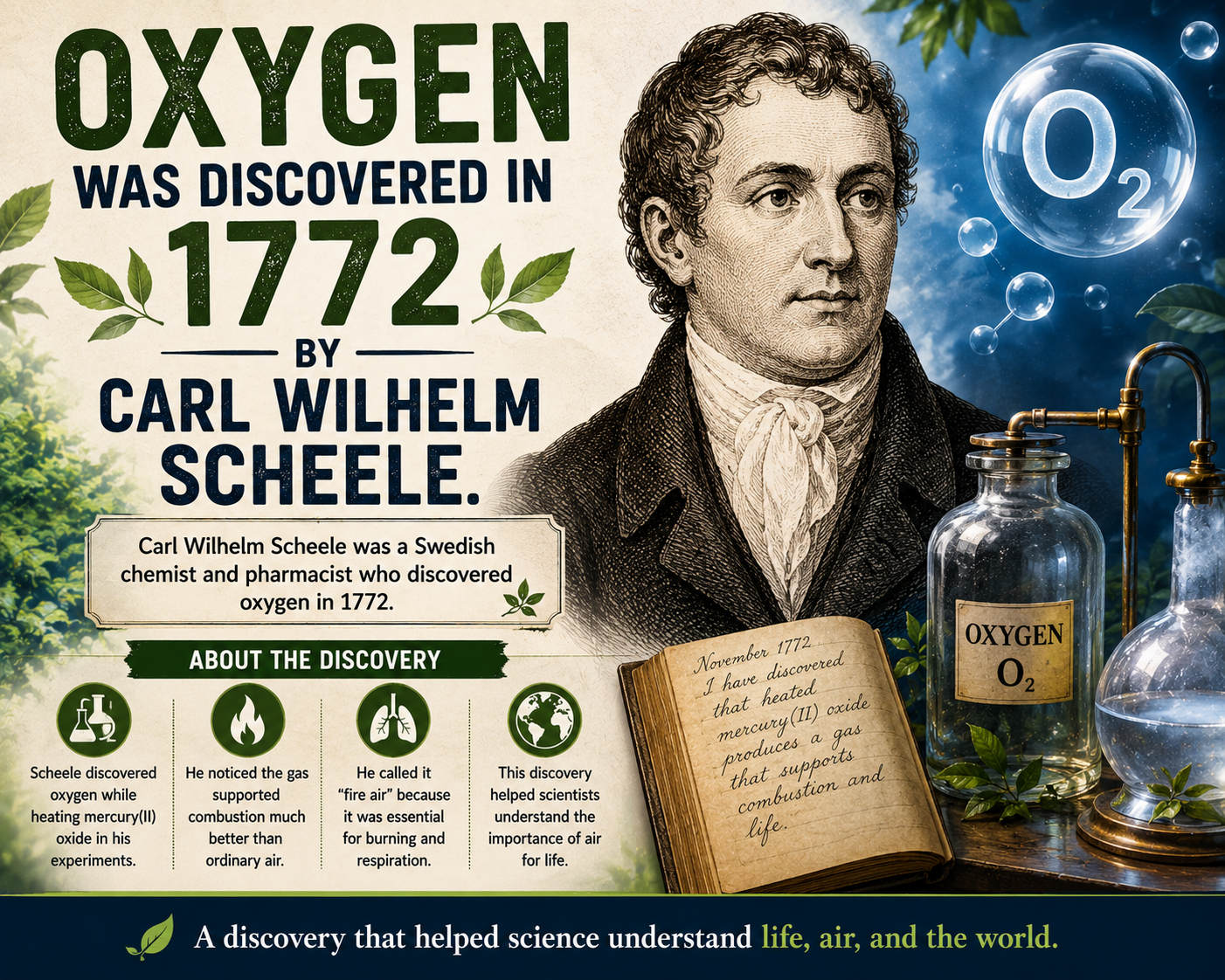
    Oxygen is one of the most important elements for life on Earth, but its discovery was the result of careful experiments, curiosity, and scientific investigation.

    In 1772, Swedish chemist and pharmacist Carl Wilhelm Scheele identified a gas that behaved differently from ordinary air. He found that this gas strongly supported combustion and played an important role in the processes we now understand as respiration and burning.

    Scheele referred to the gas as “fire air” because of its ability to support combustion. His experiments helped reveal that air was not simply one single substance, but a mixture containing different gases.

    The story of oxygen’s discovery is a fascinating example of how science develops through observation and experimentation. Scientists investigate materials, record their observations, test ideas, and gradually build a better understanding of the natural world.

    Although Scheele discovered oxygen independently, the recognition and naming of oxygen as an element also involved other scientists, including Joseph Priestley and Antoine Lavoisier. Their work helped establish oxygen’s role in combustion and contributed to the development of modern chemistry.

    Oxygen is represented by the chemical symbol O and has the atomic number 8. It is essential for aerobic respiration in humans and many other organisms. Without oxygen, most familiar forms of complex life could not survive.

    The discovery of oxygen changed the way scientists understood air, combustion, chemistry, and life. It became an important part of the scientific revolution in chemistry and helped researchers develop a much clearer understanding of chemical reactions.

    This story also reminds us that major scientific discoveries often happen through patience, careful observation, and a willingness to ask questions. Every experiment can reveal something new, and every discovery can open the door to further knowledge.

    From “fire air” to oxygen, the journey of discovery changed chemistry forever.

    Science teaches us that the world around us is full of mysteries waiting to be explored. Whether studying gases, atoms, cells, planets, or living organisms, curiosity is often the first step toward discovery.

    Question. Observe. Experiment. Discover. Learn.

    #Oxygen #DiscoveryOfOxygen #CarlWilhelmScheele #ScienceHistory #HistoryOfScience #Chemistry #ChemicalElements #OxygenDiscovery #1772 #ScientificDiscovery #ScienceEducation #ChemistryFacts #ScienceFacts #LearnScience #ScientificRevolution #Combustion #Air #Respiration #ChemistryHistory #STEM #Education #LearningJourney #ScienceExperiment #ScientificThinking #Research #Discovery #Knowledge #Innovation #Curiosity #ExploreScience #ScienceLovers #EducationalContent #Scientists #ChemicalScience #ModernChemistry #ScienceJourney #HistoryOfChemistry

    Rehan School Islamabad Campus
    Asma Shaheen EducationWali
    Irum Asim
    Saima Happinesswali

    #rsisb Roll No.240 Image With Chatgpt No.6 Foundation Level Oxygen is one of the most important elements for life on Earth, but its discovery was the result of careful experiments, curiosity, and scientific investigation. 🌱🫁πŸ”₯ In 1772, Swedish chemist and pharmacist Carl Wilhelm Scheele identified a gas that behaved differently from ordinary air. He found that this gas strongly supported combustion and played an important role in the processes we now understand as respiration and burning. πŸ”₯πŸ§ͺ Scheele referred to the gas as “fire air” because of its ability to support combustion. His experiments helped reveal that air was not simply one single substance, but a mixture containing different gases. πŸŒ¬οΈπŸ”¬ The story of oxygen’s discovery is a fascinating example of how science develops through observation and experimentation. Scientists investigate materials, record their observations, test ideas, and gradually build a better understanding of the natural world. πŸ“šπŸ”ŽπŸ’‘ Although Scheele discovered oxygen independently, the recognition and naming of oxygen as an element also involved other scientists, including Joseph Priestley and Antoine Lavoisier. Their work helped establish oxygen’s role in combustion and contributed to the development of modern chemistry. βš—οΈπŸ§ πŸŒ Oxygen is represented by the chemical symbol O and has the atomic number 8. It is essential for aerobic respiration in humans and many other organisms. 🫁🌿🐾 Without oxygen, most familiar forms of complex life could not survive. The discovery of oxygen changed the way scientists understood air, combustion, chemistry, and life. 🌎πŸ”₯πŸ”¬ It became an important part of the scientific revolution in chemistry and helped researchers develop a much clearer understanding of chemical reactions. This story also reminds us that major scientific discoveries often happen through patience, careful observation, and a willingness to ask questions. πŸ’­βž‘οΈπŸ”¬βž‘οΈπŸ’‘ Every experiment can reveal something new, and every discovery can open the door to further knowledge. ✨ From “fire air” to oxygen, the journey of discovery changed chemistry forever. ✨ Science teaches us that the world around us is full of mysteries waiting to be explored. πŸŒπŸ”Ž Whether studying gases, atoms, cells, planets, or living organisms, curiosity is often the first step toward discovery. πŸš€πŸ“š 🌟 Question. Observe. Experiment. Discover. Learn. 🌟 #Oxygen #DiscoveryOfOxygen #CarlWilhelmScheele #ScienceHistory #HistoryOfScience #Chemistry #ChemicalElements #OxygenDiscovery #1772 #ScientificDiscovery #ScienceEducation #ChemistryFacts #ScienceFacts #LearnScience #ScientificRevolution #Combustion #Air #Respiration #ChemistryHistory #STEM #Education #LearningJourney #ScienceExperiment #ScientificThinking #Research #Discovery #Knowledge #Innovation #Curiosity #ExploreScience #ScienceLovers #EducationalContent #Scientists #ChemicalScience #ModernChemistry #ScienceJourney #HistoryOfChemistry πŸ”¬πŸ§ͺ🌍πŸ”₯πŸ«πŸ“šπŸ’‘βœ¨πŸš€πŸŒ± Rehan School Islamabad Campus Asma Shaheen EducationWali Irum Asim Saima Happinesswali

    0 Reacties 0 aandelen 3277 Views
  • #rsisb
    Roll No.240
    Story Post No.24
    Foundation Level

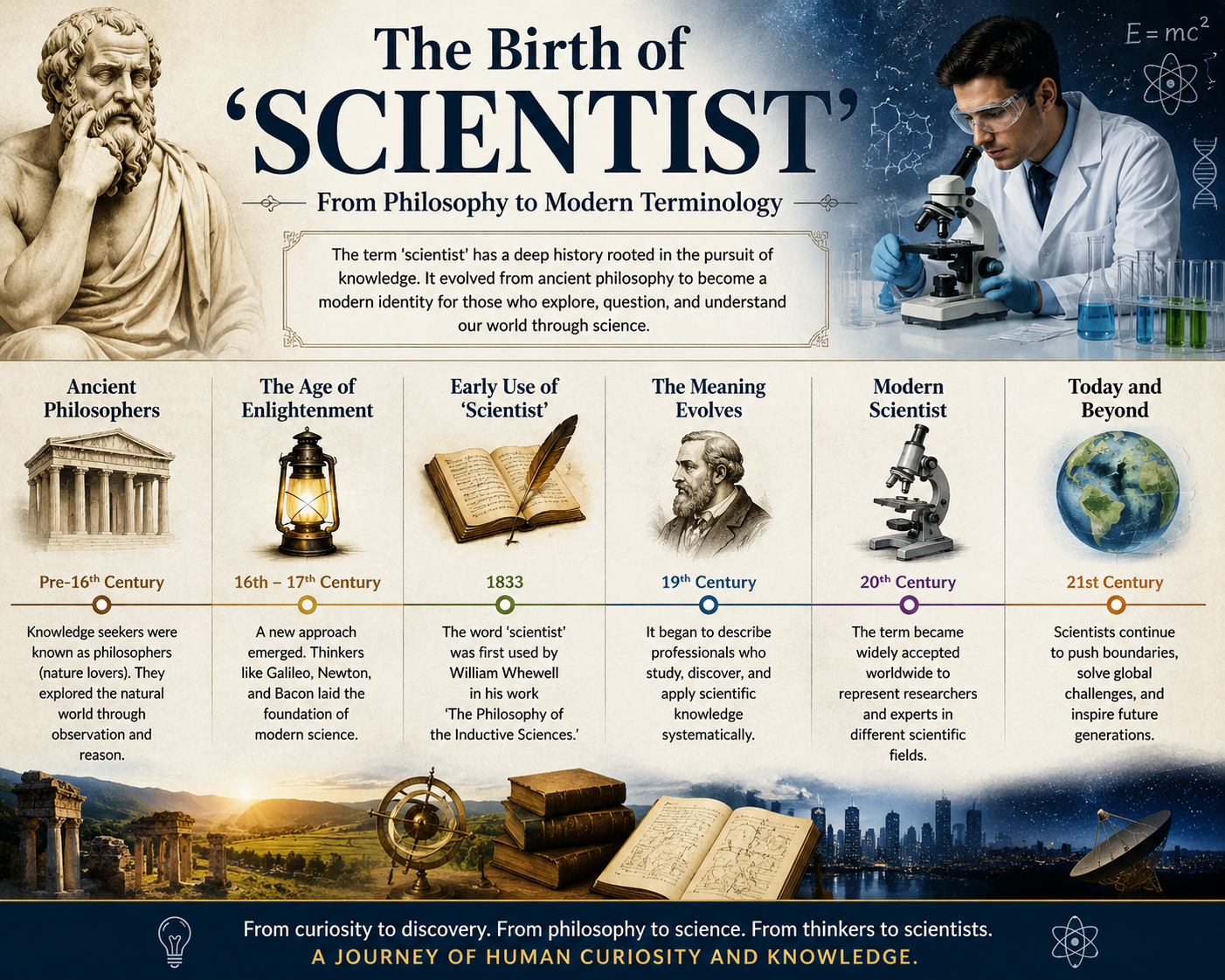
    The word “scientist” may sound like a modern term, but the journey behind it is connected to centuries of human curiosity, philosophy, observation, experimentation, and the search for knowledge.

    Long before the word “scientist” became common, people who studied the natural world were often known as philosophers, scholars, natural philosophers, mathematicians, and thinkers. They asked important questions about nature, the universe, life, matter, motion, and the world around them.

    From the thinkers of the ancient world to the scholars of the Renaissance and the Scientific Revolution, humans continued developing new ways to understand nature. Observation became more important, experiments became more systematic, and evidence gradually became a central part of scientific inquiry.

    During the 18th and 19th centuries, many different branches of knowledge began becoming more specialized. Physics, chemistry, biology, astronomy, geology, and other fields developed their own methods, discoveries, and communities of researchers.

    A major moment in terminology came in the 19th century, when the word “scientist” was introduced as a useful name for people engaged in scientific study. The term is widely associated with William Whewell, who used it in 1833. This helped provide a new, unified word for researchers working across different areas of science.

    The evolution of this word reflects something bigger than language. It represents the changing way humanity organized knowledge and recognized scientific work. The transition from “natural philosopher” to “scientist” shows how science gradually became a distinct and organized field of study.

    Today, scientists work in laboratories, universities, hospitals, observatories, research centers, engineering facilities, and many other places around the world. They investigate everything from tiny cells and molecules to distant galaxies and the origins of the universe.

    Modern science continues to grow through curiosity, evidence, teamwork, technology, and a willingness to ask difficult questions. Every discovery begins with someone wondering, “Why?”, “How?”, or “What if?”

    The story of the word “scientist” reminds us that human knowledge is always evolving. What began with simple curiosity and philosophical questioning gradually developed into the powerful and diverse scientific world we know today.

    From thinkers to researchers. From philosophy to science. From questions to discoveries.

    Science is not only about finding answers—it is also about continuing to ask better questions.

    A journey from curiosity to discovery, and from philosophy to modern science.

    #TheBirthOfScientist #Scientist #HistoryOfScience #ScienceHistory #ScientificRevolution #Philosophy #NaturalPhilosophy #WilliamWhewell #1833 #ModernScience #ScienceEducation #ScientificTerminology #Science #Scientists #Research #Discovery #Curiosity #Knowledge #Learning #Education #STEM #Physics #Chemistry #Biology #Astronomy #Geology #Innovation #Experimentation #ScientificThinking #CriticalThinking #HumanKnowledge #HistoryOfKnowledge #ScienceJourney #FromPhilosophyToScience #ScienceFacts #EducationalContent #LearningJourney #ExploreScience #DiscoverScience

    Rehan School Islamabad Campus
    Asma Shaheen EducationWali
    Irum Asim
    Saima Happinesswali

    #rsisb Roll No.240 Story Post No.24 Foundation Level The word “scientist” may sound like a modern term, but the journey behind it is connected to centuries of human curiosity, philosophy, observation, experimentation, and the search for knowledge. πŸ§ πŸ”Ž Long before the word “scientist” became common, people who studied the natural world were often known as philosophers, scholars, natural philosophers, mathematicians, and thinkers. πŸ›οΈπŸ“œ They asked important questions about nature, the universe, life, matter, motion, and the world around them. From the thinkers of the ancient world to the scholars of the Renaissance and the Scientific Revolution, humans continued developing new ways to understand nature. πŸŒŒπŸŒπŸ“– Observation became more important, experiments became more systematic, and evidence gradually became a central part of scientific inquiry. πŸ”¬πŸ§ͺ✨ During the 18th and 19th centuries, many different branches of knowledge began becoming more specialized. Physics, chemistry, biology, astronomy, geology, and other fields developed their own methods, discoveries, and communities of researchers. πŸ§¬βš—οΈπŸŒ  A major moment in terminology came in the 19th century, when the word “scientist” was introduced as a useful name for people engaged in scientific study. The term is widely associated with William Whewell, who used it in 1833. πŸ“œπŸ”¬ This helped provide a new, unified word for researchers working across different areas of science. The evolution of this word reflects something bigger than language. It represents the changing way humanity organized knowledge and recognized scientific work. πŸŒŸπŸ“š The transition from “natural philosopher” to “scientist” shows how science gradually became a distinct and organized field of study. Today, scientists work in laboratories, universities, hospitals, observatories, research centers, engineering facilities, and many other places around the world. 🌍πŸ§ͺπŸ”­ They investigate everything from tiny cells and molecules to distant galaxies and the origins of the universe. 🧬🦠🌌 Modern science continues to grow through curiosity, evidence, teamwork, technology, and a willingness to ask difficult questions. πŸ’‘πŸ€πŸš€ Every discovery begins with someone wondering, “Why?”, “How?”, or “What if?” The story of the word “scientist” reminds us that human knowledge is always evolving. What began with simple curiosity and philosophical questioning gradually developed into the powerful and diverse scientific world we know today. πŸŒ±βž‘οΈπŸ”¬βž‘οΈπŸŒ ✨ From thinkers to researchers. From philosophy to science. From questions to discoveries. ✨ Science is not only about finding answers—it is also about continuing to ask better questions. πŸ”ŽπŸ’‘ 🌟 A journey from curiosity to discovery, and from philosophy to modern science. 🌟 #TheBirthOfScientist #Scientist #HistoryOfScience #ScienceHistory #ScientificRevolution #Philosophy #NaturalPhilosophy #WilliamWhewell #1833 #ModernScience #ScienceEducation #ScientificTerminology #Science #Scientists #Research #Discovery #Curiosity #Knowledge #Learning #Education #STEM #Physics #Chemistry #Biology #Astronomy #Geology #Innovation #Experimentation #ScientificThinking #CriticalThinking #HumanKnowledge #HistoryOfKnowledge #ScienceJourney #FromPhilosophyToScience #ScienceFacts #EducationalContent #LearningJourney #ExploreScience #DiscoverScience πŸ”¬πŸ“šπŸ§ πŸŒβœ¨πŸ”­πŸ§ͺπŸš€πŸ’‘πŸŒŸ Rehan School Islamabad Campus Asma Shaheen EducationWali Irum Asim Saima Happinesswali

    0 Reacties 0 aandelen 3134 Views
  • #rsisb
    Roll no.247
    Foundation level

    **Peering Inside: The Role of Dissections in Understanding Life**

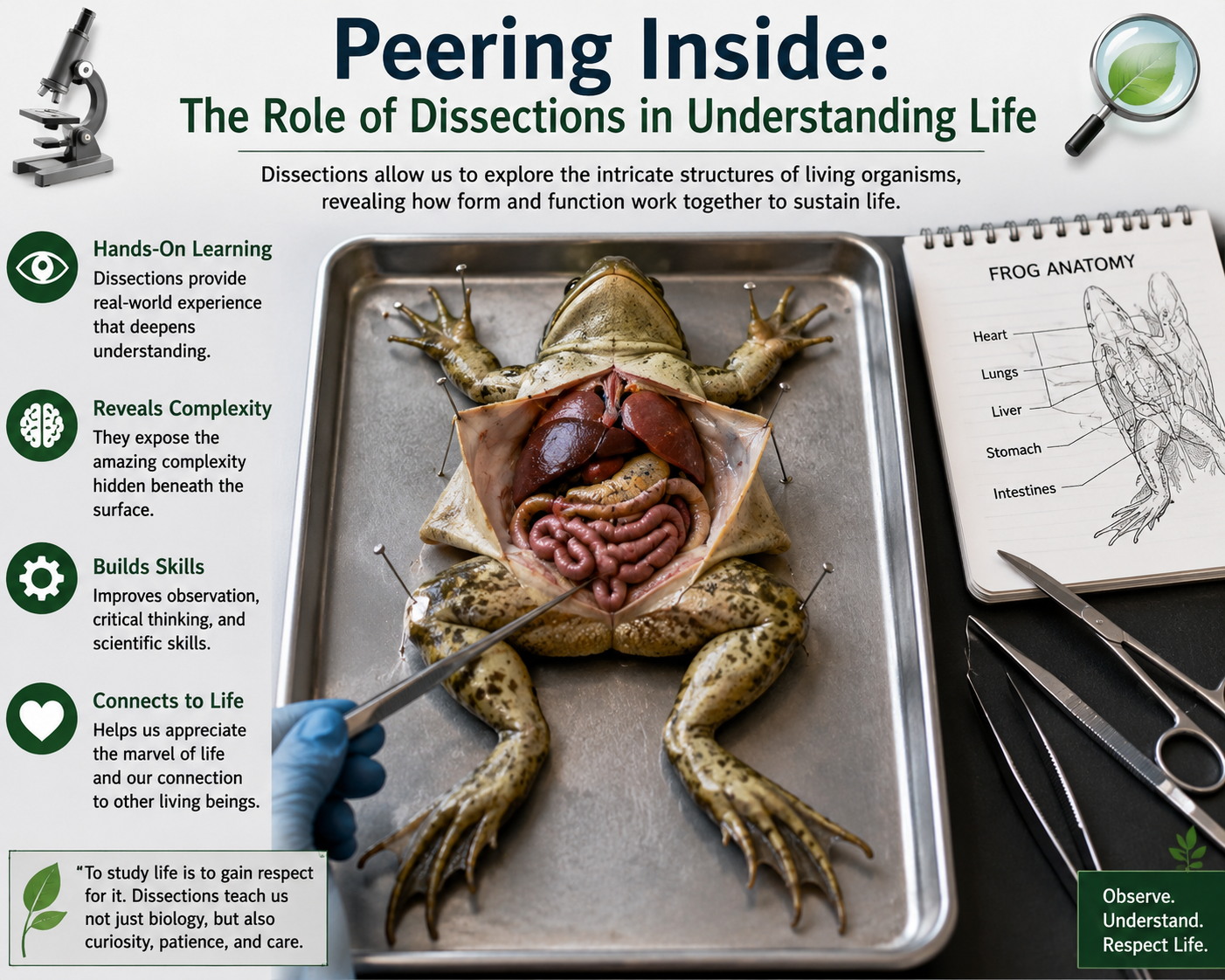
    Dissections have played an important role in helping students and scientists understand the incredible complexity of living organisms. By carefully examining biological structures, learners can move beyond diagrams and textbooks to develop a clearer understanding of how different organs, tissues, and body systems are connected.

    The study of anatomy through dissection can encourage curiosity, careful observation, scientific thinking, and respect for the complexity of life. It helps learners ask meaningful questions: How does an organ function? How are body systems connected? Why does each structure have a particular shape and position?

    From frogs and other organisms to modern anatomical models and digital simulations, the exploration of biological structures continues to support science education. Modern technology also provides alternatives such as 3D models, virtual dissections, and interactive simulations, making anatomy accessible in different ways.

    Most importantly, studying anatomy reminds us that life is a remarkable system of interconnected parts. Every structure has a role, and understanding those relationships helps us appreciate biology at a deeper level.

    Let’s explore, observe, question, and learn—because every discovery begins with curiosity!

    #Dissection #Biology #Anatomy #LifeScience #ScienceEducation #BiologyLearning #HumanAnatomy #AnimalAnatomy #ScientificDiscovery #ScienceExperiment #LearningBiology #STEMEducation #ScienceStudents #Curiosity #ExploreScience #AnatomyEducation #BiologicalSciences #ScienceJourney #LearnAndDiscover #UnderstandingLife
    #rsisb Roll no.247 Foundation level πŸ§¬πŸ”¬ **Peering Inside: The Role of Dissections in Understanding Life** 🐸✨ Dissections have played an important role in helping students and scientists understand the incredible complexity of living organisms. By carefully examining biological structures, learners can move beyond diagrams and textbooks to develop a clearer understanding of how different organs, tissues, and body systems are connected. πŸ«€πŸ«πŸ§  The study of anatomy through dissection can encourage curiosity, careful observation, scientific thinking, and respect for the complexity of life. It helps learners ask meaningful questions: How does an organ function? How are body systems connected? Why does each structure have a particular shape and position? πŸ€”πŸ”Ž From frogs and other organisms to modern anatomical models and digital simulations, the exploration of biological structures continues to support science education. πŸŒ±πŸΈπŸ’‘ Modern technology also provides alternatives such as 3D models, virtual dissections, and interactive simulations, making anatomy accessible in different ways. Most importantly, studying anatomy reminds us that life is a remarkable system of interconnected parts. Every structure has a role, and understanding those relationships helps us appreciate biology at a deeper level. 🌍🧬❀️ Let’s explore, observe, question, and learn—because every discovery begins with curiosity! πŸ”¬πŸ“šβœ¨ #Dissection #Biology #Anatomy #LifeScience #ScienceEducation #BiologyLearning #HumanAnatomy #AnimalAnatomy #ScientificDiscovery #ScienceExperiment #LearningBiology #STEMEducation #ScienceStudents #Curiosity #ExploreScience #AnatomyEducation #BiologicalSciences #ScienceJourney #LearnAndDiscover #UnderstandingLife πŸ§¬πŸ”¬πŸΈπŸ“šβœ¨
    0 Reacties 0 aandelen 3265 Views
  • RSISB
    Roll No: 209
    Story Post No. 27

    The Birth of “Scientist”: From Philosophy to Modern Terminology

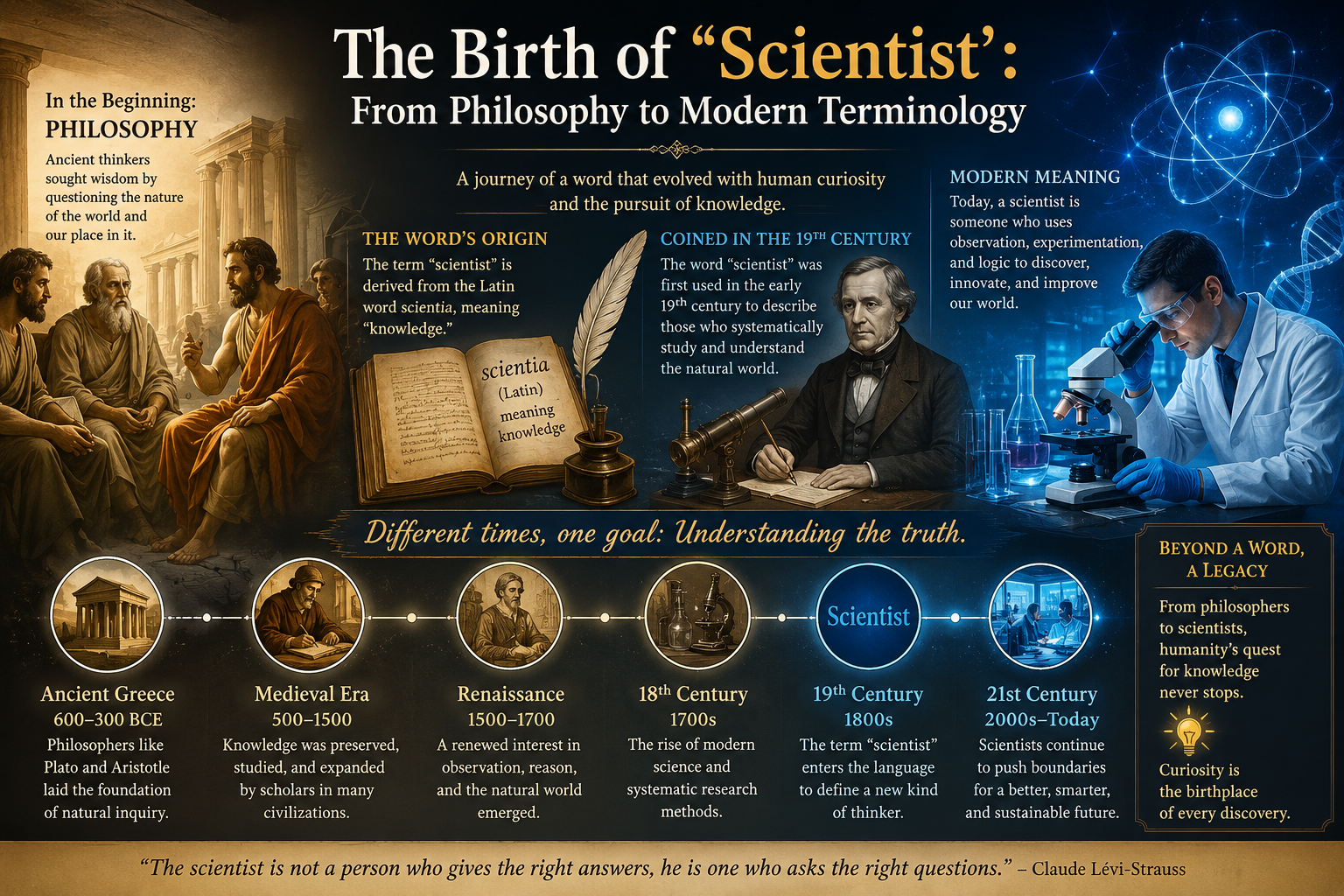
    Have you ever wondered where the word “Scientist” came from? This fascinating journey takes us from the ancient world of philosophy and natural inquiry to the modern age of laboratories, experiments, and scientific discovery.

    For centuries, thinkers explored the mysteries of nature through observation, reasoning, and philosophy. As knowledge and research evolved, a new term was needed to describe people who systematically studied the natural world—and the word “scientist” emerged in the 19th century.

    Today, scientists continue this timeless journey by asking questions, testing ideas, discovering new knowledge, and helping us understand our universe.

    From philosophers seeking wisdom to scientists seeking evidence, the quest for knowledge has never stopped!

    #Scientist #HistoryOfScience #ScienceHistory #Philosophy #ScientificDiscovery #Knowledge #ScienceAndTechnology #NaturalScience #Learning #Education #Curiosity #Innovation #Research #ModernScience #ScienceJourney
    RSISB Roll No: 209 Story Post No. 27 πŸ”¬πŸ“š The Birth of “Scientist”: From Philosophy to Modern Terminology 🌍✨ Have you ever wondered where the word “Scientist” came from? πŸ€”πŸ”Ž This fascinating journey takes us from the ancient world of philosophy and natural inquiry to the modern age of laboratories, experiments, and scientific discovery. πŸ›οΈβž‘οΈπŸ§ͺ For centuries, thinkers explored the mysteries of nature through observation, reasoning, and philosophy. As knowledge and research evolved, a new term was needed to describe people who systematically studied the natural world—and the word “scientist” emerged in the 19th century. πŸ’‘πŸ“– Today, scientists continue this timeless journey by asking questions, testing ideas, discovering new knowledge, and helping us understand our universe. πŸŒŒπŸ§¬πŸš€ ✨ From philosophers seeking wisdom to scientists seeking evidence, the quest for knowledge has never stopped! πŸ”¬πŸŒŸ #Scientist #HistoryOfScience #ScienceHistory #Philosophy #ScientificDiscovery #Knowledge #ScienceAndTechnology #NaturalScience #Learning #Education #Curiosity #Innovation #Research #ModernScience #ScienceJourney πŸ”¬πŸ“šπŸŒβœ¨
    0 Reacties 0 aandelen 1838 Views
  • #rsisb
    Roll No.240
    Story No.22
    Foundation Level

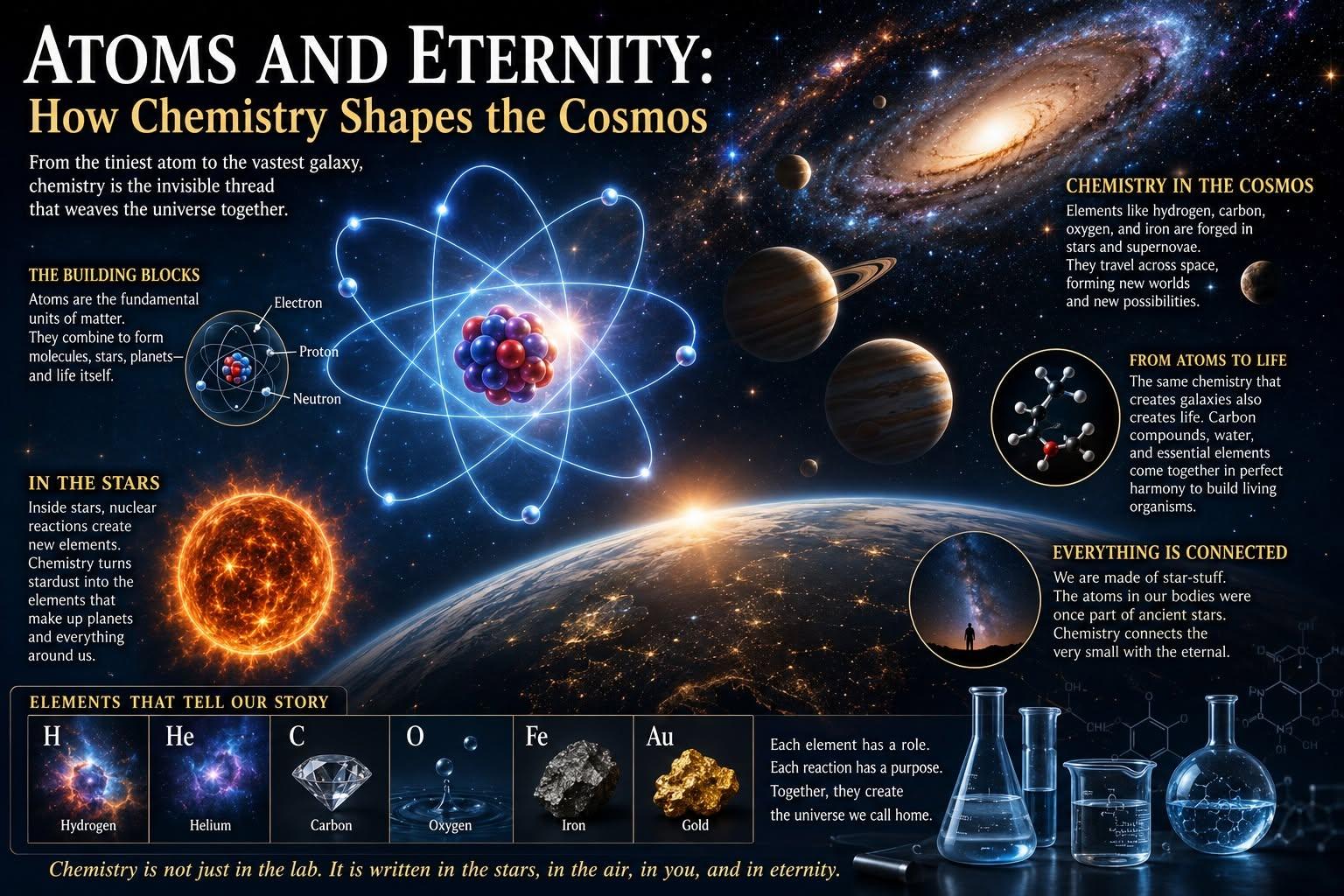
    ### **Atoms and Eternity: How Chemistry Shapes the Cosmos – Description**

    **Atoms and Eternity: How Chemistry Shapes the Cosmos** takes us on an incredible journey through the hidden world of atoms and molecules that make up everything around us. From the smallest particles inside atoms to the formation of stars, planets, and life itself, chemistry is the powerful force that connects the universe.

    Every element in the cosmos has a story — created inside ancient stars, spread across galaxies, and combined through chemical reactions to build the world we know today. The same atoms that formed distant planets also exist within our bodies, showing the deep connection between humanity and the universe.

    This exploration reveals how chemistry acts as the language of creation, explaining the birth of matter, the evolution of life, and the endless possibilities of the cosmos.

    Join this fascinating journey to discover how tiny atoms create the vast universe and how chemistry shapes the eternity of existence.

    #AtomsAndEternity #ChemistryOfCosmos #ScienceJourney #UniverseExploration #Atoms #Molecules #CosmicChemistry #ScienceEducation #MysteriesOfTheUniverse

    Rehan School Islamabad Campus
    Asma Shaheen EducationWali
    Irum Asim
    Saima Happinesswali
    #rsisb Roll No.240 Story No.22 Foundation Level ### 🌌 **Atoms and Eternity: How Chemistry Shapes the Cosmos – Description** ✨ πŸ”¬ **Atoms and Eternity: How Chemistry Shapes the Cosmos** takes us on an incredible journey through the hidden world of atoms and molecules that make up everything around us. From the smallest particles inside atoms to the formation of stars, planets, and life itself, chemistry is the powerful force that connects the universe. 🌠 Every element in the cosmos has a story — created inside ancient stars, spread across galaxies, and combined through chemical reactions to build the world we know today. The same atoms that formed distant planets also exist within our bodies, showing the deep connection between humanity and the universe. πŸ§ͺ This exploration reveals how chemistry acts as the language of creation, explaining the birth of matter, the evolution of life, and the endless possibilities of the cosmos. 🌍 Join this fascinating journey to discover how tiny atoms create the vast universe and how chemistry shapes the eternity of existence. #AtomsAndEternity #ChemistryOfCosmos #ScienceJourney #UniverseExploration #Atoms #Molecules #CosmicChemistry #ScienceEducation #MysteriesOfTheUniverse πŸŒŒπŸ”¬βœ¨ Rehan School Islamabad Campus Asma Shaheen EducationWali Irum Asim Saima Happinesswali
    0 Reacties 0 aandelen 4316 Views
  • ACCL Day 104 – The Blueprint of Existence: Unraveling DNA and the Origins of Life

    Long ago, a curious mind looked at the world and asked: “What makes life… life?” The answer lay hidden in the tiniest threads inside every cell — DNA, the blueprint of existence.

    She discovered that DNA carries the instructions for building every living organism, from the smallest microbe to the tallest tree and even humans. Each sequence of nucleotides was like a sentence in the story of life, telling cells how to grow, divide, and function. Through this microscopic code, she realized how all living things are connected, and how the origins of life are written in patterns of molecules.

    On ACCL Day 104, she marveled at the elegance of this natural blueprint — that life, in all its diversity, follows a beautifully designed code, waiting to be understood and respected.

    #ACCL #Day104 #DNA #OriginsOfLife #BlueprintOfExistence #ScienceJourney #learningmagic
    πŸ“– ACCL Day 104 – The Blueprint of Existence: Unraveling DNA and the Origins of Life 🧬✨ Long ago, a curious mind looked at the world and asked: “What makes life… life?” The answer lay hidden in the tiniest threads inside every cell — DNA, the blueprint of existence. She discovered that DNA carries the instructions for building every living organism, from the smallest microbe to the tallest tree and even humans. Each sequence of nucleotides was like a sentence in the story of life, telling cells how to grow, divide, and function. Through this microscopic code, she realized how all living things are connected, and how the origins of life are written in patterns of molecules. On ACCL Day 104, she marveled at the elegance of this natural blueprint — that life, in all its diversity, follows a beautifully designed code, waiting to be understood and respected. 🌱🧬 #ACCL #Day104 #DNA #OriginsOfLife #BlueprintOfExistence #ScienceJourney #learningmagic
    0 Reacties 0 aandelen 3083 Views