• Foundation level
    Roll no 13
    story post
    Day 48
    Rehan school urdu bazar campas

    Millions of years ago, long before humans appeared on Earth, dinosaurs lived in a world filled with dense forests, flowing rivers, towering mountains, and vast open lands. Dinosaurs first appeared about 230 million years ago during the Triassic Period. Over millions of years, they evolved into many different shapes and sizes. Some were small and quick, while others grew into enormous creatures that dominated the land. Their fascinating journey became one of the most remarkable chapters in the history of life on Earth.

    As time passed, dinosaurs spread across different environments and developed unique ways of surviving. The mighty Tyrannosaurus rex became famous for its powerful jaws and sharp teeth, while the enormous Brachiosaurus used its long neck to reach vegetation high above the ground. The Triceratops had three horns and a large bony shield around its head. Some dinosaurs hunted other animals, while many survived by eating plants. Each species played a different role in its environment, creating a complex and fascinating prehistoric world.

    However, approximately 66 million years ago, a massive asteroid struck Earth near what is now Mexico. The impact triggered enormous environmental changes, sending dust and debris into the atmosphere and disrupting ecosystems around the world. Plants struggled to survive, food sources disappeared, and many species became extinct. This event marked the end of the age of non-avian dinosaurs. Yet, not every dinosaur lineage vanished. Some feathered dinosaurs survived through evolution, eventually giving rise to the birds we see in our world today.

    Millions of years later, scientists began uncovering the hidden secrets of these ancient creatures through fossils buried deep within the Earth. Paleontologists discovered dinosaur bones, teeth, eggs, and footprints that provided clues about their appearance, behavior, and habitats. Using modern technology, including computer imaging and advanced scientific techniques, researchers can now reconstruct how many dinosaurs may have looked and lived. Every fossil discovery adds another piece to the puzzle, helping u
    1m
    Foundation level Roll no 13 story post Day 48 Rehan school urdu bazar campas Millions of years ago, long before humans appeared on Earth, dinosaurs lived in a world filled with dense forests, flowing rivers, towering mountains, and vast open lands. Dinosaurs first appeared about 230 million years ago during the Triassic Period. Over millions of years, they evolved into many different shapes and sizes. Some were small and quick, while others grew into enormous creatures that dominated the land. Their fascinating journey became one of the most remarkable chapters in the history of life on Earth. As time passed, dinosaurs spread across different environments and developed unique ways of surviving. The mighty Tyrannosaurus rex became famous for its powerful jaws and sharp teeth, while the enormous Brachiosaurus used its long neck to reach vegetation high above the ground. The Triceratops had three horns and a large bony shield around its head. Some dinosaurs hunted other animals, while many survived by eating plants. Each species played a different role in its environment, creating a complex and fascinating prehistoric world. However, approximately 66 million years ago, a massive asteroid struck Earth near what is now Mexico. The impact triggered enormous environmental changes, sending dust and debris into the atmosphere and disrupting ecosystems around the world. Plants struggled to survive, food sources disappeared, and many species became extinct. This event marked the end of the age of non-avian dinosaurs. Yet, not every dinosaur lineage vanished. Some feathered dinosaurs survived through evolution, eventually giving rise to the birds we see in our world today. Millions of years later, scientists began uncovering the hidden secrets of these ancient creatures through fossils buried deep within the Earth. Paleontologists discovered dinosaur bones, teeth, eggs, and footprints that provided clues about their appearance, behavior, and habitats. Using modern technology, including computer imaging and advanced scientific techniques, researchers can now reconstruct how many dinosaurs may have looked and lived. Every fossil discovery adds another piece to the puzzle, helping u 1m
    0 Kommentare 0 Anteile 1399 Ansichten
  • RSIF8
    Roll no:81
    Task no:48
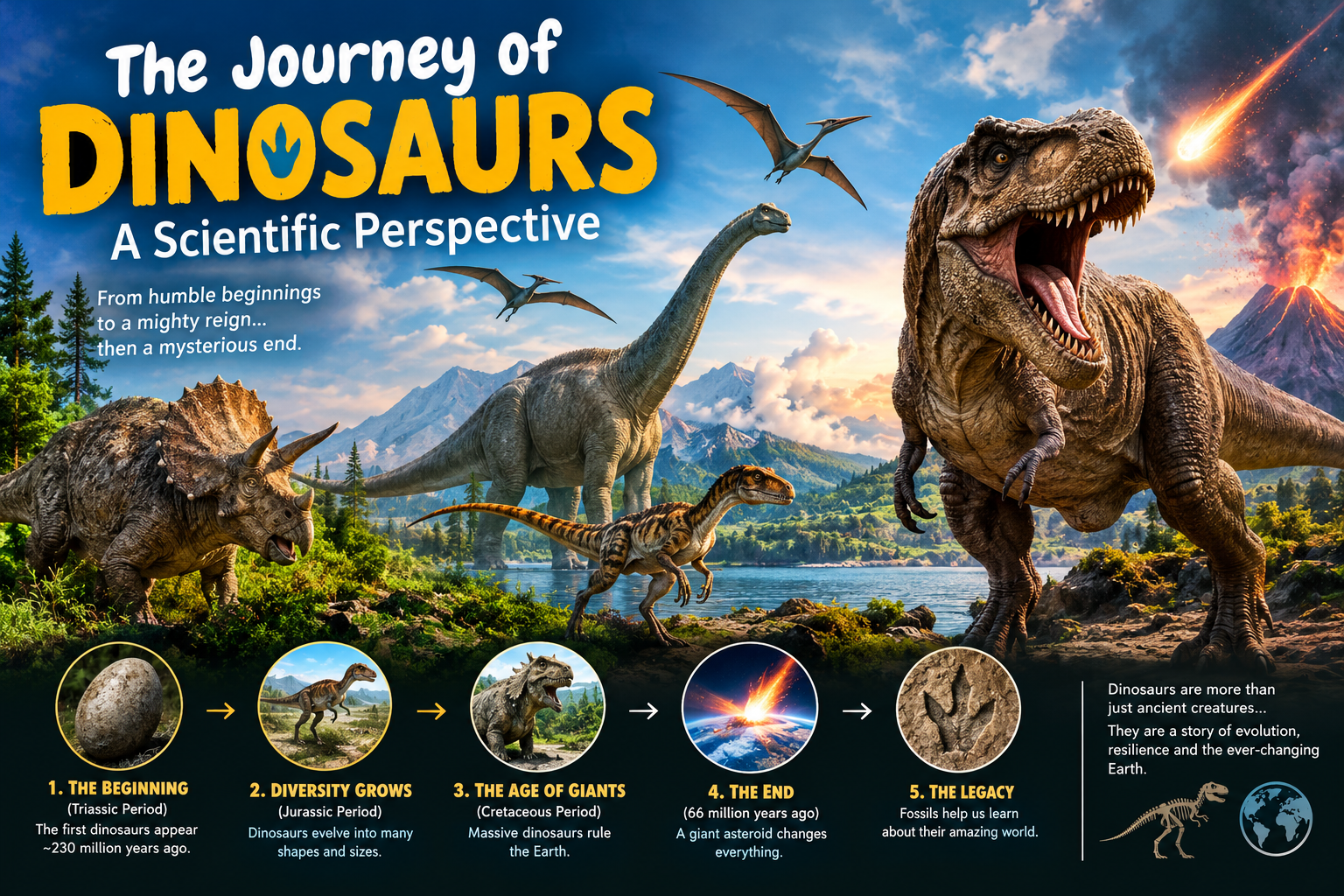
    Task topic **The Journey of Dinosaurs: A Scientific Perspective**

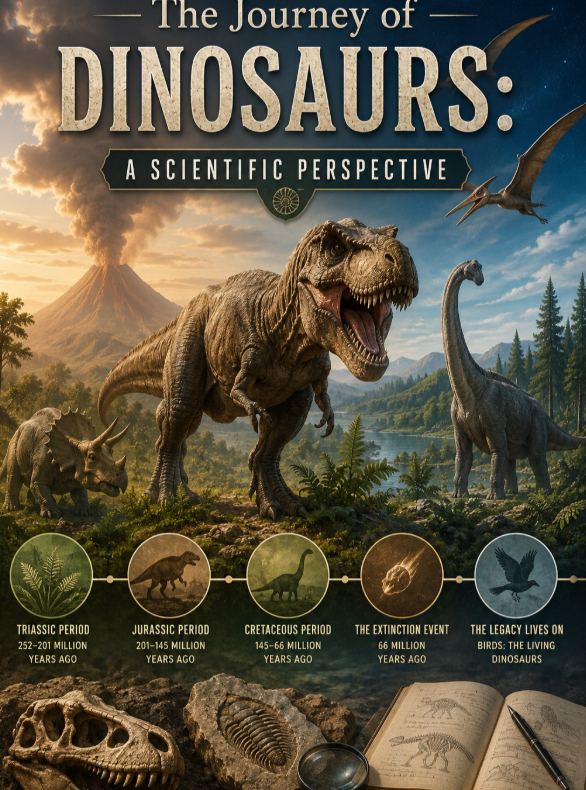
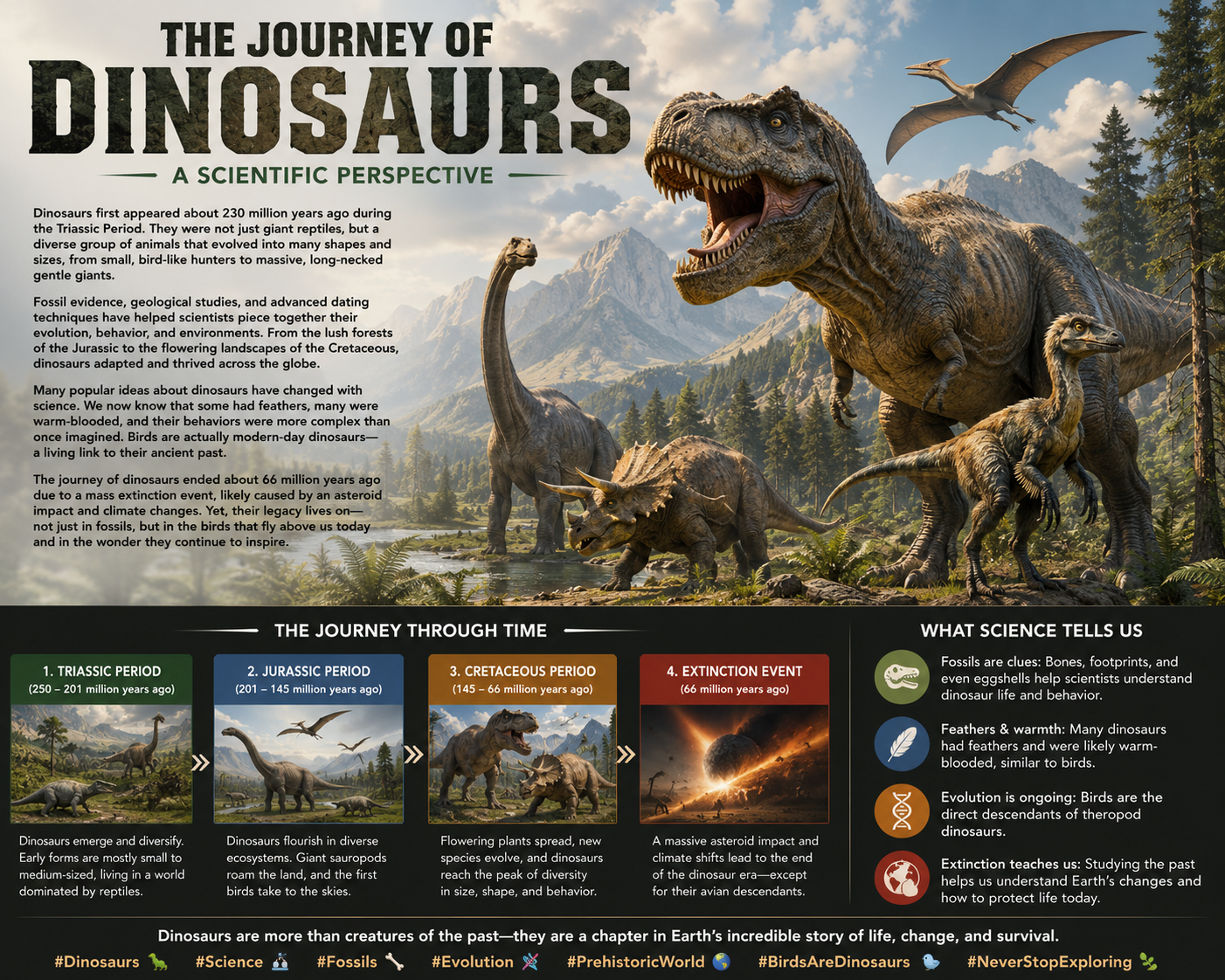
    Travel back millions of years and discover the amazing world of dinosaurs! From the first dinosaurs of the Triassic Period to the mighty giants of the Jurassic and Cretaceous Periods, explore how these incredible creatures lived, evolved, and ruled the Earth.

    Learn how scientists study fossils, discover new dinosaur species, and investigate the asteroid impact that caused the extinction of most dinosaurs about 66 million years ago.

    **What will you discover?**
    The origin and evolution of dinosaurs
    Their habitats, food, and daily lives
    The world's most famous dinosaur species
    The mystery behind dinosaur extinction
    How fossils help us understand Earth's history

    Dinosaurs are not just creatures of the past. Their story helps us understand evolution, nature, and the changing history of our planet. Did you know that modern birds are living descendants of dinosaurs?

    Like, Comment, Share, and Follow for more amazing science and educational content!

    #Dinosaurs #DinosaurJourney #Science #Paleontology #Fossils #Evolution #EarthHistory #JurassicPeriod #CretaceousPeriod #EducationalContent #ScienceLovers
    RSIF8 Roll no:81 Task no:48 Task topic🦖🌍 **The Journey of Dinosaurs: A Scientific Perspective** 🔬 Travel back millions of years and discover the amazing world of dinosaurs! 🦕✨ From the first dinosaurs of the Triassic Period to the mighty giants of the Jurassic and Cretaceous Periods, explore how these incredible creatures lived, evolved, and ruled the Earth. 🌋 Learn how scientists study fossils, discover new dinosaur species, and investigate the asteroid impact that caused the extinction of most dinosaurs about 66 million years ago. 🦴 **What will you discover?** 🔍 The origin and evolution of dinosaurs 🌿 Their habitats, food, and daily lives 🦖 The world's most famous dinosaur species ☄️ The mystery behind dinosaur extinction 🧪 How fossils help us understand Earth's history 💡 Dinosaurs are not just creatures of the past. Their story helps us understand evolution, nature, and the changing history of our planet. Did you know that modern birds are living descendants of dinosaurs? 🐦 👍 Like, 💬 Comment, 🔄 Share, and Follow for more amazing science and educational content! #Dinosaurs #DinosaurJourney #Science #Paleontology #Fossils #Evolution #EarthHistory #JurassicPeriod #CretaceousPeriod #EducationalContent #ScienceLovers 🦖🌍
    0 Kommentare 0 Anteile 1130 Ansichten
  • RSIF8
    Roll no 94
    Story post no 8
    Story post topic
    The Journey of Dinosaurs: A Scientific Perspective
    Step back in time and explore the incredible world of dinosaurs! From their rise during the Triassic Period to their dominance in the Jurassic and Cretaceous eras, dinosaurs shaped Earth's history in remarkable ways. Discover fascinating scientific facts, evolutionary changes, and the evidence that helps us understand these magnificent creatures millions of years later.
    Join me on this exciting journey through prehistoric life and uncover the mysteries of the ancient world!
    #Dinosaurs #Science #PrehistoricLife #Paleontology #Fossils #JurassicWorld #STEMEducation #LearningJourney #EarthHistory #ScientificPerspective #Education #Explore #Discovery
    RSIF8 Roll no 94 Story post no 8 Story post topic 🦖🌍 The Journey of Dinosaurs: A Scientific Perspective 🔬⏳ Step back in time and explore the incredible world of dinosaurs! From their rise during the Triassic Period to their dominance in the Jurassic and Cretaceous eras, dinosaurs shaped Earth's history in remarkable ways. 🦕✨ Discover fascinating scientific facts, evolutionary changes, and the evidence that helps us understand these magnificent creatures millions of years later. 🦴🔍 Join me on this exciting journey through prehistoric life and uncover the mysteries of the ancient world! 🌋🌿📚 #Dinosaurs #Science #PrehistoricLife #Paleontology #Fossils #JurassicWorld #STEMEducation #LearningJourney #EarthHistory #ScientificPerspective #Education #Explore #Discovery 🦖🔬
    0 Kommentare 0 Anteile 1532 Ansichten
  • RSIF8
    Roll no:85
    Task no:48
    Task topic: The Journey of Dinosaurs: A Scientific Perspective
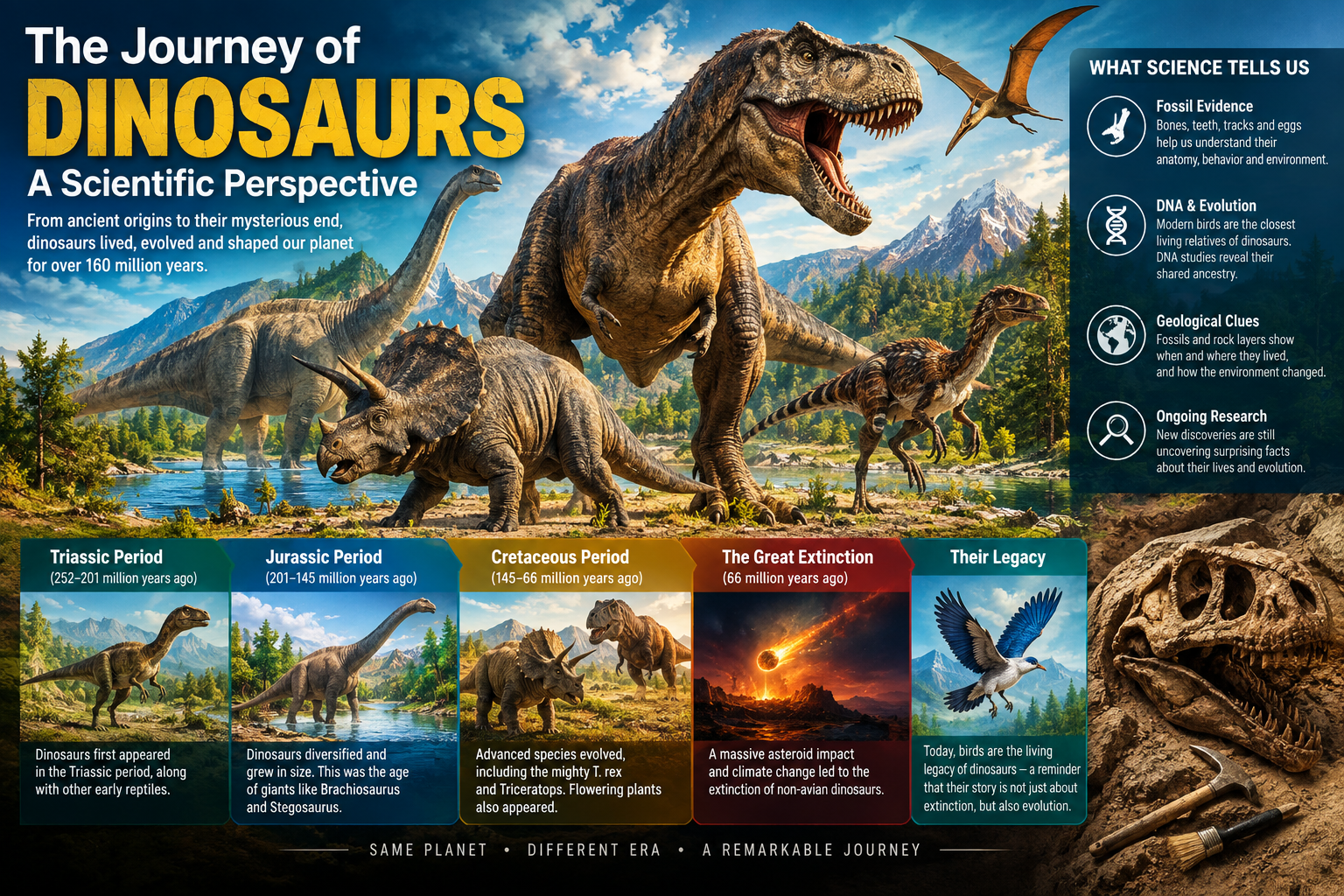
    Dinosaurs ruled our planet for more than 160 million years, evolving into countless species that ranged from tiny feathered hunters to gigantic plant-eating giants. Their incredible journey began during the Triassic Period and continued through the Jurassic and Cretaceous periods, shaping Earth's ecosystems in remarkable ways.

    Scientific discoveries through fossils have revealed fascinating details about dinosaur behavior, diets, and even their connection to modern birds. These ancient creatures adapted to changing environments and became one of the most successful groups of animals in Earth's history.

    Their story came to a dramatic end about 66 million years ago when a massive asteroid impact caused a global extinction event. However, the legacy of dinosaurs still lives on through birds, reminding us that evolution is a continuous and amazing process.

    Studying dinosaurs helps scientists understand Earth's past, climate changes, and the evolution of life itself. The journey of dinosaurs is not just a story of extinction—it's a powerful lesson about adaptation, survival, and the ever-changing nature of our planet.
    RSIF8 Roll no:85 Task no:48 Task topic: The Journey of Dinosaurs: A Scientific Perspective Dinosaurs ruled our planet for more than 160 million years, evolving into countless species that ranged from tiny feathered hunters to gigantic plant-eating giants. Their incredible journey began during the Triassic Period and continued through the Jurassic and Cretaceous periods, shaping Earth's ecosystems in remarkable ways. Scientific discoveries through fossils have revealed fascinating details about dinosaur behavior, diets, and even their connection to modern birds. These ancient creatures adapted to changing environments and became one of the most successful groups of animals in Earth's history. Their story came to a dramatic end about 66 million years ago when a massive asteroid impact caused a global extinction event. However, the legacy of dinosaurs still lives on through birds, reminding us that evolution is a continuous and amazing process. Studying dinosaurs helps scientists understand Earth's past, climate changes, and the evolution of life itself. The journey of dinosaurs is not just a story of extinction—it's a powerful lesson about adaptation, survival, and the ever-changing nature of our planet. 🌍
    0 Kommentare 0 Anteile 2025 Ansichten
  • RSIF8
    Roll no: 99
    Story Post No: 7
    Story Post Topic: The Journey of Dinosaurs: A Scientific Perspective
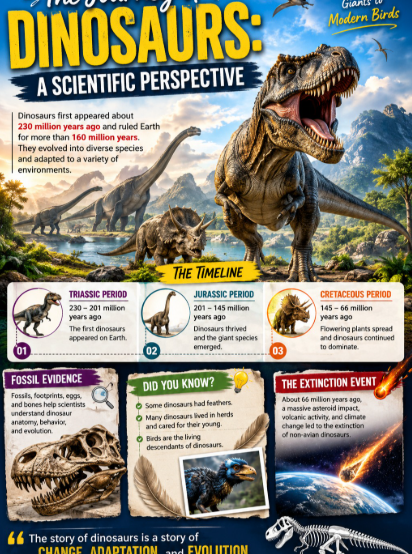
    Dinosaurs first appeared about 230 million years ago during the Triassic Period.
    Over millions of years, they evolved into many different species and sizes.
    Some were huge plant-eaters, while others were powerful predators.
    During the Jurassic and Cretaceous periods, dinosaurs became dominant across Earth.
    Scientists study fossils, bones, and footprints to understand how they lived.
    About 66 million years ago, a massive asteroid impact caused the extinction of most dinosaurs.
    However, one group survived and evolved into the birds we see today.
    The journey of dinosaurs shows how life can evolve, adapt, and survive through Earth's changing history.
    RSIF8 Roll no: 99 Story Post No: 7 Story Post Topic: The Journey of Dinosaurs: A Scientific Perspective Dinosaurs first appeared about 230 million years ago during the Triassic Period. Over millions of years, they evolved into many different species and sizes. Some were huge plant-eaters, while others were powerful predators. During the Jurassic and Cretaceous periods, dinosaurs became dominant across Earth. Scientists study fossils, bones, and footprints to understand how they lived. About 66 million years ago, a massive asteroid impact caused the extinction of most dinosaurs. However, one group survived and evolved into the birds we see today. The journey of dinosaurs shows how life can evolve, adapt, and survive through Earth's changing history.
    0 Kommentare 0 Anteile 1499 Ansichten
  • **Roll No: 2**
    **Batch: 14**
    **Book: ACCL**
    **Task No: 49**

    # The Journey of Dinosaurs: A Scientific Perspective

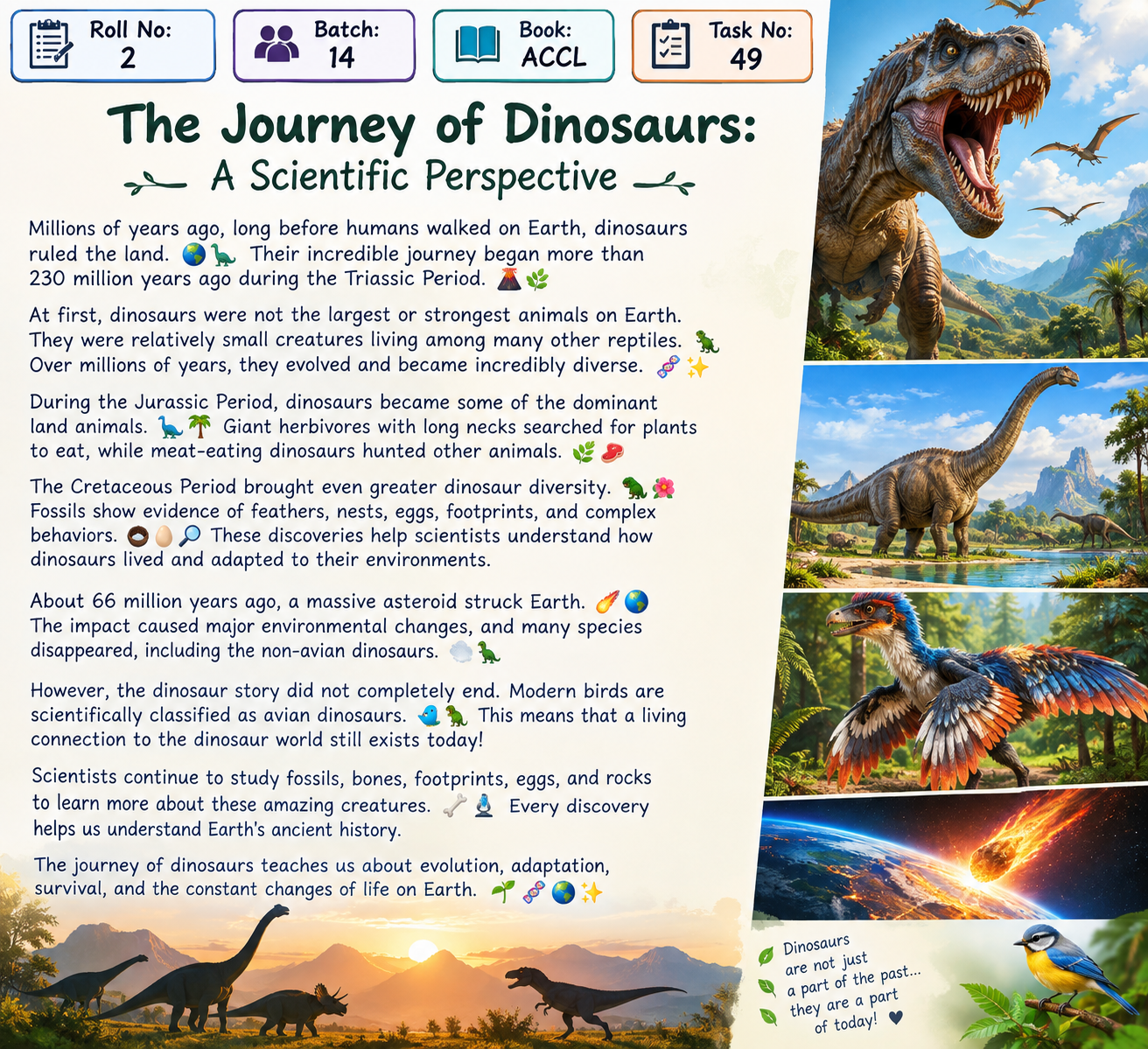
    Millions of years ago, long before humans walked on Earth, dinosaurs ruled the land. Their incredible journey began more than **230 million years ago** during the Triassic Period.

    At first, dinosaurs were not the largest or strongest animals on Earth. They were relatively small creatures living among many other reptiles. Over millions of years, they evolved and became incredibly diverse.

    During the **Jurassic Period**, dinosaurs became some of the dominant land animals. Giant herbivores with long necks searched for plants to eat, while meat-eating dinosaurs hunted other animals.

    The **Cretaceous Period** brought even greater dinosaur diversity. Fossils show evidence of feathers, nests, eggs, footprints, and complex behaviors. 🪺 These discoveries help scientists understand how dinosaurs lived and adapted to their environments.

    About **66 million years ago**, a massive asteroid struck Earth. The impact caused major environmental changes, and many species disappeared, including the non-avian dinosaurs.

    However, the dinosaur story did not completely end. Modern birds are scientifically classified as **avian dinosaurs**. This means that a living connection to the dinosaur world still exists today!

    Scientists continue to study fossils, bones, footprints, eggs, and rocks to learn more about these amazing creatures. Every discovery helps us understand Earth's ancient history.

    The journey of dinosaurs teaches us about evolution, adaptation, survival, and the constant changes of life on Earth.
    **Roll No: 2** **Batch: 14** **Book: ACCL** **Task No: 49** # 🦖 The Journey of Dinosaurs: A Scientific Perspective 🌍🔬 Millions of years ago, long before humans walked on Earth, dinosaurs ruled the land. 🌎🦕 Their incredible journey began more than **230 million years ago** during the Triassic Period. 🌋🌿 At first, dinosaurs were not the largest or strongest animals on Earth. They were relatively small creatures living among many other reptiles. 🦎 Over millions of years, they evolved and became incredibly diverse. 🧬✨ During the **Jurassic Period**, dinosaurs became some of the dominant land animals. 🦕🌴 Giant herbivores with long necks searched for plants to eat, while meat-eating dinosaurs hunted other animals. 🌿🥩 The **Cretaceous Period** brought even greater dinosaur diversity. 🦖🌺 Fossils show evidence of feathers, nests, eggs, footprints, and complex behaviors. 🪺🥚🔎 These discoveries help scientists understand how dinosaurs lived and adapted to their environments. About **66 million years ago**, a massive asteroid struck Earth. ☄️🌎 The impact caused major environmental changes, and many species disappeared, including the non-avian dinosaurs. 🌫️🦖 However, the dinosaur story did not completely end. Modern birds are scientifically classified as **avian dinosaurs**. 🐦🦖 This means that a living connection to the dinosaur world still exists today! Scientists continue to study fossils, bones, footprints, eggs, and rocks to learn more about these amazing creatures. 🦴🔬 Every discovery helps us understand Earth's ancient history. The journey of dinosaurs teaches us about evolution, adaptation, survival, and the constant changes of life on Earth. 🌱🧬🌍✨
    0 Kommentare 0 Anteile 1846 Ansichten
  • RSLC ROLL NO 80#
    FONDATION LEVEL Batch 06#
    task: 48
    DAY: 48

    The Journey of Dinosaurs: A Scientific Perspective

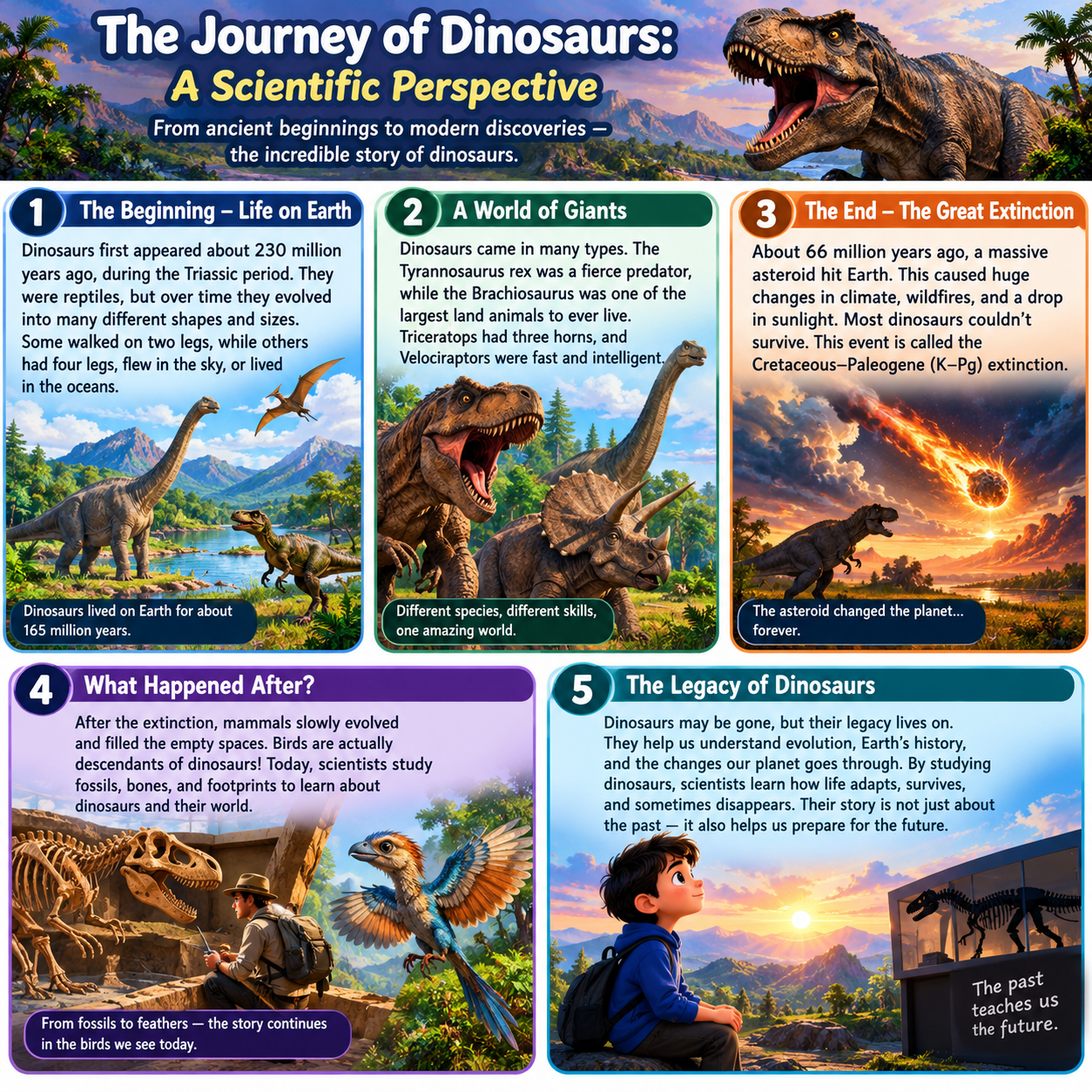
    Dinosaurs were a remarkable group of reptiles that lived on Earth for more than **165 million years**. They first appeared during the **Triassic Period**, about **230 million years ago**, and became one of the most successful groups of land animals in Earth’s history.

    Scientists learn about dinosaurs by studying **fossils**, including bones, teeth, footprints, eggs, and fossilized skin impressions. These discoveries help scientists understand how dinosaurs looked, moved, ate, and lived. Some dinosaurs were enormous plant-eaters, while others were powerful meat-eaters. Scientists have also discovered evidence that many dinosaurs had feathers, showing their close relationship with modern birds.

    About **66 million years ago**, a massive asteroid struck Earth near what is now Mexico. The impact caused major environmental changes, including darkness, cooling, and the collapse of many food chains. **Non-avian dinosaurs became extinct**, while some feathered dinosaurs survived and eventually evolved into the birds we see today.

    Today, dinosaurs continue to fascinate scientists. New fossils and research constantly improve our understanding of these ancient animals. Their story teaches us that **Earth is always changing and life must adapt to survive**. By studying the past, we can better understand our planet and the history of life.

    ### Moral

    **The story of dinosaurs teaches us that change is a natural part of life. By learning from the past and adapting to change, we can better understand and prepare for the future.**

    ### #Tags

    #Dinosaurs #Science #Fossils #Evolution #Paleontology
    RSLC ROLL NO 80# FONDATION LEVEL Batch 06# task: 48 DAY: 48 🦖 The Journey of Dinosaurs: A Scientific Perspective Dinosaurs were a remarkable group of reptiles that lived on Earth for more than **165 million years**. They first appeared during the **Triassic Period**, about **230 million years ago**, and became one of the most successful groups of land animals in Earth’s history. Scientists learn about dinosaurs by studying **fossils**, including bones, teeth, footprints, eggs, and fossilized skin impressions. These discoveries help scientists understand how dinosaurs looked, moved, ate, and lived. Some dinosaurs were enormous plant-eaters, while others were powerful meat-eaters. Scientists have also discovered evidence that many dinosaurs had feathers, showing their close relationship with modern birds. About **66 million years ago**, a massive asteroid struck Earth near what is now Mexico. The impact caused major environmental changes, including darkness, cooling, and the collapse of many food chains. **Non-avian dinosaurs became extinct**, while some feathered dinosaurs survived and eventually evolved into the birds we see today. Today, dinosaurs continue to fascinate scientists. New fossils and research constantly improve our understanding of these ancient animals. Their story teaches us that **Earth is always changing and life must adapt to survive**. By studying the past, we can better understand our planet and the history of life. ### 🌍 Moral **The story of dinosaurs teaches us that change is a natural part of life. By learning from the past and adapting to change, we can better understand and prepare for the future.** 🦖🌍 ### 🏷️ #Tags #Dinosaurs #Science #Fossils #Evolution #Paleontology
    0 Kommentare 0 Anteile 1533 Ansichten
  • #rsisb
    Roll no.279
    story post no.15
    Foundation Level
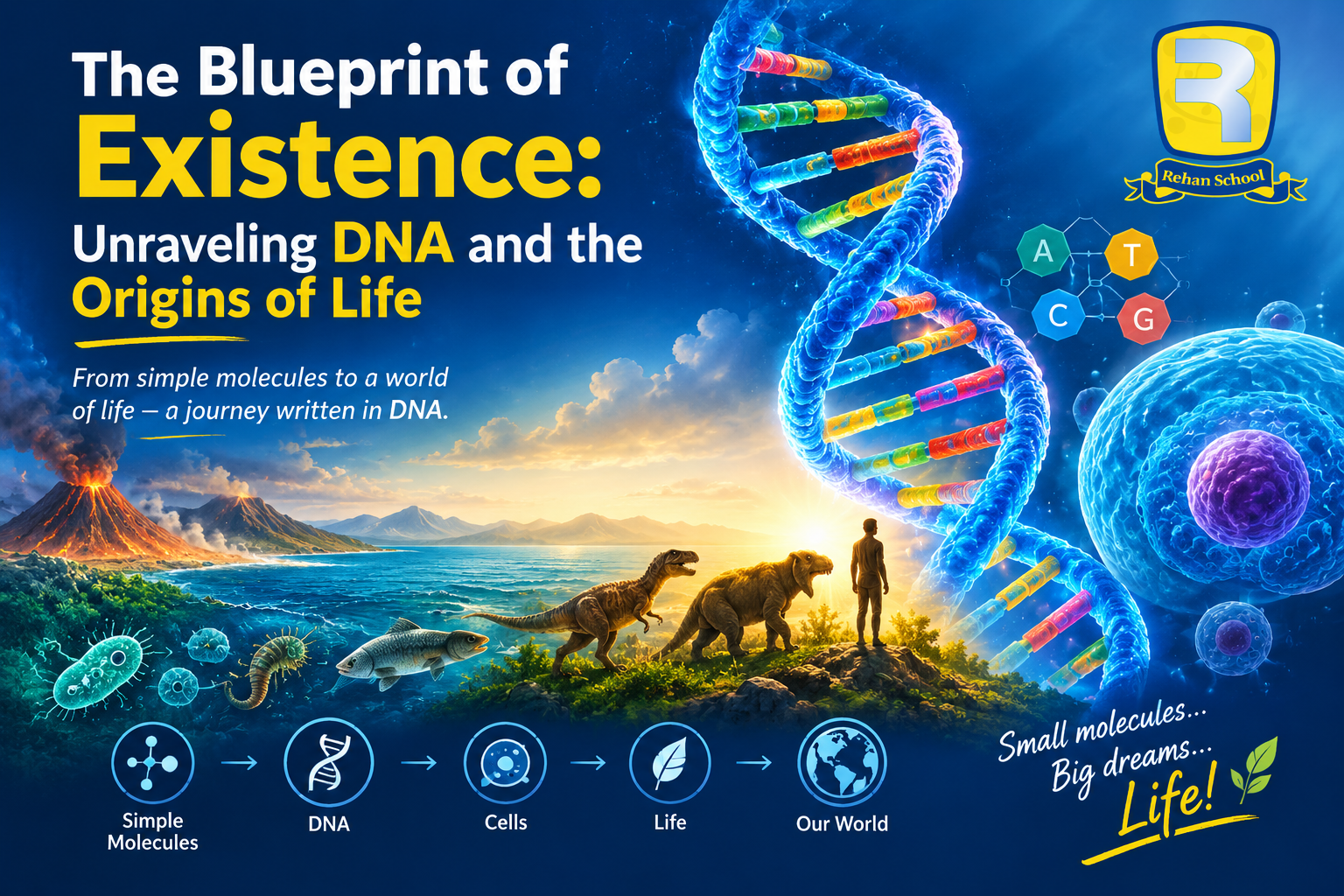
    # The Blueprint of Existence: Unraveling DNA and the Origins of Life
    Long before humans walked on Earth, before forests covered the land, and before animals filled the oceans, our planet was a young and mysterious world. Scientists believe that billions of years ago, the early Earth contained water, gases, minerals, and energy that created conditions where the first forms of life could eventually emerge.
    At the heart of life today is an incredible molecule called **DNA**. DNA carries biological information that helps living organisms grow, function, and reproduce. It is often described as a **blueprint of life** because it stores instructions used by cells to build and maintain an organism.
    Imagine DNA as a tiny library inside our cells. Every cell contains carefully organized information written in a chemical code. Four chemical bases—**A, T, C, and G**—form the language of DNA. Their arrangement creates instructions that cells can read and use.
    But how did life begin in the first place? Scientists are still investigating this enormous question. One idea is that simple chemical molecules on the early Earth gradually formed more complex molecules, eventually leading to systems capable of copying information and participating in early life processes.
    Over immense periods of time, life changed and diversified. From tiny microscopic organisms to enormous dinosaurs and eventually humans, the history of life is a remarkable story of change and adaptation.
    DNA connects all modern life in a fascinating way. Although organisms can look incredibly different, many of the fundamental processes of life are shared across living things. Studying DNA allows scientists to explore relationships between organisms and understand more about evolution and biology.
    The story of DNA reminds us that even the smallest structures can hold enormous importance. Inside microscopic cells lies information that helps make life possible—a remarkable connection between chemistry, biology, evolution, and the history of our planet.
    **The journey from simple molecules to the incredible diversity of life is one of science’s greatest mysteries—and there is still much left to discover.**
    #DNA #OriginsOfLife #Science #Biology #Genetics #Evolution #LifeOnEarth #ScientificDiscovery #Chemistry #Learning #Education #Technology #Curiosity
    Asma Shaheen EducationWali
    Saima Empowerment Wali
    Irum Asim Leadershipwali
    #rsisb Roll no.279 story post no.15 Foundation Level # 🧬 The Blueprint of Existence: Unraveling DNA and the Origins of Life 🌍✨ Long before humans walked on Earth, before forests covered the land, and before animals filled the oceans, our planet was a young and mysterious world. 🌋🌊✨ Scientists believe that billions of years ago, the early Earth contained water, gases, minerals, and energy that created conditions where the first forms of life could eventually emerge. 🌍🔬 At the heart of life today is an incredible molecule called **DNA**. 🧬 DNA carries biological information that helps living organisms grow, function, and reproduce. It is often described as a **blueprint of life** because it stores instructions used by cells to build and maintain an organism. 📖🔐 Imagine DNA as a tiny library inside our cells. 📚🔬 Every cell contains carefully organized information written in a chemical code. Four chemical bases—**A, T, C, and G**—form the language of DNA. Their arrangement creates instructions that cells can read and use. 🧬💡 But how did life begin in the first place? 🤔🌎 Scientists are still investigating this enormous question. One idea is that simple chemical molecules on the early Earth gradually formed more complex molecules, eventually leading to systems capable of copying information and participating in early life processes. ⚗️🌊🧪 Over immense periods of time, life changed and diversified. 🌱🐠🦕🦅 From tiny microscopic organisms to enormous dinosaurs and eventually humans, the history of life is a remarkable story of change and adaptation. 🌳🌍✨ DNA connects all modern life in a fascinating way. 🧬❤️ Although organisms can look incredibly different, many of the fundamental processes of life are shared across living things. Studying DNA allows scientists to explore relationships between organisms and understand more about evolution and biology. 🔬🌿 The story of DNA reminds us that even the smallest structures can hold enormous importance. 🧬✨ Inside microscopic cells lies information that helps make life possible—a remarkable connection between chemistry, biology, evolution, and the history of our planet. 🌍💫 **The journey from simple molecules to the incredible diversity of life is one of science’s greatest mysteries—and there is still much left to discover.** 🔬🚀🧬🌎 #DNA #OriginsOfLife #Science #Biology #Genetics #Evolution #LifeOnEarth #ScientificDiscovery #Chemistry #Learning #Education #Technology #Curiosity 🧬🔬🌍✨ Asma Shaheen EducationWali Saima Empowerment Wali Irum Asim Leadershipwali
    0 Kommentare 0 Anteile 1421 Ansichten
  • RSIF8
    Roll No 13
    Story post no 7
    story post topic **The Journey of Dinosaurs: A Scientific Perspective**

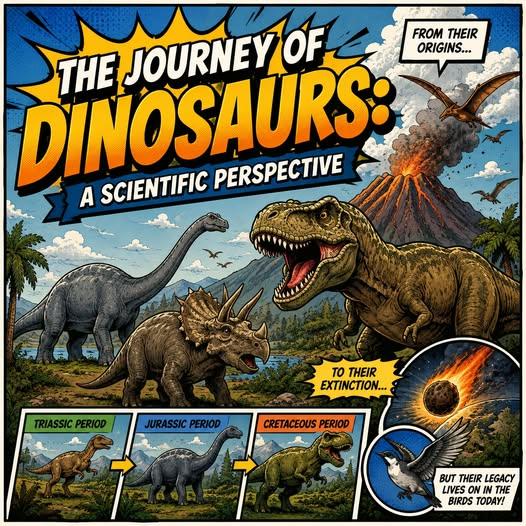
    Step back millions of years and explore the incredible journey of dinosaurs—from their emergence during the Triassic Period to their remarkable diversity in the Jurassic and Cretaceous Periods, and finally the mass extinction about 66 million years ago.

    This fascinating journey explores what science has discovered through **fossils, bones, footprints, geological evidence, and evolutionary research**. Discover how dinosaurs lived, evolved, adapted to changing environments, and left behind a lasting legacy through modern birds.

    From the mighty **T. rex** and enormous sauropods to armored dinosaurs and flying pterosaurs, their story continues to inspire scientists and uncover new mysteries about Earth's ancient past.

    **Explore the evidence. Discover the evolution. Travel through 160+ million years of dinosaur history!**

    #Dinosaurs #DinosaurHistory #Science #Paleontology #Evolution #Fossils #TyrannosaurusRex #Jurassic #Cretaceous #Triassic #AncientEarth #DinosaurFacts #ScientificPerspective #HistoryOfEarth
    RSIF8 Roll No 13 Story post no 7 story post topic 🦖 **The Journey of Dinosaurs: A Scientific Perspective** 🌍 Step back millions of years and explore the incredible journey of dinosaurs—from their emergence during the Triassic Period to their remarkable diversity in the Jurassic and Cretaceous Periods, and finally the mass extinction about 66 million years ago. 🦕🌋 This fascinating journey explores what science has discovered through **fossils, bones, footprints, geological evidence, and evolutionary research**. Discover how dinosaurs lived, evolved, adapted to changing environments, and left behind a lasting legacy through modern birds. 🐦🔬 From the mighty **T. rex** and enormous sauropods to armored dinosaurs and flying pterosaurs, their story continues to inspire scientists and uncover new mysteries about Earth's ancient past. 🔎 **Explore the evidence. Discover the evolution. Travel through 160+ million years of dinosaur history!** #Dinosaurs #DinosaurHistory #Science #Paleontology #Evolution #Fossils #TyrannosaurusRex #Jurassic #Cretaceous #Triassic #AncientEarth #DinosaurFacts #ScientificPerspective #HistoryOfEarth
    0 Kommentare 0 Anteile 3205 Ansichten
  • Mohsin #RSF8
    #Storypostt6
    Class: Foundation level
    Made by Me
    rool no:13
    The Journey of Dinosaurs: A Scientific Perspective

    Travel back hundreds of millions of years and discover the extraordinary story of dinosaurs—some of the most fascinating creatures to ever inhabit our planet. Their journey began during the Triassic Period, approximately 230 million years ago, when the Earth looked vastly different from the world we know today. Continents were joined together in a giant landmass called Pangaea, and early dinosaurs emerged as small, agile reptiles. Over time, these ancient creatures evolved into a diverse range of species, occupying nearly every ecological niche and becoming the dominant animals on Earth for more than 160 million years.

    During the Jurassic Period, dinosaurs flourished and diversified into countless forms. Massive herbivores such as Brachiosaurus and Diplodocus roamed lush forests, while formidable predators like Allosaurus hunted across vast landscapes. Their remarkable adaptations allowed them to thrive in changing environments, demonstrating the power of evolution and natural selection. As ecosystems became increasingly complex, dinosaurs developed specialized characteristics that enabled them to survive and dominate their habitats.

    The Cretaceous Period marked the peak of dinosaur diversity. Iconic species such as Tyrannosaurus rex, Triceratops, and Velociraptor appeared during this era. Scientists believe that many dinosaurs displayed advanced behaviors, including social interaction, parental care, and migration. Fossil evidence has even revealed that some dinosaurs possessed feathers, providing strong support for the evolutionary link between dinosaurs and modern birds. These discoveries have transformed our understanding of dinosaurs, showing that they were dynamic, intelligent, and highly adaptable creatures rather than the slow-moving reptiles once imagined.

    Our knowledge of dinosaurs comes primarily from the study of fossils. Paleontologists carefully examine fossilized bones, footprints, eggs, and even preserved skin impressions to reconstruct the lives of these prehistoric animals. Modern technologies.
    Mohsin #RSF8🎓✨ #Storypostt6 Class: Foundation level 📚 Made by Me 💻🚀 rool no:13 🦖 The Journey of Dinosaurs: A Scientific Perspective Travel back hundreds of millions of years and discover the extraordinary story of dinosaurs—some of the most fascinating creatures to ever inhabit our planet. Their journey began during the Triassic Period, approximately 230 million years ago, when the Earth looked vastly different from the world we know today. Continents were joined together in a giant landmass called Pangaea, and early dinosaurs emerged as small, agile reptiles. Over time, these ancient creatures evolved into a diverse range of species, occupying nearly every ecological niche and becoming the dominant animals on Earth for more than 160 million years. During the Jurassic Period, dinosaurs flourished and diversified into countless forms. Massive herbivores such as Brachiosaurus and Diplodocus roamed lush forests, while formidable predators like Allosaurus hunted across vast landscapes. Their remarkable adaptations allowed them to thrive in changing environments, demonstrating the power of evolution and natural selection. As ecosystems became increasingly complex, dinosaurs developed specialized characteristics that enabled them to survive and dominate their habitats. The Cretaceous Period marked the peak of dinosaur diversity. Iconic species such as Tyrannosaurus rex, Triceratops, and Velociraptor appeared during this era. Scientists believe that many dinosaurs displayed advanced behaviors, including social interaction, parental care, and migration. Fossil evidence has even revealed that some dinosaurs possessed feathers, providing strong support for the evolutionary link between dinosaurs and modern birds. These discoveries have transformed our understanding of dinosaurs, showing that they were dynamic, intelligent, and highly adaptable creatures rather than the slow-moving reptiles once imagined. Our knowledge of dinosaurs comes primarily from the study of fossils. Paleontologists carefully examine fossilized bones, footprints, eggs, and even preserved skin impressions to reconstruct the lives of these prehistoric animals. Modern technologies.
    0 Kommentare 0 Anteile 3106 Ansichten
Suchergebnis