• #rsisb
    Roll no. 253
    Story Post no. 08
    Foundation level
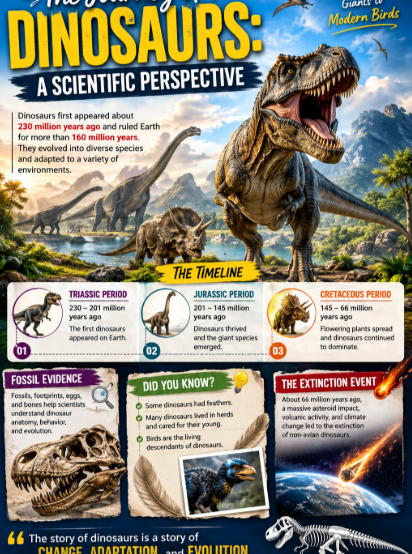
    ## The Journey of Dinosaurs: A Scientific Perspective
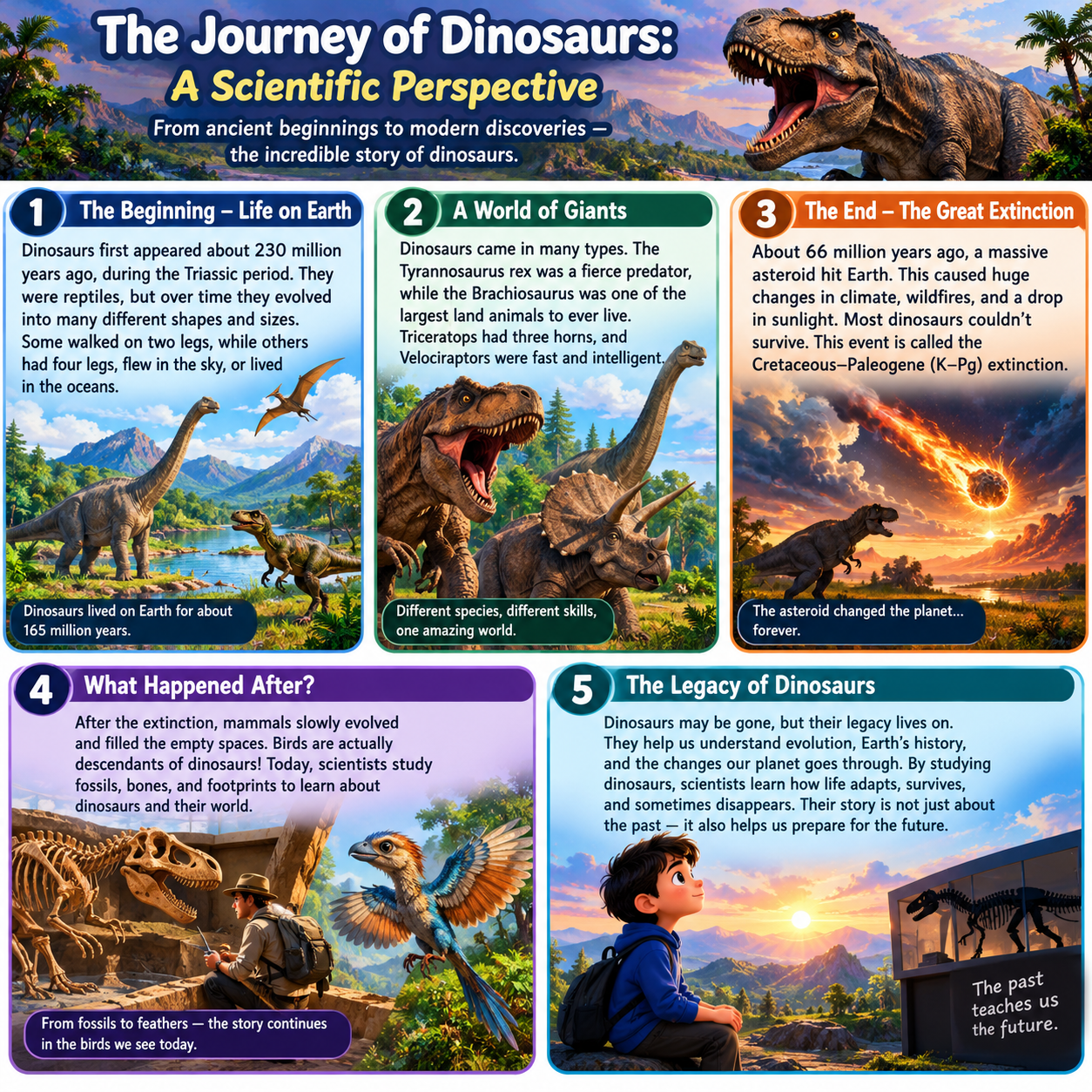
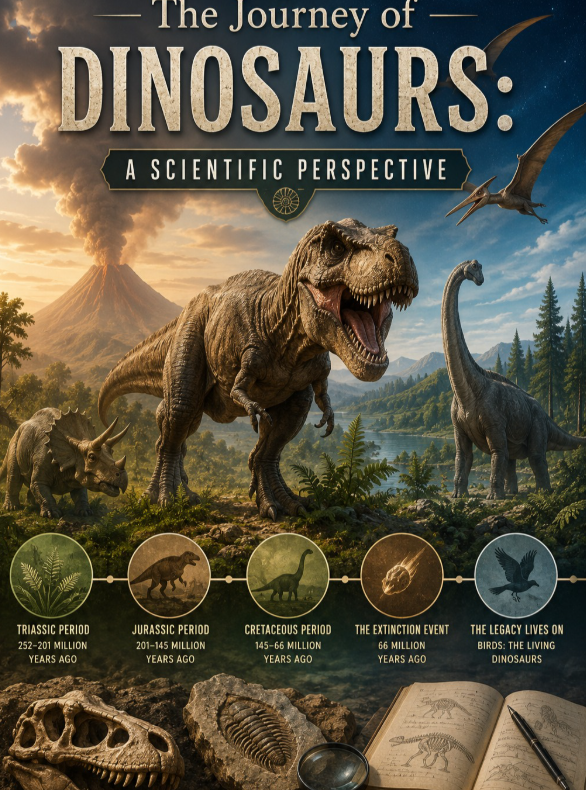
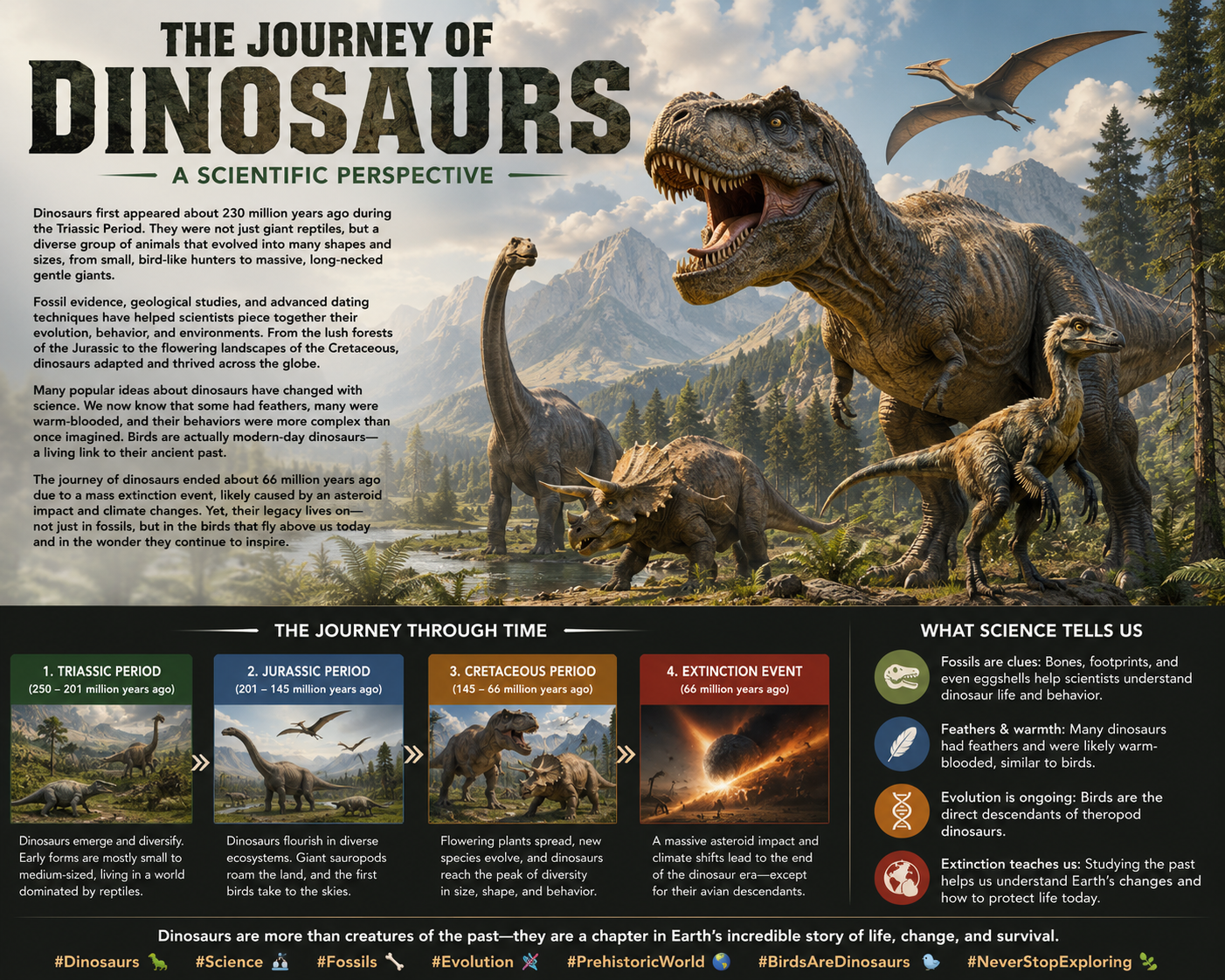
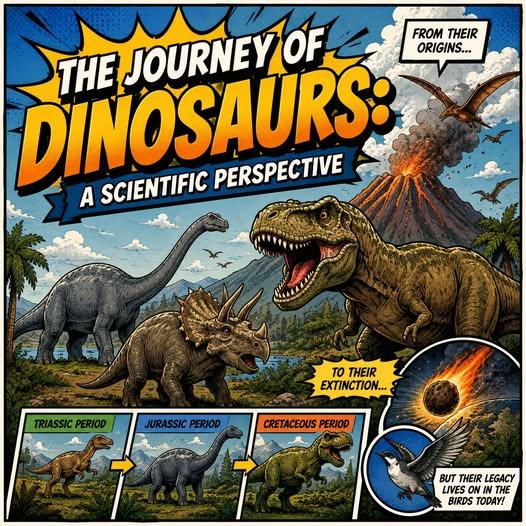
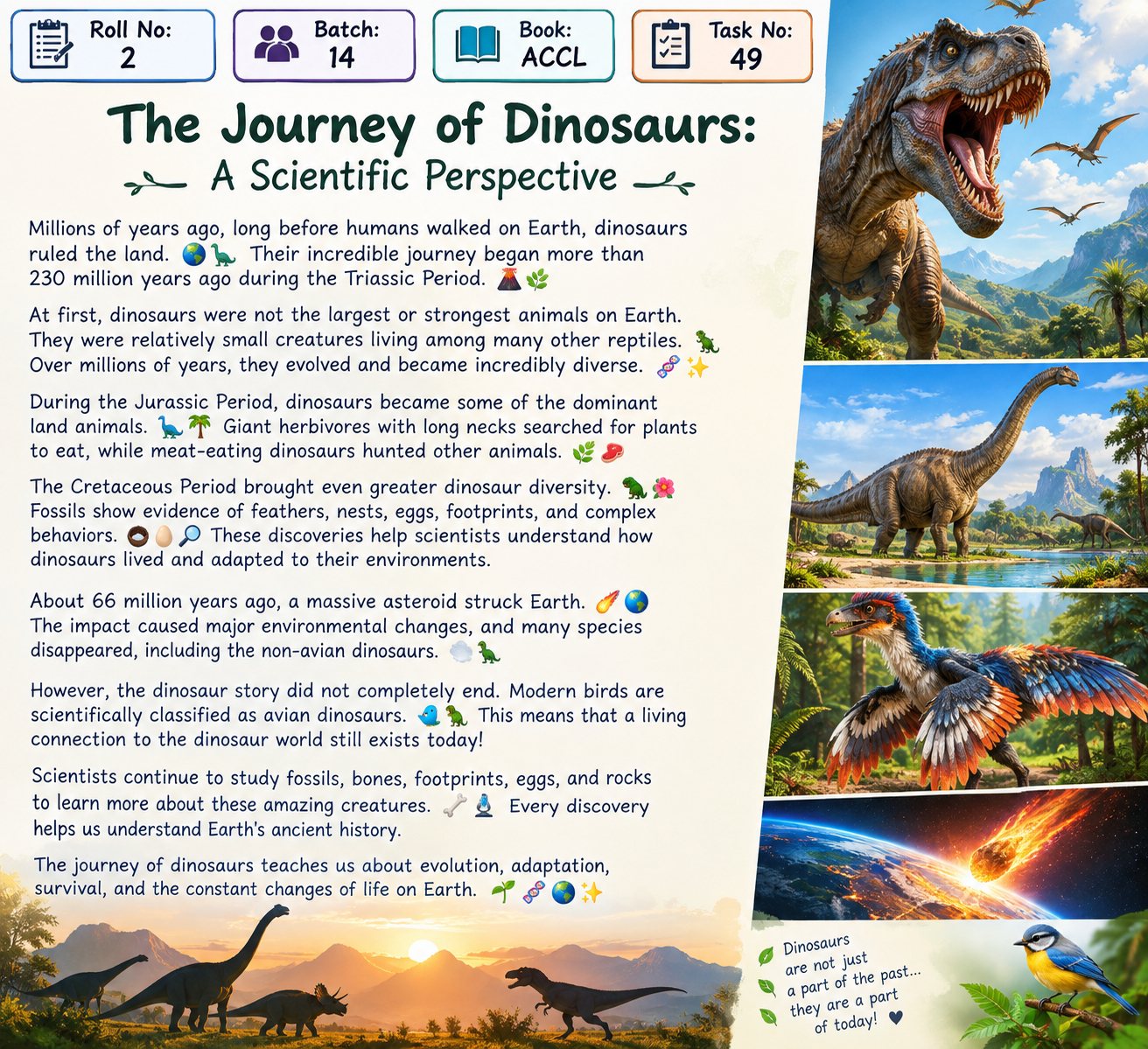
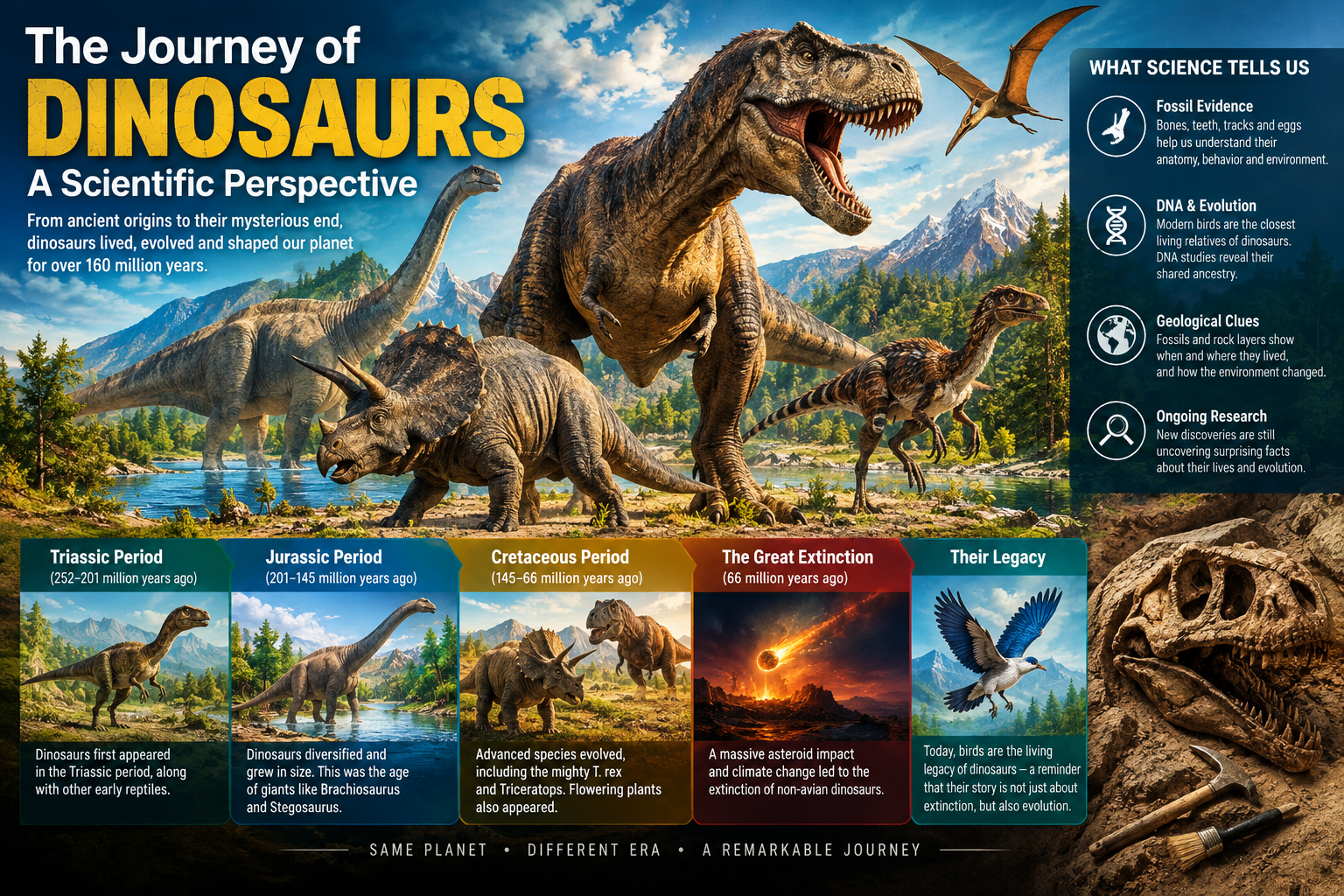
    Dinosaurs were extraordinary creatures that lived on Earth for more than 160 million years, dominating a wide variety of environments during the Triassic, Jurassic, and Cretaceous periods. Through the study of fossils, footprints, eggs, and bones, scientists have uncovered valuable information about how dinosaurs lived, evolved, and eventually became extinct around 66 million years ago. Modern technology and scientific research continue to reveal fascinating discoveries, helping us understand the connection between ancient dinosaurs and today's birds. Exploring the journey of dinosaurs inspires curiosity, encourages scientific thinking, and reminds us of the ever-changing history of life on our planet.
    ** Key Lesson:** *Fossils and scientific research help us uncover the history of dinosaurs and deepen our understanding of Earth's incredible past.*
    ** Tags:**
    #Dinosaurs #Paleontology #Science #Fossils #EarthHistory #Jurassic #Cretaceous #Triassic #STEM #Education #Learning #ScientificDiscovery #NaturalHistory #Biology #RehanSchool
    Asma Shaheen EducationWali
    Saima Happinesswali
    Irum Asim
    #rsisb Roll no. 253 Story Post no. 08 Foundation level ## 🦖🌍 The Journey of Dinosaurs: A Scientific Perspective Dinosaurs were extraordinary creatures that lived on Earth for more than 160 million years, dominating a wide variety of environments during the Triassic, Jurassic, and Cretaceous periods. Through the study of fossils, footprints, eggs, and bones, scientists have uncovered valuable information about how dinosaurs lived, evolved, and eventually became extinct around 66 million years ago. Modern technology and scientific research continue to reveal fascinating discoveries, helping us understand the connection between ancient dinosaurs and today's birds. Exploring the journey of dinosaurs inspires curiosity, encourages scientific thinking, and reminds us of the ever-changing history of life on our planet. 🔬🦴🌎 **📚 Key Lesson:** *Fossils and scientific research help us uncover the history of dinosaurs and deepen our understanding of Earth's incredible past.* **🏷️ Tags:** #Dinosaurs #Paleontology #Science #Fossils #EarthHistory #Jurassic #Cretaceous #Triassic #STEM #Education #Learning #ScientificDiscovery #NaturalHistory #Biology #RehanSchool 🦕🔬🌍 Asma Shaheen EducationWali Saima Happinesswali Irum Asim
    0 Commenti 0 condivisioni 2848 Views

  • #rsisb
    Roll no. 214
    Foundation level
    Story post no. 9
    The Journey of Dinosaurs: A Scientific Perspective**
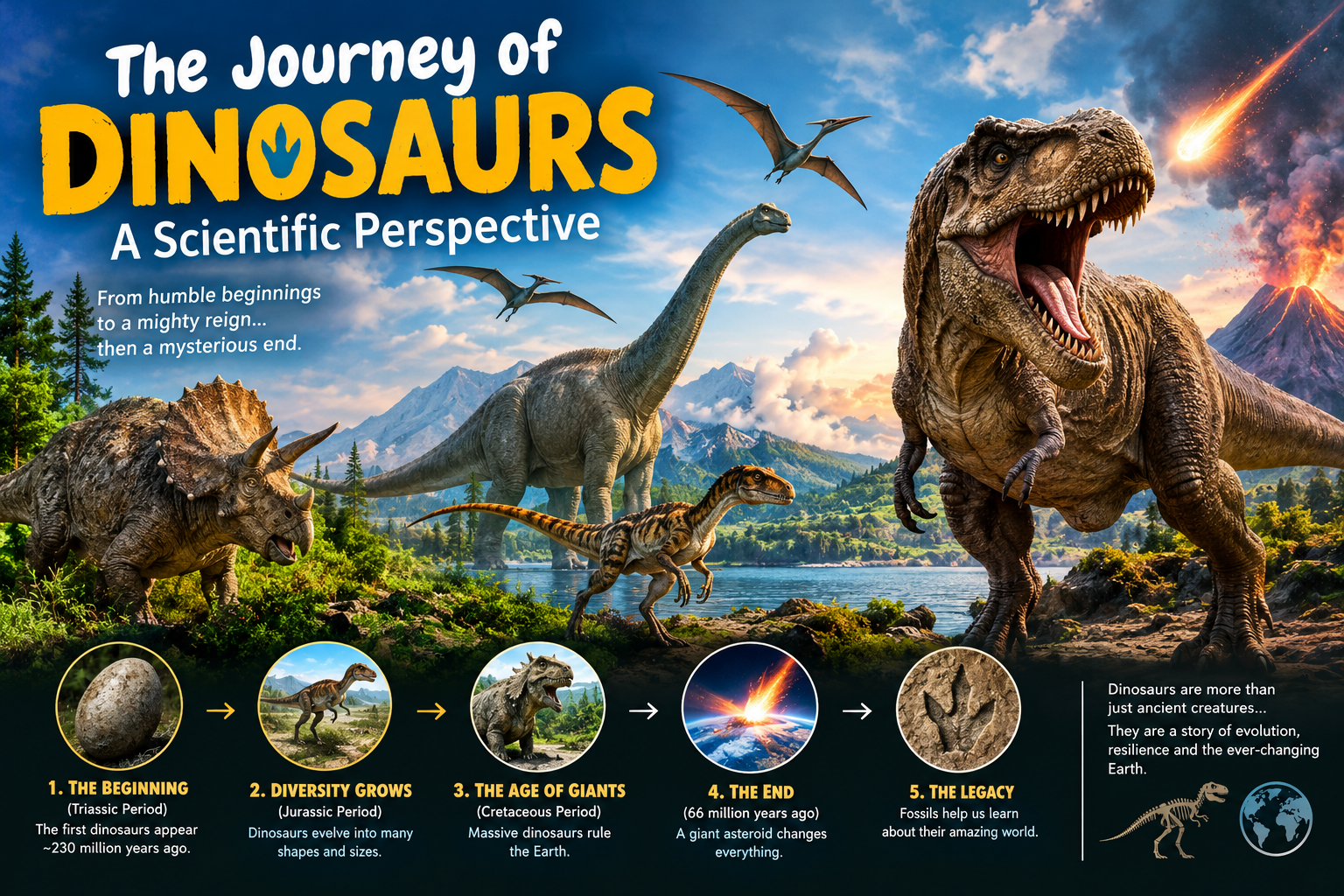
    Step back in time and explore the incredible world of dinosaurs! From their rise over 230 million years ago to their dominance of Earth and their eventual extinction, dinosaurs remain one of science's greatest mysteries. Fossils, footprints, and modern research continue to reveal fascinating insights into their lives, evolution, and the ancient environments they called home. Join us as we uncover the scientific story of these extraordinary creatures and discover how they shaped the history of our planet.
    Science helps us understand the past, inspires curiosity, and reminds us that our planet has an amazing history waiting to be explored!
    **#Dinosaurs #Science #Paleontology #Fossils #EarthHistory #Jurassic #Cretaceous #PrehistoricLife #Evolution #STEM #ScienceEducation #Nature #History #Learning #Discovery #AncientWorld #Geology #EducationalContent #ExploreScience #Knowledge
    #rsisb Roll no. 214 Foundation level Story post no. 9 The Journey of Dinosaurs: A Scientific Perspective** Step back in time and explore the incredible world of dinosaurs! From their rise over 230 million years ago to their dominance of Earth and their eventual extinction, dinosaurs remain one of science's greatest mysteries. Fossils, footprints, and modern research continue to reveal fascinating insights into their lives, evolution, and the ancient environments they called home. Join us as we uncover the scientific story of these extraordinary creatures and discover how they shaped the history of our planet. Science helps us understand the past, inspires curiosity, and reminds us that our planet has an amazing history waiting to be explored! **#Dinosaurs #Science #Paleontology #Fossils #EarthHistory #Jurassic #Cretaceous #PrehistoricLife #Evolution #STEM #ScienceEducation #Nature #History #Learning #Discovery #AncientWorld #Geology #EducationalContent #ExploreScience #Knowledge
    0 Commenti 0 condivisioni 2011 Views
  • The Day Heaven Touched Earth

    I woke up today to a sunrise so soft, so impossibly golden, it felt like the sky itself was smiling at me.
    The air smelled of jasmine and fresh rain, even though it hadn’t rained in days.
    A gentle whisper — Welcome. You made it. — brushed against my soul.

    I stepped outside.

    And there it was.
    The New World.


    Children raced past me on hover-skateboards, laughing, wearing clothes stitched with fibers of light.
    Old people sat under giant trees that sang songs tuned to their heartbeat — some meditated, some painted masterpieces in the air with their fingertips.
    Nobody was rushing. Nobody was worrying. Everyone was simply… being.

    Across the horizon, cities shimmered like living gardens.
    Skyscrapers were covered in vines of strawberries, tomatoes, and wildflowers, feeding anyone who passed by.
    Rivers ran clean again, so clear I could see the pebbles smiling at me from below.

    Above, solar kites floated — gathering infinite energy from the sun — keeping the planet charged with unlimited power, like a heartbeat that never tires.


    Food was abundant.
    I stopped by a community feast in the middle of the park.
    Bowls of mangoes, steaming breads, salads so colorful they looked photoshopped — all free, because here, hunger was as ancient a memory as dinosaurs.

    Health was a given.
    People carried no medicine bottles, no worried faces.
    Their bodies moved like poetry, every step a celebration of being alive.


    But what struck me the most… was the love.

    It wasn’t just romantic love — it was human love.
    Every glance, every conversation, every handshake carried the electric hum of “I see you. I honor you.”

    There were no strangers.
    Every person I met greeted me as if we had been best friends in a thousand past lives.


    Purpose flowed everywhere.
    I met a man teaching music to dolphins.
    A woman who grew trees that could “listen” to lonely souls.
    Kids inventing games that taught compassion better than any classroom ever could.

    Work was not about surviving.
    It was about expressing the art you were born to make.


    Freedom fluttered in every breath.
    Nobody was trapped by money, or rules designed to shrink the spirit.
    If you wanted to travel, you traveled.
    If you wanted to learn, you learned from holographic mentors that appeared instantly.
    If you wanted to rest, the world held space for your stillness without judgment.


    Creativity exploded like fireworks.
    Buildings shaped like musical instruments.
    Parks that changed colors based on the collective emotions of the people walking through them.
    Libraries that whispered stories to you the moment you touched their ancient doors.


    Gratitude buzzed everywhere.
    People didn’t just “say thank you.”
    They lived thank you — in every hug, every art piece, every community gathering around bonfires under the stars.


    Community wrapped around me like a warm cloak.
    Elders were honored as living libraries.
    Children were treated as sacred creators of the future.
    Everyone belonged. No one was left behind.


    Peace of Mind was no longer a luxury.
    It was the default setting.
    The past pains of humanity — fear, greed, war — were now museum exhibits:
    “Here lies the madness we once mistook for normal.”


    Playfulness sprinkled it all.
    In the streets, giant bubble machines filled the air with floating dreams.
    Adults played games without fear of looking silly.
    Every park had a festival happening — music, art, laughter twirling through the sunlight like confetti.


    And as I stood there… tears filled my eyes.

    Because I realized:
    This was not a dream.
    This was not heaven “later.”
    This was heaven now.

    We did it.
    We finally remembered who we are:
    Infinite, kind, wise, creative, unstoppable beings of love.


    I closed my eyes,
    lifted my face to the golden sky,
    and whispered with a voice trembling with joy:

    “Thank you for letting me live long enough to see this with my own eyes.”

    And somewhere in the distance,
    the Earth herself smiled back.


    The End. (Or rather, the real Beginning.)
    The Day Heaven Touched Earth I woke up today to a sunrise so soft, so impossibly golden, it felt like the sky itself was smiling at me. The air smelled of jasmine and fresh rain, even though it hadn’t rained in days. A gentle whisper — Welcome. You made it. — brushed against my soul. I stepped outside. And there it was. The New World. ⸻ Children raced past me on hover-skateboards, laughing, wearing clothes stitched with fibers of light. Old people sat under giant trees that sang songs tuned to their heartbeat — some meditated, some painted masterpieces in the air with their fingertips. Nobody was rushing. Nobody was worrying. Everyone was simply… being. Across the horizon, cities shimmered like living gardens. Skyscrapers were covered in vines of strawberries, tomatoes, and wildflowers, feeding anyone who passed by. Rivers ran clean again, so clear I could see the pebbles smiling at me from below. Above, solar kites floated — gathering infinite energy from the sun — keeping the planet charged with unlimited power, like a heartbeat that never tires. ⸻ Food was abundant. I stopped by a community feast in the middle of the park. Bowls of mangoes, steaming breads, salads so colorful they looked photoshopped — all free, because here, hunger was as ancient a memory as dinosaurs. Health was a given. People carried no medicine bottles, no worried faces. Their bodies moved like poetry, every step a celebration of being alive. ⸻ But what struck me the most… was the love. It wasn’t just romantic love — it was human love. Every glance, every conversation, every handshake carried the electric hum of “I see you. I honor you.” There were no strangers. Every person I met greeted me as if we had been best friends in a thousand past lives. ⸻ Purpose flowed everywhere. I met a man teaching music to dolphins. A woman who grew trees that could “listen” to lonely souls. Kids inventing games that taught compassion better than any classroom ever could. Work was not about surviving. It was about expressing the art you were born to make. ⸻ Freedom fluttered in every breath. Nobody was trapped by money, or rules designed to shrink the spirit. If you wanted to travel, you traveled. If you wanted to learn, you learned from holographic mentors that appeared instantly. If you wanted to rest, the world held space for your stillness without judgment. ⸻ Creativity exploded like fireworks. Buildings shaped like musical instruments. Parks that changed colors based on the collective emotions of the people walking through them. Libraries that whispered stories to you the moment you touched their ancient doors. ⸻ Gratitude buzzed everywhere. People didn’t just “say thank you.” They lived thank you — in every hug, every art piece, every community gathering around bonfires under the stars. ⸻ Community wrapped around me like a warm cloak. Elders were honored as living libraries. Children were treated as sacred creators of the future. Everyone belonged. No one was left behind. ⸻ Peace of Mind was no longer a luxury. It was the default setting. The past pains of humanity — fear, greed, war — were now museum exhibits: “Here lies the madness we once mistook for normal.” ⸻ Playfulness sprinkled it all. In the streets, giant bubble machines filled the air with floating dreams. Adults played games without fear of looking silly. Every park had a festival happening — music, art, laughter twirling through the sunlight like confetti. ⸻ And as I stood there… tears filled my eyes. Because I realized: This was not a dream. This was not heaven “later.” This was heaven now. We did it. We finally remembered who we are: Infinite, kind, wise, creative, unstoppable beings of love. ⸻ I closed my eyes, lifted my face to the golden sky, and whispered with a voice trembling with joy: “Thank you for letting me live long enough to see this with my own eyes.” And somewhere in the distance, the Earth herself smiled back. ⸻ The End. (Or rather, the real Beginning.)
    0 Commenti 0 condivisioni 953 Views
  • Spaceship Earth

    Right now…

    You are standing on a giant spaceship.

    Not metaphorically.
    Not poetically.

    Literally.

    Earth is a massive living spaceship carrying more than 8 billion humans through an endless dark universe.

    Most people never think about this.

    They wake up.
    Check WhatsApp.
    Go to work.
    Eat food.
    Sleep.

    But almost nobody pauses for one second and asks:

    “Where exactly are we?”


    Look around you.

    The ground feels still.

    But it is not still.

    At this very moment:

    * Earth is spinning at about 1,670 km per hour at the equator.
    * At the same time, Earth is orbiting around the Sun at about 107,000 km per hour.
    * Our entire solar system is moving through the Milky Way galaxy at around 828,000 km per hour.
    * And the galaxy itself is flying through the universe even faster.

    You feel none of it.

    A car moving at 120 km/h feels fast.

    An airplane at 900 km/h feels unbelievably fast.

    But you are already moving through space faster than any bullet train, jet, or rocket most humans will ever experience.

    And you are doing it right now while sitting quietly in a chair.


    Think about how strange this really is.

    We are tiny creatures made from atoms…

    standing on a wet rock…

    covered with a thin layer of air…

    floating in infinite darkness.

    No roads.
    No rails.
    No visible support system.

    Just silence.

    And yet this spaceship Earth perfectly carries forests, oceans, birds, clouds, whales, ants, cities, dreams, memories, music, and human emotions across the universe.


    The saddest part is not that we are on spaceship Earth.

    The saddest part is that most humans never become curious about it.

    A child looks at the sky and asks:

    * What are stars?
    * Where does space end?
    * Why are we here?

    But many adults stop asking.

    Bills replace curiosity.
    Routine replaces wonder.
    Notifications replace thinking.

    People become experts in celebrities…

    but know nothing about the spaceship they are living on.


    From space, there are no countries.

    No Pakistan.
    No India.
    No America.
    No Europe.

    Just one glowing blue spaceship.

    One atmosphere.

    One home.

    One species trying to survive together.

    The air you breathe today may contain molecules once breathed by:

    * Albert Einstein
    * Isaac Newton
    * dinosaurs
    * ancient kings
    * forgotten children from 5,000 years ago

    Everything on Earth is connected.

    The oceans connect us.
    The atmosphere connects us.
    The internet connects us.
    AI is beginning to connect human intelligence itself.

    Yet humans still fight over tiny divisions while flying together on the same spaceship.

    It is like passengers fighting over seats while the ship moves through an infinite cosmic ocean.


    And what is outside this spaceship?

    Darkness.

    Silence.

    Billions of galaxies.

    Possibly trillions of planets.

    Maybe other life.

    Maybe civilizations far older than ours.

    Maybe answers humanity has not even learned how to ask.

    We do not know.

    And that is exactly why curiosity matters.

    Curiosity created science.
    Curiosity created airplanes.
    Curiosity created the internet.
    Curiosity created AI.

    Every great human achievement began with someone asking:

    “Why?”

    or

    “What if?”


    Perhaps the real purpose of humanity is not just survival.

    Perhaps it is understanding.

    Understanding ourselves.
    Understanding consciousness.
    Understanding the universe.
    Understanding why anything exists at all.

    And maybe one day, humans will finally stop thinking like isolated tribes…

    and start thinking like the crew of Spaceship Earth.

    Because that is what we truly are.
    Spaceship Earth Right now… You are standing on a giant spaceship. Not metaphorically. Not poetically. Literally. Earth is a massive living spaceship carrying more than 8 billion humans through an endless dark universe. Most people never think about this. They wake up. Check WhatsApp. Go to work. Eat food. Sleep. But almost nobody pauses for one second and asks: “Where exactly are we?” ⸻ Look around you. The ground feels still. But it is not still. At this very moment: * Earth is spinning at about 1,670 km per hour at the equator. * At the same time, Earth is orbiting around the Sun at about 107,000 km per hour. * Our entire solar system is moving through the Milky Way galaxy at around 828,000 km per hour. * And the galaxy itself is flying through the universe even faster. You feel none of it. A car moving at 120 km/h feels fast. An airplane at 900 km/h feels unbelievably fast. But you are already moving through space faster than any bullet train, jet, or rocket most humans will ever experience. And you are doing it right now while sitting quietly in a chair. ⸻ Think about how strange this really is. We are tiny creatures made from atoms… standing on a wet rock… covered with a thin layer of air… floating in infinite darkness. No roads. No rails. No visible support system. Just silence. And yet this spaceship Earth perfectly carries forests, oceans, birds, clouds, whales, ants, cities, dreams, memories, music, and human emotions across the universe. ⸻ The saddest part is not that we are on spaceship Earth. The saddest part is that most humans never become curious about it. A child looks at the sky and asks: * What are stars? * Where does space end? * Why are we here? But many adults stop asking. Bills replace curiosity. Routine replaces wonder. Notifications replace thinking. People become experts in celebrities… but know nothing about the spaceship they are living on. ⸻ From space, there are no countries. No Pakistan. No India. No America. No Europe. Just one glowing blue spaceship. One atmosphere. One home. One species trying to survive together. The air you breathe today may contain molecules once breathed by: * Albert Einstein * Isaac Newton * dinosaurs * ancient kings * forgotten children from 5,000 years ago Everything on Earth is connected. The oceans connect us. The atmosphere connects us. The internet connects us. AI is beginning to connect human intelligence itself. Yet humans still fight over tiny divisions while flying together on the same spaceship. It is like passengers fighting over seats while the ship moves through an infinite cosmic ocean. ⸻ And what is outside this spaceship? Darkness. Silence. Billions of galaxies. Possibly trillions of planets. Maybe other life. Maybe civilizations far older than ours. Maybe answers humanity has not even learned how to ask. We do not know. And that is exactly why curiosity matters. Curiosity created science. Curiosity created airplanes. Curiosity created the internet. Curiosity created AI. Every great human achievement began with someone asking: “Why?” or “What if?” ⸻ Perhaps the real purpose of humanity is not just survival. Perhaps it is understanding. Understanding ourselves. Understanding consciousness. Understanding the universe. Understanding why anything exists at all. And maybe one day, humans will finally stop thinking like isolated tribes… and start thinking like the crew of Spaceship Earth. Because that is what we truly are.
    0 Commenti 0 condivisioni 781 Views
  • Scientists in China built a super-smart computer called Jiuzhang, which is very different from regular computers. It’s a quantum computer, which means it uses special science tricks like superposition (being in two places at once) and entanglement (particles being connected even far apart) to solve problems super quickly.

    Here’s how amazing it is: Jiuzhang solved a math problem in just 4 minutes that would take a normal supercomputer 2.6 billion years to figure out! That’s older than the dinosaurs!

    This computer is made of lasers, mirrors, and detectors that can count tiny particles of light called photons. Jiuzhang can count 76 photons at once, which is way better than regular computers that can only handle 5 photons. This special way of counting is called Gaussian boson sampling (a fancy name for the technique it uses).

    But how does a quantum computer like Jiuzhang work? Regular computers use tiny switches called “bits” to handle information. These bits can either be 0 or 1, like little light switches that are either off or on. Quantum computers use something much cooler called qubits (short for quantum bits). A qubit can be 0, 1, or even both at the same time! This happens because of a special science rule called superposition. Imagine flipping a coin, and instead of it landing heads or tails, it floats in between both at once.

    Quantum computers also use entanglement, which means qubits can “talk” to each other instantly, even if they’re far apart. This teamwork between qubits helps quantum computers test many possibilities at the same time, making them much faster at solving very hard problems.

    Why does this matter? Well, Jiuzhang’s abilities could help solve tricky problems in areas like chemistry, math, and even create a super-fast quantum internet. It’s not just a faster version of regular computers—it’s like a whole new way of thinking about how to solve problems!
    Scientists in China built a super-smart computer called Jiuzhang, which is very different from regular computers. It’s a quantum computer, which means it uses special science tricks like superposition (being in two places at once) and entanglement (particles being connected even far apart) to solve problems super quickly. Here’s how amazing it is: Jiuzhang solved a math problem in just 4 minutes that would take a normal supercomputer 2.6 billion years to figure out! That’s older than the dinosaurs! This computer is made of lasers, mirrors, and detectors that can count tiny particles of light called photons. Jiuzhang can count 76 photons at once, which is way better than regular computers that can only handle 5 photons. This special way of counting is called Gaussian boson sampling (a fancy name for the technique it uses). But how does a quantum computer like Jiuzhang work? Regular computers use tiny switches called “bits” to handle information. These bits can either be 0 or 1, like little light switches that are either off or on. Quantum computers use something much cooler called qubits (short for quantum bits). A qubit can be 0, 1, or even both at the same time! This happens because of a special science rule called superposition. Imagine flipping a coin, and instead of it landing heads or tails, it floats in between both at once. Quantum computers also use entanglement, which means qubits can “talk” to each other instantly, even if they’re far apart. This teamwork between qubits helps quantum computers test many possibilities at the same time, making them much faster at solving very hard problems. Why does this matter? Well, Jiuzhang’s abilities could help solve tricky problems in areas like chemistry, math, and even create a super-fast quantum internet. It’s not just a faster version of regular computers—it’s like a whole new way of thinking about how to solve problems!
    0 Commenti 0 condivisioni 227 Views
  • Rexy the Dinosaur and the Power of Kindness

    In a lush green valley millions of years ago, lived a young T. rex named Rexy. Unlike other dinosaurs who used their size to scare others, Rexy had a gentle heart. The other dinosaurs laughed at him for being too soft.

    One day, a wildfire spread through the valley. While the stronger dinosaurs ran to save themselves, Rexy noticed a group of small, helpless dinos trapped under a fallen tree. Without thinking twice, Rexy rushed back, used his strong jaws to lift the tree, and guided the little ones to safety.

    When the fire ended, the entire dinosaur community praised Rexy. They realized that strength isn't just about power—it’s about using it to help others.

    Moral: True strength lies in kindness and compassion.

    LEVEL: 02 TASK
    STORY POST: 63

    @followers
    Rexy the Dinosaur and the Power of Kindness In a lush green valley millions of years ago, lived a young T. rex named Rexy. Unlike other dinosaurs who used their size to scare others, Rexy had a gentle heart. The other dinosaurs laughed at him for being too soft. One day, a wildfire spread through the valley. While the stronger dinosaurs ran to save themselves, Rexy noticed a group of small, helpless dinos trapped under a fallen tree. Without thinking twice, Rexy rushed back, used his strong jaws to lift the tree, and guided the little ones to safety. When the fire ended, the entire dinosaur community praised Rexy. They realized that strength isn't just about power—it’s about using it to help others. Moral: True strength lies in kindness and compassion. LEVEL: 02 TASK STORY POST: 63 @followers
    0 Commenti 0 condivisioni 315 Views
  • ** ACCl Task 36 – Day 48: The Journey of Dinosaurs: A Scientific Perspective **

    I have successfully completed my thirty-sixth ACCl task titled **“The Journey of Dinosaurs: A Scientific Perspective”** .
    This task helped me explore how **dinosaurs lived, evolved, and disappeared**, deepening my understanding of Earth’s ancient history and the science of evolution .

    Part I: The Rise of Argentumdraco The world was the Mesozoic Era, a sprawling, humid greenhouse, and in the heart of what would one day be the Patagonia desert, the first Argentumdraco ("Silver Dragon") hatched. It was the early Late Cretaceous period, about 95 million years ago. Argentumdraco magnificens was a magnificent specimen of the Titanosauria, a subclass of the long-necked, plant-eating Sauropods.Unlike its ancient, bulkier ancestors, the Argentumdraco possessed a relatively slender frame, a long, flexible neck used to graze on the canopy's highest cycads and conifers, and skin that, when wet, shimmered with a faint, silvery-green iridescence—hence its name. Its feet, like those of all sauropods, were columnar, built for supporting its $60$-ton mass across the moist floodplain.The young Argentumdraco, who the paleontologists of the future would affectionately nickname "Ares," grew fast. His life was a constant, slow-motion migration, following the seasonal blooms of vegetation and avoiding the razor-toothed gaze of the massive Giganotosaurus that patrolled the forests. For millions of years, the species thrived. They were the undisputed, slow-moving monarchs of their ecosystem, a testament to evolutionary success.Part II: The Shadow of Chicxulub Then, $66$ million years ago, the environment began to subtly shift. Volcanic activity had been increasing across the globe—the Deccan Traps were pouring out vast sheets of lava and gas—straining the atmosphere. Ares, now old and scarred, felt the dryness in the air and the increasing scarcity of his preferred equatorial ferns.The true cataclysm, however, came in the form of a blinding flash from above. A massive asteroid, estimated to be $10$ kilometers wide, hurtled into the shallow waters of the Yucatán Peninsula, near what is now Chicxulub.The immediate effects were devastating: an immense shockwave, tsunamis, and a fiery blast that ignited global wildfires. But it was the aftermath that truly sealed the fate of the dinosaurs. The impact hurled colossal amounts of dust, soot, and sulfur aerosols into the stratosphere, blocking out the sun and plunging the Earth into years of "impact winter."Ares and his herd, thousands of miles away, did not die in the blast. They died of starvation. As the darkness persisted, photosynthesis failed. The massive ferns and conifers withered. Ares's immense bulk, once an advantage in warding off predators, became a metabolic liability. His $60$-ton body simply required too much energy from a world that had none left to give. Ares was among the last of his kind, his final resting place a muddy riverbed, an end not of violence, but of slow, cold inevitability.Part III: The Legacy of a Bone For $66$ million years, Ares's fossilized skeleton lay undisturbed. The continents drifted, the climate cooled, and new life—the small, resilient mammals that had scurried in the dinosaurs' shadow—inherited the Earth.Then, in the 21st century, a team of paleontologists, using geological mapping and seismic surveys, unearthed Ares's massive femur. It was enormous, a pale, petrified column of calcium and time.The scientists named the site "The Silver Bed." Through painstaking excavation and laboratory analysis, they didn't just find a skeleton; they reconstructed a story.CT scans revealed lines of arrested growth, like tree rings, detailing Ares's rapid juvenile growth rate.Geochemical analysis of the rock surrounding the bones confirmed the precise dating—$95.2 \pm 0.4$ million years ago.The unique pelvic structure was analyzed, helping to refine the evolutionary tree of sauropods.Ares, the Argentumdraco, became a key piece of the puzzle, a Type Specimen illustrating the magnificence of the dinosaurian world and the fragility of even the greatest life forms against a cosmic event.The scientists realized that while the asteroid wiped out all non-avian dinosaurs, it didn't truly end the dinosaur journey. The small, feathered theropods—birds—survived. The robin on your windowsill and the mighty Argentumdraco share an ancient, unbroken lineage.Ares’s bone now rests in a museum, a silent, monumental testament to a biological empire that spanned $165$ million years. It is a scientific narrative written in stone: the ultimate power of evolution, the devastating force of extinction, and the endless cycle of life on a tumultuous planet.
    **📘 ACCl Task 36 – Day 48: The Journey of Dinosaurs: A Scientific Perspective 🦖** I have successfully completed my thirty-sixth ACCl task titled **“The Journey of Dinosaurs: A Scientific Perspective”** 🌍. This task helped me explore how **dinosaurs lived, evolved, and disappeared**, deepening my understanding of Earth’s ancient history and the science of evolution 🔬✨. Part I: The Rise of Argentumdraco 🌍The world was the Mesozoic Era, a sprawling, humid greenhouse, and in the heart of what would one day be the Patagonia desert, the first Argentumdraco ("Silver Dragon") hatched. It was the early Late Cretaceous period, about 95 million years ago. Argentumdraco magnificens was a magnificent specimen of the Titanosauria, a subclass of the long-necked, plant-eating Sauropods.Unlike its ancient, bulkier ancestors, the Argentumdraco possessed a relatively slender frame, a long, flexible neck used to graze on the canopy's highest cycads and conifers, and skin that, when wet, shimmered with a faint, silvery-green iridescence—hence its name. Its feet, like those of all sauropods, were columnar, built for supporting its $60$-ton mass across the moist floodplain.The young Argentumdraco, who the paleontologists of the future would affectionately nickname "Ares," grew fast. His life was a constant, slow-motion migration, following the seasonal blooms of vegetation and avoiding the razor-toothed gaze of the massive Giganotosaurus that patrolled the forests. For millions of years, the species thrived. They were the undisputed, slow-moving monarchs of their ecosystem, a testament to evolutionary success.Part II: The Shadow of Chicxulub 🔥Then, $66$ million years ago, the environment began to subtly shift. Volcanic activity had been increasing across the globe—the Deccan Traps were pouring out vast sheets of lava and gas—straining the atmosphere. Ares, now old and scarred, felt the dryness in the air and the increasing scarcity of his preferred equatorial ferns.The true cataclysm, however, came in the form of a blinding flash from above. A massive asteroid, estimated to be $10$ kilometers wide, hurtled into the shallow waters of the Yucatán Peninsula, near what is now Chicxulub.The immediate effects were devastating: an immense shockwave, tsunamis, and a fiery blast that ignited global wildfires. But it was the aftermath that truly sealed the fate of the dinosaurs. The impact hurled colossal amounts of dust, soot, and sulfur aerosols into the stratosphere, blocking out the sun and plunging the Earth into years of "impact winter."Ares and his herd, thousands of miles away, did not die in the blast. They died of starvation. As the darkness persisted, photosynthesis failed. The massive ferns and conifers withered. Ares's immense bulk, once an advantage in warding off predators, became a metabolic liability. His $60$-ton body simply required too much energy from a world that had none left to give. Ares was among the last of his kind, his final resting place a muddy riverbed, an end not of violence, but of slow, cold inevitability.Part III: The Legacy of a Bone 🦴For $66$ million years, Ares's fossilized skeleton lay undisturbed. The continents drifted, the climate cooled, and new life—the small, resilient mammals that had scurried in the dinosaurs' shadow—inherited the Earth.Then, in the 21st century, a team of paleontologists, using geological mapping and seismic surveys, unearthed Ares's massive femur. It was enormous, a pale, petrified column of calcium and time.The scientists named the site "The Silver Bed." Through painstaking excavation and laboratory analysis, they didn't just find a skeleton; they reconstructed a story.CT scans revealed lines of arrested growth, like tree rings, detailing Ares's rapid juvenile growth rate.Geochemical analysis of the rock surrounding the bones confirmed the precise dating—$95.2 \pm 0.4$ million years ago.The unique pelvic structure was analyzed, helping to refine the evolutionary tree of sauropods.Ares, the Argentumdraco, became a key piece of the puzzle, a Type Specimen illustrating the magnificence of the dinosaurian world and the fragility of even the greatest life forms against a cosmic event.The scientists realized that while the asteroid wiped out all non-avian dinosaurs, it didn't truly end the dinosaur journey. The small, feathered theropods—birds—survived. The robin on your windowsill and the mighty Argentumdraco share an ancient, unbroken lineage.Ares’s bone now rests in a museum, a silent, monumental testament to a biological empire that spanned $165$ million years. It is a scientific narrative written in stone: the ultimate power of evolution, the devastating force of extinction, and the endless cycle of life on a tumultuous planet.
    0 Commenti 0 condivisioni 410 Views
  • ACCL Day 48
    "The Journey of Dinosaurs: A Scientific Perspective"

    Millions of years ago, long before humans walked the Earth, dinosaurs ruled the land, sky, and seas. From the gigantic Brachiosaurus grazing on treetops to the fierce Tyrannosaurus Rex hunting its prey, these magnificent creatures shaped the prehistoric world.

    Through fossils and scientific research, weve uncovered their mysterious journey — how they lived, evolved, and eventually disappeared due to dramatic changes in Earths environment.

    Their story reminds us how powerful and fragile life can be, leaving behind a legacy written in stone.

    Imran Khan Street Wala
    🦕 ACCL Day 48 "The Journey of Dinosaurs: A Scientific Perspective" Millions of years ago, long before humans walked the Earth, dinosaurs ruled the land, sky, and seas. From the gigantic Brachiosaurus grazing on treetops to the fierce Tyrannosaurus Rex hunting its prey, these magnificent creatures shaped the prehistoric world. Through fossils and scientific research, we've uncovered their mysterious journey — how they lived, evolved, and eventually disappeared due to dramatic changes in Earth's environment. 🌍✨ Their story reminds us how powerful and fragile life can be, leaving behind a legacy written in stone. ⏳🦖 Imran Khan Street Wala
    0 Commenti 0 condivisioni 443 Views