• #rsisb
    Roll no. 247
    Story post . 29
    Foundation level

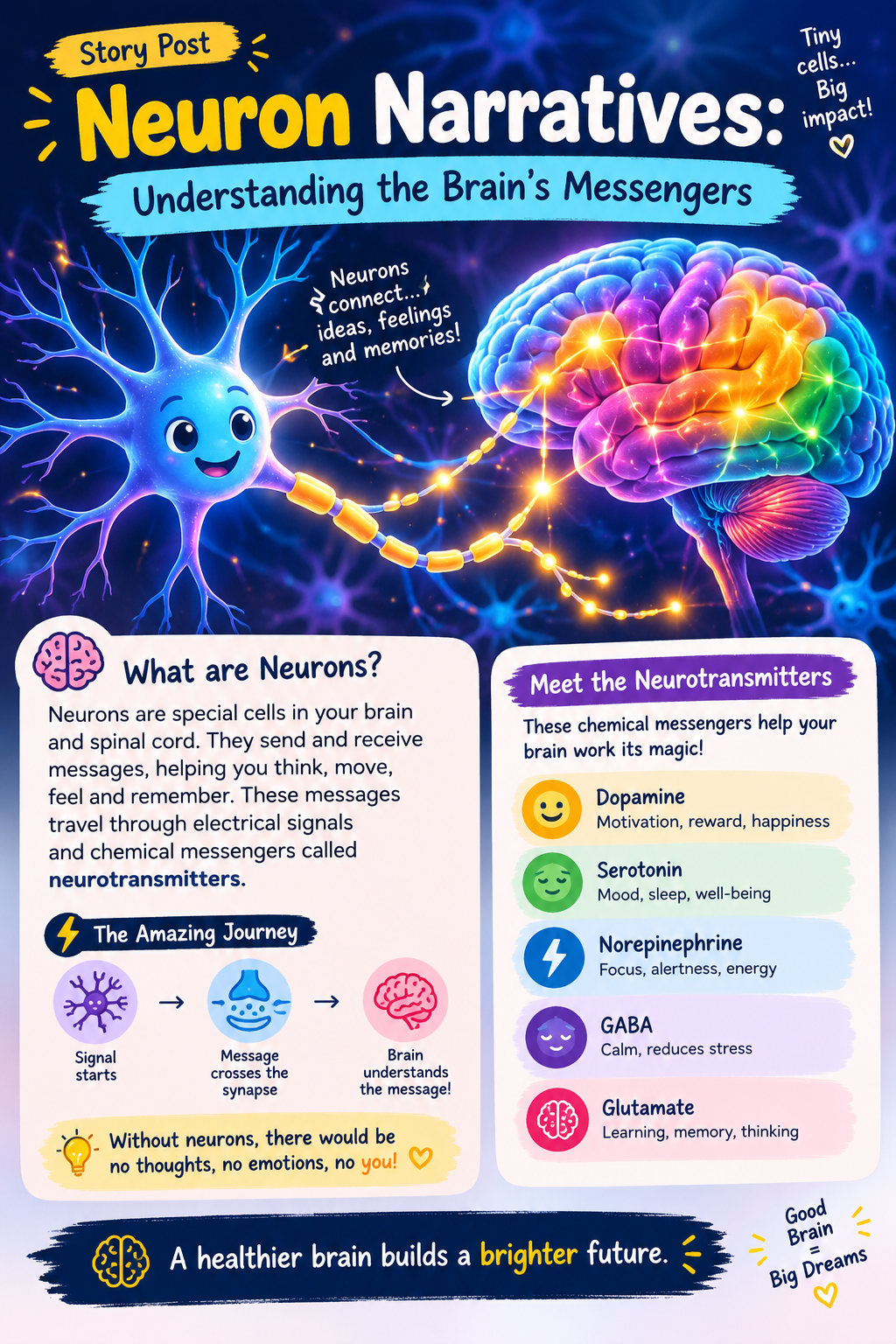
    **Neuron Narratives: Understanding the Brain's Messengers**

    Welcome to the fascinating world of neurons, the tiny messengers that make our brains extraordinary! Have you ever wondered how you think, learn, remember, move, or feel emotions? The answer lies in the incredible network of nerve cells called **neurons**!

    **What Are Neurons?**

    Neurons are specialized cells in our nervous system that carry information throughout the body. They communicate using electrical signals and chemical messengers, helping the brain and body work together. From remembering your favorite story to moving your hands , neurons play an important role in countless everyday activities!

    **How Do Neurons Work?**

    Neurons receive information through tiny branches called dendrites, process signals in the cell body, and send signals along a long structure called the axon. At the ends of neurons, connections called synapses allow messages to pass to other neurons or target cells.

    **Why Are Neurons So Important?**

    **Thinking and Learning:** Neurons help us understand new ideas and develop knowledge.

    **Memory:** Networks of neurons help us store and recall information.

    **Movement:** Signals from the nervous system help control our muscles.

    **Emotions:** Brain networks contribute to how we experience and respond to emotions.

    **Senses:** Neurons help the brain interpret information from our eyes, ears, skin, nose, and tongue.

    **Amazing Brain Fact!**

    The human brain contains approximately 86 billion neurons! Each neuron can connect with many other cells, creating a vast network that supports learning, communication, creativity, and problem-solving. Isn't that amazing?

    **Let's Explore the Science of the Brain!**

    In *Neuron Narratives*, we discover how these microscopic messengers help us experience the world around us. Every thought, every new skill, and every curious question opens the door to learning more about the amazing human brain!

    Remember, curiosity is the beginning of discovery. Keep asking questions, keep exploring science, and keep learning something new every day!

    **Question for You:** If you could learn more about one part of the brain, would you choose memory, emotions, creativity, or intelligence? Tell us in the comments!

    Like, share, and follow for more exciting science stories, educational discoveries, and fascinating facts!

    #NeuronNarratives #Neurons #HumanBrain #BrainScience #Neuroscience #ScienceEducation #AmazingBrain #NervousSystem #LearningIsFun #ScienceFacts #Biology #STEMEducation #ExploreScience #KnowledgeIsPower #EducationalContent #Curiosity #BrainPower #ScienceForEveryone #KeepLearning #DiscoverTheBrain
    #rsisb Roll no. 247 Story post . 29 Foundation level 🧠⚡ **Neuron Narratives: Understanding the Brain's Messengers** 🔬✨ 🌟 Welcome to the fascinating world of neurons, the tiny messengers that make our brains extraordinary! 🧠💡 Have you ever wondered how you think, learn, remember, move, or feel emotions? The answer lies in the incredible network of nerve cells called **neurons**! ⚡🔍 🧬 **What Are Neurons?** Neurons are specialized cells in our nervous system that carry information throughout the body. They communicate using electrical signals and chemical messengers, helping the brain and body work together. From remembering your favorite story 📚 to moving your hands ✋, neurons play an important role in countless everyday activities! ⚡ **How Do Neurons Work?** Neurons receive information through tiny branches called dendrites, process signals in the cell body, and send signals along a long structure called the axon. At the ends of neurons, connections called synapses allow messages to pass to other neurons or target cells. 🔗🧠 🌈 **Why Are Neurons So Important?** ✅ 🧠 **Thinking and Learning:** Neurons help us understand new ideas and develop knowledge. ✅ 📚 **Memory:** Networks of neurons help us store and recall information. ✅ 🏃 **Movement:** Signals from the nervous system help control our muscles. ✅ ❤️ **Emotions:** Brain networks contribute to how we experience and respond to emotions. ✅ 👀 **Senses:** Neurons help the brain interpret information from our eyes, ears, skin, nose, and tongue. 💡 **Amazing Brain Fact!** The human brain contains approximately 86 billion neurons! 🤯 Each neuron can connect with many other cells, creating a vast network that supports learning, communication, creativity, and problem-solving. Isn't that amazing? 🌍🔬 🚀 **Let's Explore the Science of the Brain!** In *Neuron Narratives*, we discover how these microscopic messengers help us experience the world around us. Every thought, every new skill, and every curious question opens the door to learning more about the amazing human brain! 🌟📖 Remember, curiosity is the beginning of discovery. Keep asking questions, keep exploring science, and keep learning something new every day! 💙🧠🔬 💬 **Question for You:** If you could learn more about one part of the brain, would you choose memory, emotions, creativity, or intelligence? Tell us in the comments! 👇😊 ❤️ Like, share, and follow for more exciting science stories, educational discoveries, and fascinating facts! 🌎✨ #NeuronNarratives #Neurons #HumanBrain #BrainScience #Neuroscience #ScienceEducation #AmazingBrain #NervousSystem #LearningIsFun #ScienceFacts #Biology #STEMEducation #ExploreScience #KnowledgeIsPower #EducationalContent #Curiosity #BrainPower #ScienceForEveryone #KeepLearning #DiscoverTheBrain 🧠⚡🔬📚🌟
    0 التعليقات 0 المشاركات 2121 مشاهدة
  • RSIF8
    ROLL NO 77
    SONG TOPIC "Light Chasers: Exploring Colors and Refraction"

    **Light Chasers: Exploring Colors and Refraction**

    کیا آپ نے کبھی سوچا ہے کہ سفید روشنی سے اتنے سارے رنگ کیسے پیدا ہوتے ہیں؟
    روشنی جب مختلف مادّوں سے گزرتی ہے تو اس کا راستہ بدل سکتا ہے، جسے **Refraction (انعطافِ نور)** کہا جاتا ہے۔

    اس دلچسپ سفر میں جانیں کہ روشنی کیسے مڑتی ہے، رنگ کیسے ظاہر ہوتے ہیں، اور ہماری روزمرہ زندگی میں **Refraction** کا کیا کردار ہے!

    **Learn about light, discover colors, and explore the amazing world of science!**

    #LightChasers #Refraction #Light #Colors #Physics #Science #ScienceFacts #EducationalContent #Learning #Knowledge #ExploreScience #DidYouKnow #ScienceForEveryone #LearnEveryDay
    RSIF8 ROLL NO 77 SONG TOPIC "Light Chasers: Exploring Colors and Refraction" 🌈💡 **Light Chasers: Exploring Colors and Refraction** 🔬✨ کیا آپ نے کبھی سوچا ہے کہ سفید روشنی سے اتنے سارے رنگ کیسے پیدا ہوتے ہیں؟ 🤔🌈 روشنی جب مختلف مادّوں سے گزرتی ہے تو اس کا راستہ بدل سکتا ہے، جسے **Refraction (انعطافِ نور)** کہا جاتا ہے۔ 🔬💎 اس دلچسپ سفر میں جانیں کہ روشنی کیسے مڑتی ہے، رنگ کیسے ظاہر ہوتے ہیں، اور ہماری روزمرہ زندگی میں **Refraction** کا کیا کردار ہے! 🌟👀 📚✨ **Learn about light, discover colors, and explore the amazing world of science!** 🚀🌍 #LightChasers #Refraction #Light #Colors #Physics #Science #ScienceFacts #EducationalContent #Learning #Knowledge #ExploreScience #DidYouKnow #ScienceForEveryone #LearnEveryDay 🌈💡🔬✨
    0 التعليقات 0 المشاركات 736 مشاهدة 8
  • #rsisb
    Roll no. 247
    Story post . 24
    Foundation level

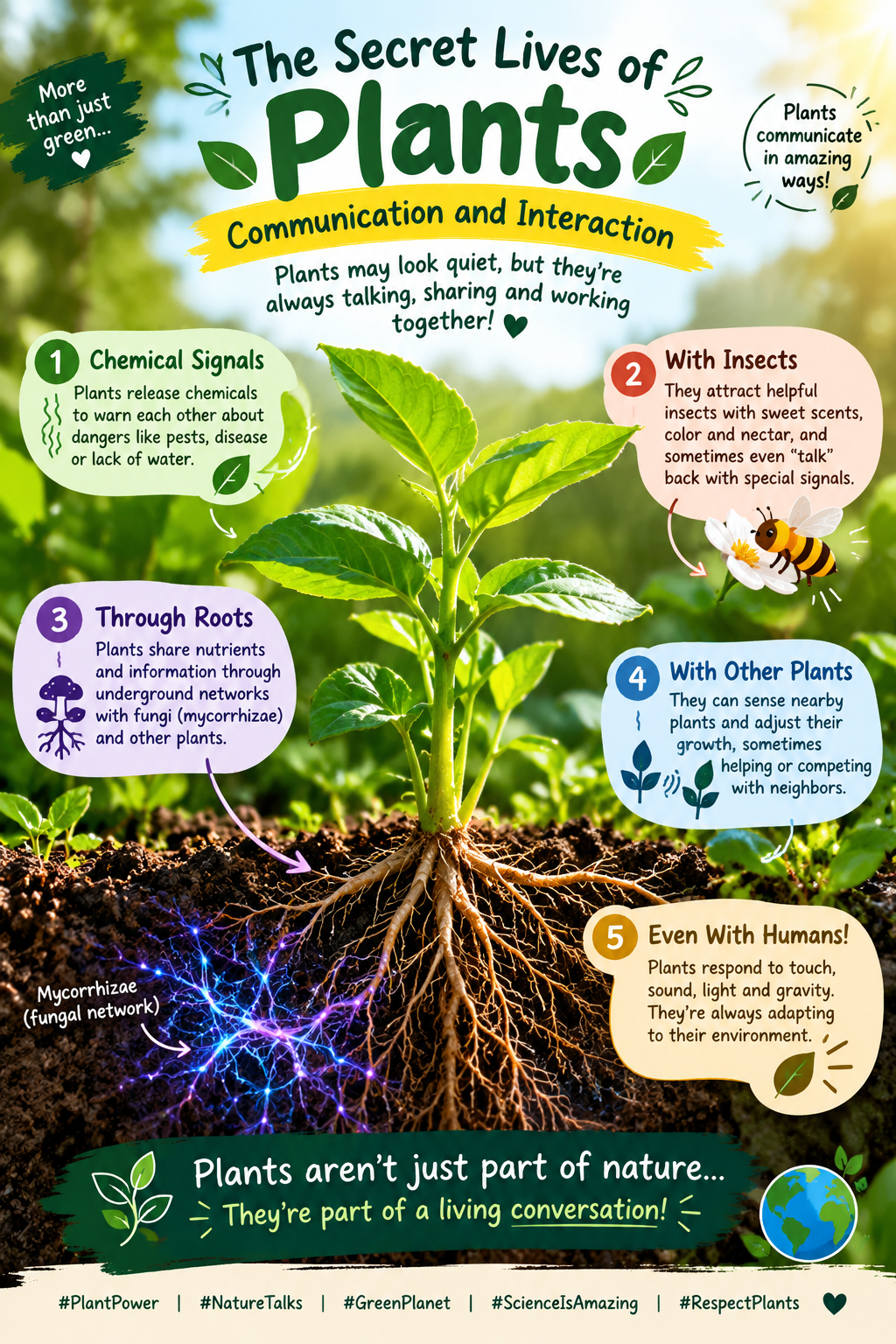
    **The Secret Lives of Plants: Communication and Interaction **

    Have you ever wondered if plants can communicate with each other? The world of plants is full of amazing secrets, hidden connections, and fascinating interactions! Although plants cannot speak like humans, they have incredible ways of responding to their surroundings and interacting with other living things.

    **How Do Plants Communicate?**

    Plants use different methods to exchange information with their environment. Some plants release chemical signals into the air when they are damaged by insects, which can help nearby plants prepare their own defenses. Plants can also send chemical signals through their roots and interact with helpful fungi living in the soil. These underground relationships help plants access nutrients and water, showing us how connected nature really is!

    **Plants and Their Amazing Partners**

    Plants have special relationships with insects, birds, animals, and microorganisms. Bees and butterflies visit flowers to collect nectar and pollen while helping plants reproduce through pollination. Birds and animals spread seeds to new places, allowing more plants to grow. Beneath the ground, roots, fungi, and tiny soil organisms work together to support healthy ecosystems. Every living thing has an important role in maintaining the balance of nature!

    **How Plants Respond to Their Environment**

    Plants may not walk from one place to another, but they can respond to sunlight, gravity, touch, temperature, and water. Sunflowers and many other plants show movements related to light, while roots generally grow toward sources of water and respond to gravity. Some plants even close their leaves when touched! These wonderful abilities help plants survive, grow, and adapt to changing conditions.

    **Why Should We Protect Plants?**

    Plants provide oxygen, food, shelter, and habitats for countless living organisms. They help maintain healthy soil, absorb carbon dioxide, and support biodiversity. By planting trees, growing flowers, protecting forests, saving water, and avoiding unnecessary damage to plants, we can help protect our beautiful planet. Even small actions can make a positive difference!

    **Let's Explore the Wonders of Nature!**

    Through *“The Secret Lives of Plants: Communication and Interaction,”* we discover that nature is much more connected than we might imagine. Plants are not simply decorations in our surroundings; they are living organisms that respond to their environment and participate in complex relationships with other species.

    Let’s keep asking questions, exploring science, observing nature, and learning something new every day! The more we understand plants, the more we appreciate the incredible world around us.

    **Question for Everyone:** Did you know that plants can respond to chemical signals and interact with fungi underground? Share your thoughts in the comments!

    Like, share, and comment to spread awareness about the amazing secret lives of plants!

    **Protect Nature. Respect Life. Keep Exploring!**

    #TheSecretLivesOfPlants #PlantCommunication #PlantScience #NatureLovers #AmazingPlants #ScienceEducation #PlantInteractions #NatureIsAmazing #EnvironmentalAwareness #Biodiversity #Ecosystems #PlantLife #GreenPlanet #SaveNature #ProtectOurPlanet #Biology #LearnSomethingNew #ScienceForEveryone #EducationalPost #StoryPost #PlantsAndNature #SustainableLiving #ExploreNature #RehanSchool #LearningWithAI
    #rsisb Roll no. 247 Story post . 24 Foundation level 🌿🌱 **The Secret Lives of Plants: Communication and Interaction 🌻🌳** 🌍✨ Have you ever wondered if plants can communicate with each other? 🤔🌿 The world of plants is full of amazing secrets, hidden connections, and fascinating interactions! 🌱💚 Although plants cannot speak like humans, they have incredible ways of responding to their surroundings and interacting with other living things. 🌻🦋 🌳💬 **How Do Plants Communicate?** Plants use different methods to exchange information with their environment. 🌿🌬️ Some plants release chemical signals into the air when they are damaged by insects, which can help nearby plants prepare their own defenses. 🐛🍃 Plants can also send chemical signals through their roots and interact with helpful fungi living in the soil. 🍄🌱 These underground relationships help plants access nutrients and water, showing us how connected nature really is! 🌍🤝 🌻🐝 **Plants and Their Amazing Partners** Plants have special relationships with insects, birds, animals, and microorganisms. 🦋🐝 Bees and butterflies visit flowers to collect nectar and pollen while helping plants reproduce through pollination. 🌺🐝 Birds and animals spread seeds to new places, allowing more plants to grow. 🐦🌳 Beneath the ground, roots, fungi, and tiny soil organisms work together to support healthy ecosystems. 🍄🌿 Every living thing has an important role in maintaining the balance of nature! 💚🌎 🌞💧 **How Plants Respond to Their Environment** Plants may not walk from one place to another, but they can respond to sunlight, gravity, touch, temperature, and water. ☀️🌱 Sunflowers and many other plants show movements related to light, while roots generally grow toward sources of water and respond to gravity. 🌻💦 Some plants even close their leaves when touched! 🌿👏 These wonderful abilities help plants survive, grow, and adapt to changing conditions. 🌎💚 **Why Should We Protect Plants?** Plants provide oxygen, food, shelter, and habitats for countless living organisms. 🌳🌍 They help maintain healthy soil, absorb carbon dioxide, and support biodiversity. 🐝🌼 By planting trees, growing flowers, protecting forests, saving water, and avoiding unnecessary damage to plants, we can help protect our beautiful planet. 🌱♻️ Even small actions can make a positive difference! 🔬📚 **Let's Explore the Wonders of Nature!** Through *“The Secret Lives of Plants: Communication and Interaction,”* we discover that nature is much more connected than we might imagine. 🌿✨ Plants are not simply decorations in our surroundings; they are living organisms that respond to their environment and participate in complex relationships with other species. 🌳💚 Let’s keep asking questions, exploring science, observing nature, and learning something new every day! 🔍🌱 The more we understand plants, the more we appreciate the incredible world around us. 🌍💫 💬 **Question for Everyone:** Did you know that plants can respond to chemical signals and interact with fungi underground? 🍄🌱 Share your thoughts in the comments! 👇😊 ❤️ Like, 🔄 share, and 💬 comment to spread awareness about the amazing secret lives of plants! 🌿 **Protect Nature. Respect Life. Keep Exploring!** 🌎💚 #TheSecretLivesOfPlants #PlantCommunication #PlantScience #NatureLovers #AmazingPlants #ScienceEducation #PlantInteractions #NatureIsAmazing #EnvironmentalAwareness #Biodiversity #Ecosystems #PlantLife #GreenPlanet #SaveNature #ProtectOurPlanet #Biology #LearnSomethingNew #ScienceForEveryone #EducationalPost #StoryPost #PlantsAndNature #SustainableLiving #ExploreNature #RehanSchool #LearningWithAI 🌿🌻🌎✨💚
    0 التعليقات 0 المشاركات 3082 مشاهدة
  • RSIF8
    Roll no 94
    Story post no 15
    Story post topic
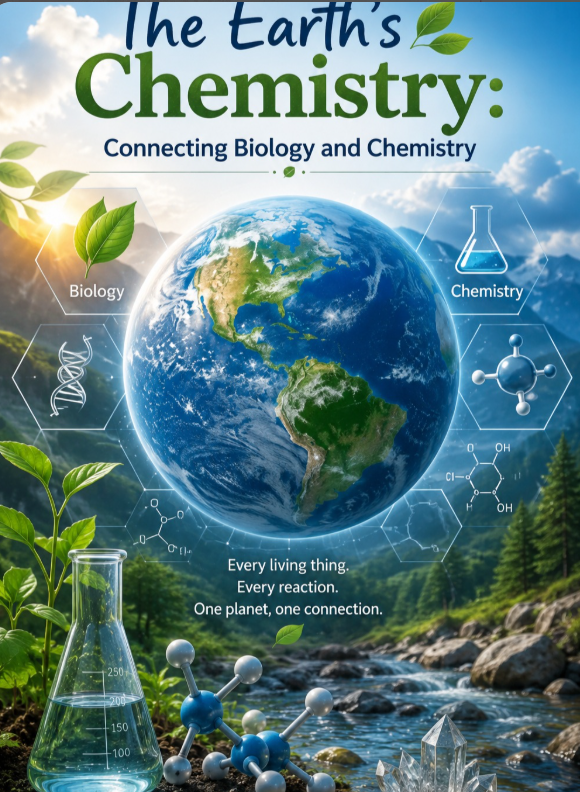
    The Earth's Chemistry: Connecting Biology and Chemistry
    Today I explored the amazing connection between Biology and Chemistry and discovered how these two sciences work together to explain life on Earth. Every living organism, from the smallest cell to the largest tree, depends on chemical reactions to survive and grow.
    Chemistry helps us understand how nutrients are absorbed, how plants perform photosynthesis, and how our bodies produce energy. Biology shows us how these chemical processes create and sustain life. Together, they reveal the incredible systems that keep our planet healthy and balanced.
    Learning about Earth's chemistry reminds us that everything in nature is connected. The air we breathe, the water we drink, the food we eat, and the ecosystems around us all depend on important chemical and biological interactions.
    By studying these connections, scientists can develop new medicines, protect the environment, improve agriculture, and find solutions to global challenges. The more we learn about science, the more we appreciate the beauty and complexity of our world.
    Let's continue exploring, learning, and protecting our planet for future generations!
    #EarthsChemistry #BiologyAndChemistry #ScienceEducation #STEM #EnvironmentalScience #LifeScience #Chemistry #Biology #ScienceLovers #LearningJourney #NatureAndScience #ScientificDiscovery #EarthScience #FutureScientists #Innovation #Education #ExploreScience #KnowledgeIsPower #PlanetEarth #ScienceForEveryone
    RSIF8 Roll no 94 Story post no 15 Story post topic 🌍🧪 The Earth's Chemistry: Connecting Biology and Chemistry 🌱🔬 Today I explored the amazing connection between Biology and Chemistry and discovered how these two sciences work together to explain life on Earth. 🌎✨ Every living organism, from the smallest cell to the largest tree, depends on chemical reactions to survive and grow. 🌿🧬 Chemistry helps us understand how nutrients are absorbed, how plants perform photosynthesis, and how our bodies produce energy. ⚡🌱 Biology shows us how these chemical processes create and sustain life. Together, they reveal the incredible systems that keep our planet healthy and balanced. 🌍💚 Learning about Earth's chemistry reminds us that everything in nature is connected. The air we breathe, the water we drink, the food we eat, and the ecosystems around us all depend on important chemical and biological interactions. 💧🌳☀️ By studying these connections, scientists can develop new medicines, protect the environment, improve agriculture, and find solutions to global challenges. 🔬🌾💊 The more we learn about science, the more we appreciate the beauty and complexity of our world. 🌎✨ Let's continue exploring, learning, and protecting our planet for future generations! 🌍💙🌱 #EarthsChemistry #BiologyAndChemistry #ScienceEducation #STEM #EnvironmentalScience #LifeScience #Chemistry #Biology #ScienceLovers #LearningJourney #NatureAndScience #ScientificDiscovery #EarthScience #FutureScientists #Innovation #Education #ExploreScience #KnowledgeIsPower #PlanetEarth #ScienceForEveryone 🌍🧪🌿🔬💚
    0 التعليقات 0 المشاركات 1469 مشاهدة
  • #rsisb
    Roll no. 247
    Story post . 18
    Foundation level

    **The Journey of “Cell”: From Monks’ Chambers to Biology Labs **

    **Have you ever wondered why the tiny building blocks of life are called “cells”?** The story behind this important scientific word takes us on a fascinating journey from the quiet chambers of monks to modern biology laboratories!

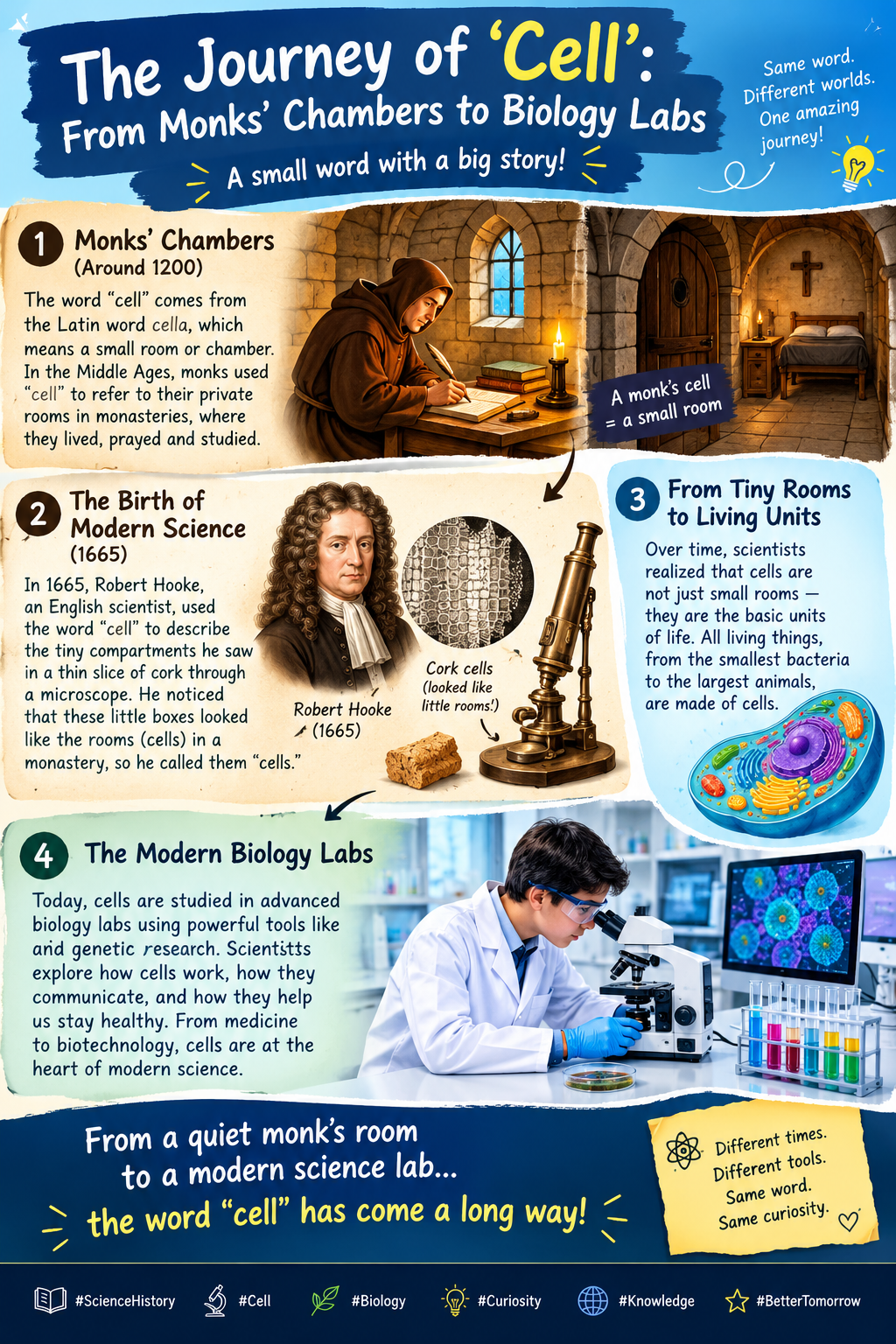
    The word **“cell”** comes from the Latin word *cella*, which means a small room or chamber. In the past, monks lived and prayed in small rooms called cells. These simple rooms inspired a name that would later become one of the most important words in biology! ‍

    In 1665, an English scientist named **Robert Hooke** made an important discovery. While examining a thin slice of cork under a microscope, he noticed many tiny, box-like compartments. They reminded him of the small rooms where monks lived, so he called them **“cells.”** This observation was published in his famous book *Micrographia*.

    But the story did not end there! Years later, scientists developed better microscopes and discovered that cells were not just empty compartments. They were the basic units of living things!

    ‍‍ Scientists such as **Antonie van Leeuwenhoek** observed living microscopic organisms, while other researchers helped build our understanding of cells. Over time, scientists developed the **cell theory**, which explains that all living organisms are made of one or more cells and that new cells come from existing cells.

    Today, cells are studied in laboratories all around the world. Scientists explore how cells grow, obtain energy, communicate, reproduce, and help our bodies function. From the cells in plants to the cells in humans , these tiny structures play an enormous role in life!

    **What makes this journey so amazing?** A word that once described a small room became the name for the fundamental unit of life. It reminds us that even the smallest observation can lead to a huge scientific discovery!

    **Learning Message:** Stay curious, keep asking questions, and never underestimate the power of observation. Every great discovery begins with someone noticing something others might overlook!

    **Question for You:** If you could look at any object under a powerful microscope, what would you choose to explore? Share your answer in the comments!

    Like, share, and comment to spread the love of science and learning! Let's inspire more young scientists to explore the amazing world around us.

    #JourneyOfCell #HistoryOfScience #RobertHooke #CellDiscovery #CellTheory #Biology #ScienceEducation #Microscope #ScientificDiscoveries #LearningIsFun #YoungScientists #ExploreAndDiscover #ScienceForEveryone #BiologyFacts #KnowledgeIsPower #Curiosity #STEMEducation #RehanSchool #RSISB #RehanCodingWithAI
    #rsisb Roll no. 247 Story post . 18 Foundation level 🔬📚 **The Journey of “Cell”: From Monks’ Chambers to Biology Labs 🧫✨** 🌍🤔 **Have you ever wondered why the tiny building blocks of life are called “cells”?** The story behind this important scientific word takes us on a fascinating journey from the quiet chambers of monks to modern biology laboratories! 🏛️➡️🔬 📖✨ The word **“cell”** comes from the Latin word *cella*, which means a small room or chamber. In the past, monks lived and prayed in small rooms called cells. These simple rooms inspired a name that would later become one of the most important words in biology! 🧑‍🏫🏛️ 🔍🧪 In 1665, an English scientist named **Robert Hooke** made an important discovery. While examining a thin slice of cork under a microscope, he noticed many tiny, box-like compartments. They reminded him of the small rooms where monks lived, so he called them **“cells.”** 🧫🔬 This observation was published in his famous book *Micrographia*. 🌟🔬 But the story did not end there! Years later, scientists developed better microscopes and discovered that cells were not just empty compartments. They were the basic units of living things! 🦠🌱 👨‍🔬👩‍🔬 Scientists such as **Antonie van Leeuwenhoek** observed living microscopic organisms, while other researchers helped build our understanding of cells. Over time, scientists developed the **cell theory**, which explains that all living organisms are made of one or more cells and that new cells come from existing cells. 🧬💡 🌿🐾 Today, cells are studied in laboratories all around the world. Scientists explore how cells grow, obtain energy, communicate, reproduce, and help our bodies function. From the cells in plants 🌱 to the cells in humans 🧍, these tiny structures play an enormous role in life! 🚀💭 **What makes this journey so amazing?** A word that once described a small room became the name for the fundamental unit of life. It reminds us that even the smallest observation can lead to a huge scientific discovery! 🎯📚 **Learning Message:** Stay curious, keep asking questions, and never underestimate the power of observation. Every great discovery begins with someone noticing something others might overlook! 🌈🔍 💬 **Question for You:** If you could look at any object under a powerful microscope, what would you choose to explore? 🔬🤔 Share your answer in the comments! ❤️👍 Like, share, and comment to spread the love of science and learning! Let's inspire more young scientists to explore the amazing world around us. 🌍🧪✨ #JourneyOfCell #HistoryOfScience #RobertHooke #CellDiscovery #CellTheory #Biology #ScienceEducation #Microscope #ScientificDiscoveries #LearningIsFun #YoungScientists #ExploreAndDiscover #ScienceForEveryone #BiologyFacts #KnowledgeIsPower #Curiosity #STEMEducation #RehanSchool #RSISB #RehanCodingWithAI 📚🔬🌱✨
    0 التعليقات 0 المشاركات 1754 مشاهدة
  • #rsisb
    Roll no. 247
    Story post . 17
    Foundation level

    **The Journey of “Quarantine”: From Venetian Ports to Global Health **

    Have you ever wondered where the word **“Quarantine”** came from? Today, we use this word when people need to stay separated for a period to help prevent the spread of infectious diseases. But did you know that its history goes back hundreds of years?

    **The Story Begins in Venice! **

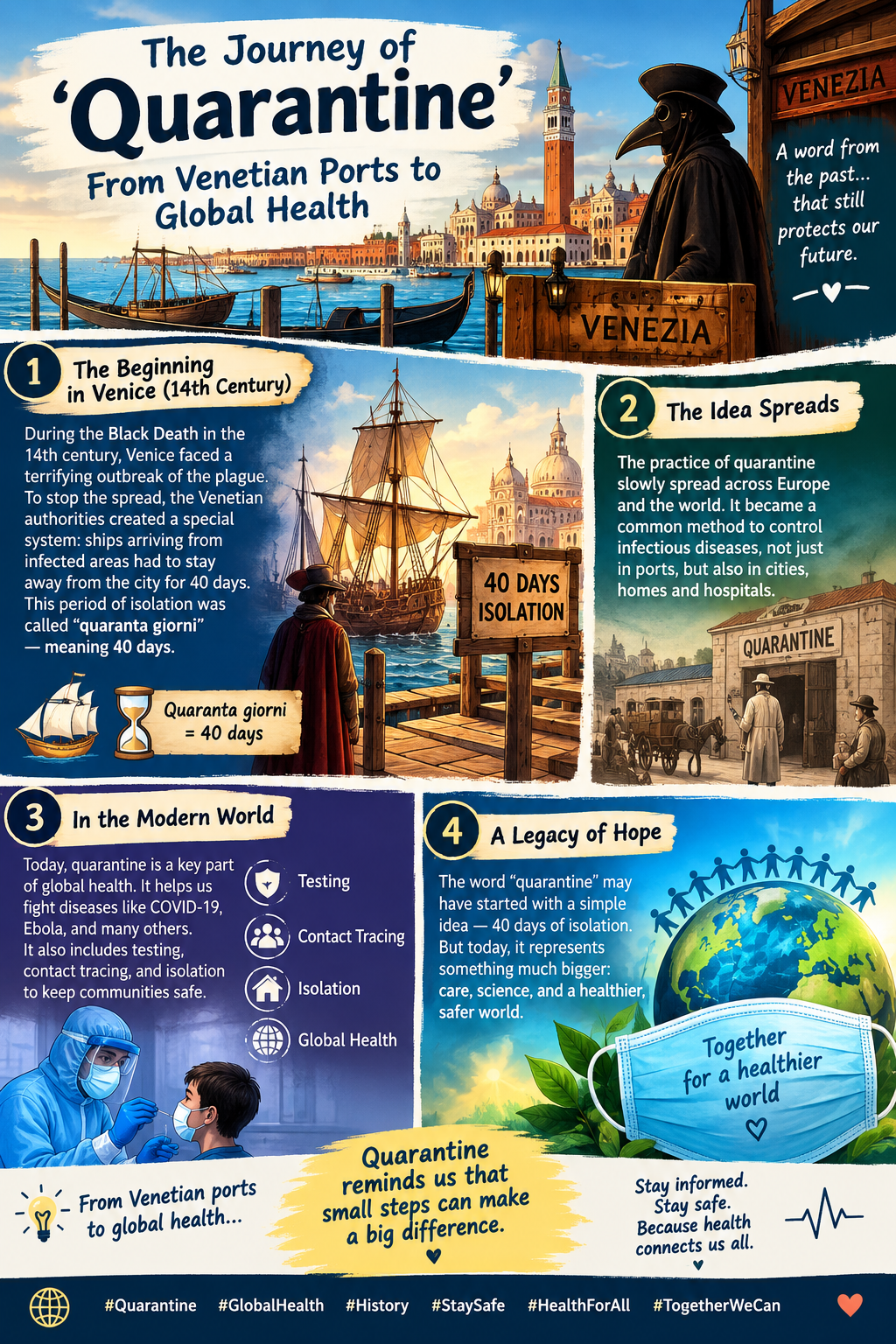
    The word *quarantine* comes from the Italian word *quarantena*, meaning **forty days**. During the 14th century, when the plague threatened communities across Europe, the Venetian authorities required certain ships arriving from places affected by disease to wait before allowing passengers and goods to enter the city. This waiting period helped reduce the risk of spreading illness.

    **A Simple Idea That Changed Public Health!**

    The idea of keeping people separated during a possible infectious disease outbreak became an important part of public health. Over time, quarantine practices developed in different countries to help protect communities from dangerous diseases.

    **Quarantine in the Modern World**

    Today, quarantine and related public health measures may be used during outbreaks of infectious diseases. During the COVID-19 pandemic, people around the world became familiar with these measures. Scientists, doctors, nurses, and public health workers helped communities understand how to reduce the spread of infections. ‍‍

    **What Can We Learn From This History?**

    Words have fascinating stories behind them!
    History helps us understand how public health developed.
    Science and cooperation can help protect communities.
    Learning about the past can prepare us for future challenges.

    From the busy ports of Venice to modern hospitals and communities around the world, the journey of the word *quarantine* shows how language, history, and public health are connected.

    **Remember:** Every word has a story, and every story gives us an opportunity to learn something new! Keep exploring, keep asking questions, and never stop learning!

    Thank you for reading! If you enjoyed this historical journey, please Like, Comment, Share, and Follow for more amazing stories about words, science, history, and the world around us!

    #Quarantine #WordHistory #HistoryOfWords #Etymology #VeniceHistory #PublicHealth #HealthEducation #ScienceAndHistory #MedicalHistory #GlobalHealth #LearnSomethingNew #EducationalContent #KnowledgeIsPower #HistoryLovers #ScienceForEveryone #DidYouKnow #StoryPost #LearningJourney #StayCurious #RehanSchool #RehanCodingWithAI
    #rsisb Roll no. 247 Story post . 17 Foundation level 📜🌍 **The Journey of “Quarantine”: From Venetian Ports to Global Health 🛳️🦠** 🤔✨ Have you ever wondered where the word **“Quarantine”** came from? Today, we use this word when people need to stay separated for a period to help prevent the spread of infectious diseases. But did you know that its history goes back hundreds of years? 📚🔍 🏛️🚢 **The Story Begins in Venice! 🇮🇹** The word *quarantine* comes from the Italian word *quarantena*, meaning **forty days**. During the 14th century, when the plague threatened communities across Europe, the Venetian authorities required certain ships arriving from places affected by disease to wait before allowing passengers and goods to enter the city. This waiting period helped reduce the risk of spreading illness. ⚓⏳ 🦠🌊 **A Simple Idea That Changed Public Health!** The idea of keeping people separated during a possible infectious disease outbreak became an important part of public health. Over time, quarantine practices developed in different countries to help protect communities from dangerous diseases. 🏥🛡️ 🌍💙 **Quarantine in the Modern World** Today, quarantine and related public health measures may be used during outbreaks of infectious diseases. During the COVID-19 pandemic, people around the world became familiar with these measures. Scientists, doctors, nurses, and public health workers helped communities understand how to reduce the spread of infections. 🔬👩‍⚕️👨‍⚕️ 📖💡 **What Can We Learn From This History?** ✅ Words have fascinating stories behind them! ✅ History helps us understand how public health developed. ✅ Science and cooperation can help protect communities. ✅ Learning about the past can prepare us for future challenges. 🌱🌎 ✨ From the busy ports of Venice to modern hospitals and communities around the world, the journey of the word *quarantine* shows how language, history, and public health are connected. 🎯 **Remember:** Every word has a story, and every story gives us an opportunity to learn something new! Keep exploring, keep asking questions, and never stop learning! 📚🚀💫 🙏 Thank you for reading! If you enjoyed this historical journey, please ❤️ Like, 💬 Comment, 🔁 Share, and 📌 Follow for more amazing stories about words, science, history, and the world around us! #Quarantine #WordHistory #HistoryOfWords #Etymology #VeniceHistory #PublicHealth #HealthEducation #ScienceAndHistory #MedicalHistory #GlobalHealth #LearnSomethingNew #EducationalContent #KnowledgeIsPower #HistoryLovers #ScienceForEveryone #DidYouKnow #StoryPost #LearningJourney #StayCurious #RehanSchool #RehanCodingWithAI 🌍📚🔬✨
    0 التعليقات 0 المشاركات 2374 مشاهدة
  • #rsisb
    Roll no . 257
    Story post . 16
    Foundation level
    **The Birth of “Scientist”: From Philosophy to Modern Terminology **
    **Have you ever wondered where the word “scientist” came from?** The word we use today to describe people who explore the mysteries of the universe, discover new things, and develop amazing inventions has an interesting history!
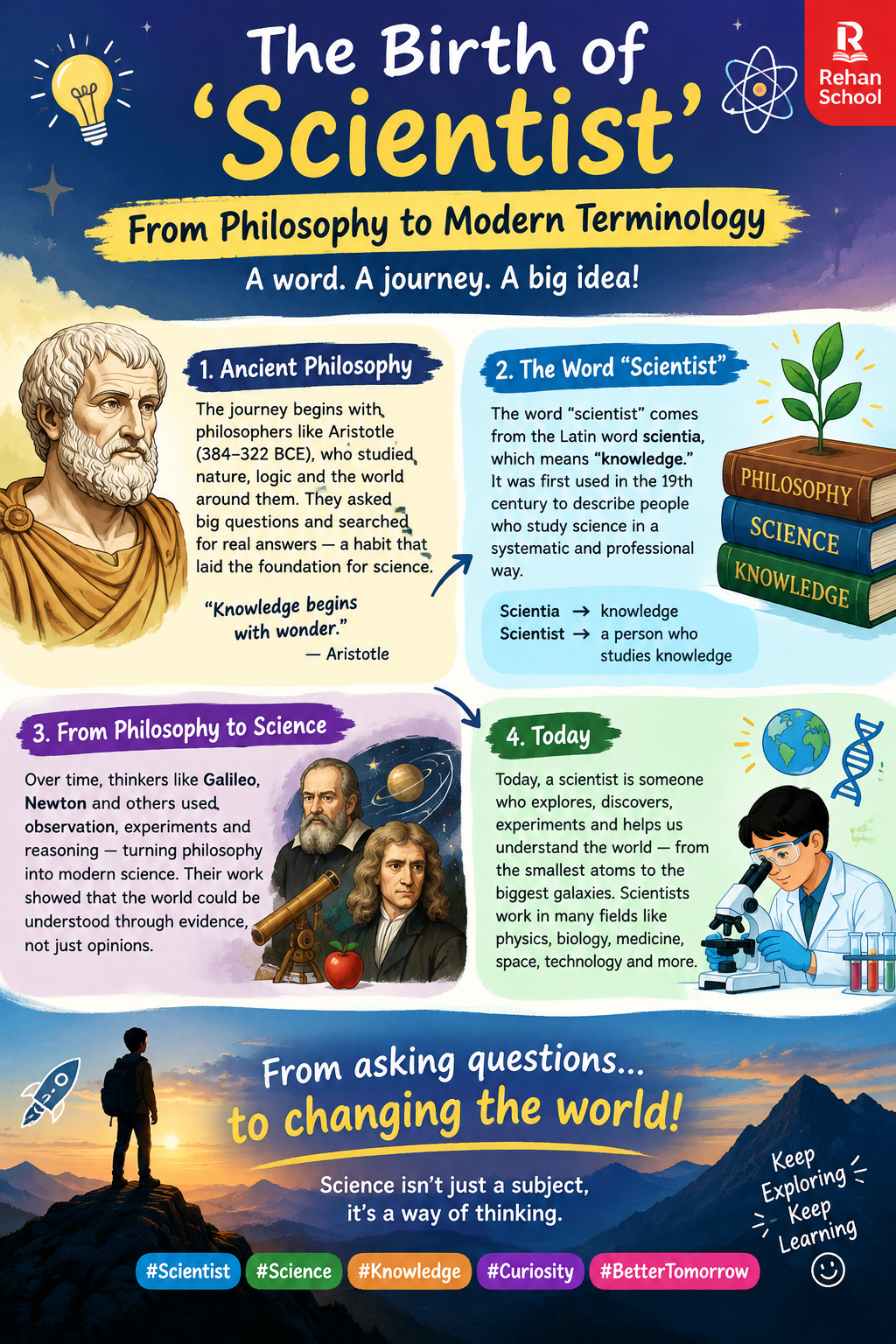
    In ancient times, people who studied nature, the stars, mathematics, medicine, and the world around them were often called **natural philosophers**. They asked important questions about how the world worked and tried to find answers through observation, reasoning, and experiments. Their curiosity helped build the foundations of modern science!
    Over time, the study of nature developed into different scientific fields, including physics , chemistry , biology , astronomy , and many others. As scientific research became more specialized, people needed a new word to describe those who dedicated their lives to scientific investigation.
    The word **“scientist” was coined by William Whewell in 1833 and publicly introduced in 1834** during discussions about how to describe people who studied science. Before that, terms such as natural philosopher were commonly used. The new word gradually became popular as science developed into a recognized profession.
    Today, scientists work in laboratories, universities, hospitals, observatories, research centers, and even in space exploration! ‍‍ They study everything from tiny cells to distant galaxies . Their discoveries help us understand diseases, protect our planet , develop new technologies , and improve our daily lives.
    **The biggest lesson from this story is that curiosity can change the world!** Every great discovery begins with a question. Every invention begins with an idea. And every scientist begins with a desire to learn something new!
    **Think and Discuss:**
    Who were natural philosophers?
    Who introduced the word “scientist”?
    Why do we need scientists in today's world?
    If you could become a scientist, what would you like to discover?
    **Share your thoughts in the comments!** What scientific mystery would you love to solve?
    Keep asking questions, keep exploring, and never stop learning! Because the journey from curiosity to discovery is what makes science truly amazing!
    ━━━━━━━━━━━━━━━━━━━━
    **HASHTAGS**
    #BirthOfScientist #HistoryOfScience #Scientist #ScienceHistory #NaturalPhilosophy #WilliamWhewell #ScienceEducation #LearnSomethingNew #AmazingFacts #DidYouKnow #ScientificDiscoveries #Curiosity #KnowledgeIsPower #Education #ScienceLovers #STEMEducation #Physics #Chemistry #Biology #Astronomy #Innovation #Technology #ExploreTheWorld #LearningJourney #StoryPost #EducationalContent #StudentLife #NeverStopLearning #ScienceForEveryone #KnowledgeSharing
    #rsisb Roll no . 257 Story post . 16 Foundation level 🔬📚 **The Birth of “Scientist”: From Philosophy to Modern Terminology 🧠✨** 🌍💡 **Have you ever wondered where the word “scientist” came from?** 🤔🔍 The word we use today to describe people who explore the mysteries of the universe, discover new things, and develop amazing inventions has an interesting history! 🚀🌟 📖✨ In ancient times, people who studied nature, the stars, mathematics, medicine, and the world around them were often called **natural philosophers**. 🏛️🌌 They asked important questions about how the world worked and tried to find answers through observation, reasoning, and experiments. 🧪🔭 Their curiosity helped build the foundations of modern science! 🌱🧠 Over time, the study of nature developed into different scientific fields, including physics ⚡, chemistry 🧫, biology 🧬, astronomy 🌠, and many others. As scientific research became more specialized, people needed a new word to describe those who dedicated their lives to scientific investigation. ✨📚 The word **“scientist” was coined by William Whewell in 1833 and publicly introduced in 1834** during discussions about how to describe people who studied science. Before that, terms such as natural philosopher were commonly used. The new word gradually became popular as science developed into a recognized profession. 🔬🌍 💡🚀 Today, scientists work in laboratories, universities, hospitals, observatories, research centers, and even in space exploration! 🧑‍🔬👩‍🔬 They study everything from tiny cells 🔬 to distant galaxies 🌌. Their discoveries help us understand diseases, protect our planet 🌳, develop new technologies 🤖, and improve our daily lives. 🌟📖 **The biggest lesson from this story is that curiosity can change the world!** Every great discovery begins with a question. 🤔 Every invention begins with an idea. 💡 And every scientist begins with a desire to learn something new! 🌱✨ 🎯 **Think and Discuss:** 🔹 Who were natural philosophers? 🔹 Who introduced the word “scientist”? 🔹 Why do we need scientists in today's world? 🔹 If you could become a scientist, what would you like to discover? 🚀🧬 💬 **Share your thoughts in the comments!** What scientific mystery would you love to solve? 🌍🔭 ❤️ Keep asking questions, keep exploring, and never stop learning! Because the journey from curiosity to discovery is what makes science truly amazing! 🧠🔬✨ ━━━━━━━━━━━━━━━━━━━━ 🏷️ **HASHTAGS** #BirthOfScientist #HistoryOfScience #Scientist #ScienceHistory #NaturalPhilosophy #WilliamWhewell #ScienceEducation #LearnSomethingNew #AmazingFacts #DidYouKnow #ScientificDiscoveries #Curiosity #KnowledgeIsPower #Education #ScienceLovers #STEMEducation #Physics #Chemistry #Biology #Astronomy #Innovation #Technology #ExploreTheWorld #LearningJourney #StoryPost #EducationalContent #StudentLife #NeverStopLearning #ScienceForEveryone #KnowledgeSharing 🔬📚🌍🚀 🚀
    0 التعليقات 0 المشاركات 2370 مشاهدة
  • #rsisb
    Roll no. 247
    Story post 14
    Foundation level

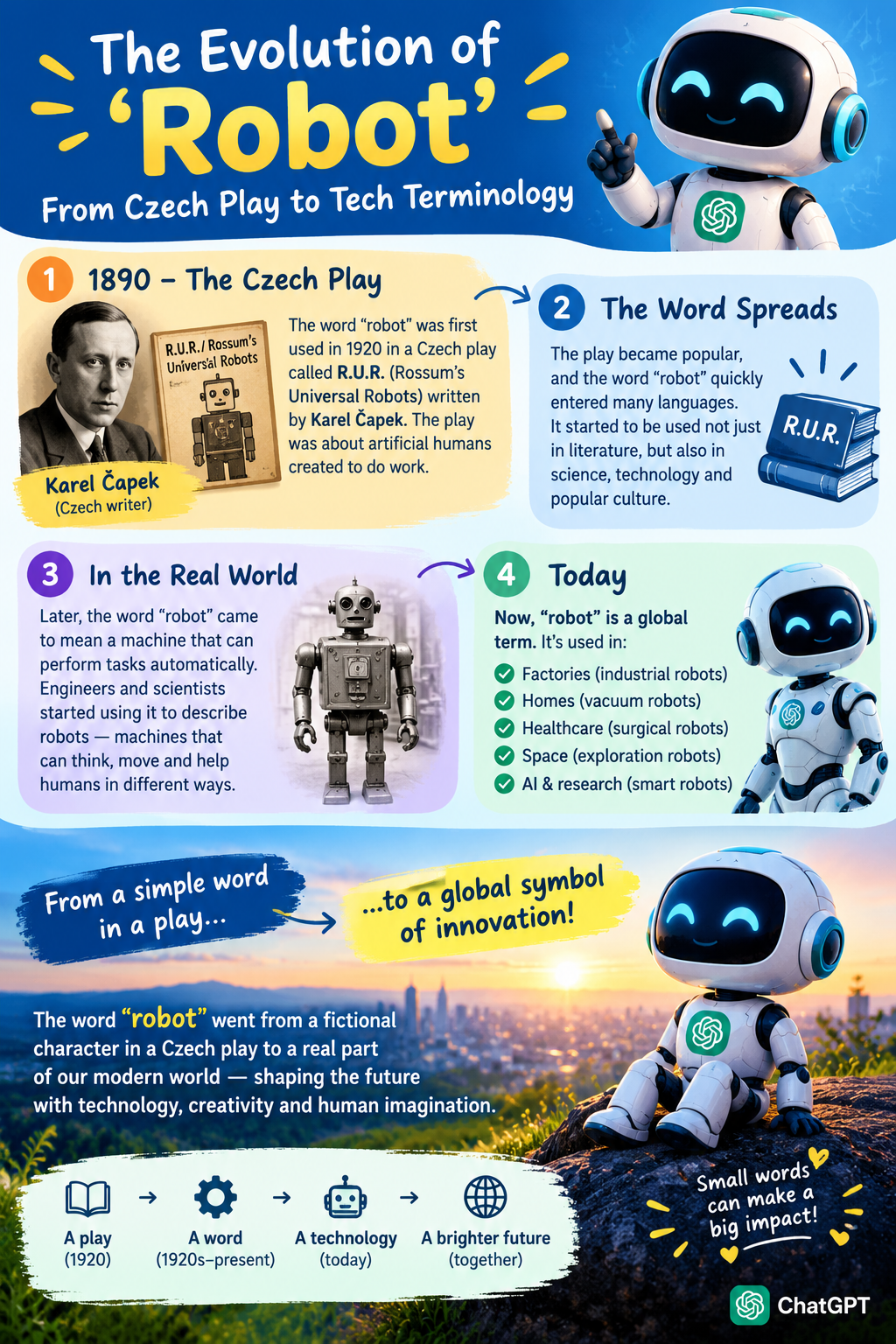
    **The Evolution of “Robot”: From Czech Play to Tech Terminology **

    Have you ever wondered where the word **“robot”** came from? Today, we use this word when talking about smart machines, artificial intelligence, factories, space exploration, and modern technology. But did you know that the word “robot” became popular through a Czech play written more than a century ago? Let's explore the fascinating journey of this little word that became a big part of our technological world!

    **1. The Beginning: A Czech Play **

    The story of the word “robot” begins with Czech writer and playwright **Karel Čapek** and his science-fiction play *R.U.R. (Rossum’s Universal Robots)*, first performed in 1921 and published in 1920. The play imagined artificial workers created to perform tasks for humans. It introduced audiences to ideas about artificial beings, technology, work, and the relationship between humans and machines.

    The word “robot” comes from the Czech word *robota*, associated with forced labor or compulsory work. Interestingly, Karel Čapek credited his brother, **Josef Čapek**, with suggesting the word for the play.

    **2. How the Word Spread Around the World **

    As the play gained attention, the word “robot” spread beyond literature and entered everyday language. People began using it to discuss machines that could perform tasks automatically. Over time, robots became a popular subject in science-fiction stories, films, books, and discussions about the future.

    Writers and scientists explored exciting questions: Could machines help humans? Could robots perform difficult tasks? How might technology change our lives? These questions helped inspire generations of inventors and researchers.

    **3. From Fiction to Real Machines **

    Robots eventually became an important part of real-world engineering and science. Modern robots can perform repetitive tasks, assist with manufacturing, explore places that are difficult for humans to reach, and help researchers carry out complex work.

    Today, we can find robots in many areas:

    **Factories:** Industrial robots help assemble products and perform precise tasks.

    **Homes:** Robotic vacuum cleaners help people with household cleaning.

    **Healthcare:** Specialised robotic systems assist medical professionals with certain procedures.

    **Space Exploration:** Robotic rovers and spacecraft help scientists explore distant worlds.

    **Agriculture:** Some robots help monitor crops and perform farming tasks.

    **Research:** Scientists use robots to test ideas, collect information, and explore new possibilities.

    **4. Robots and Artificial Intelligence **

    Modern technology has introduced new possibilities through artificial intelligence (AI). Some robots use AI to interpret information from sensors, recognise objects, plan actions, or respond to changing conditions. However, not every robot uses AI, and not every AI system is a robot.

    This difference is important! A robot is generally a physical machine that can carry out tasks, while AI refers to computer systems designed to perform tasks that may require abilities such as recognising patterns or understanding language. Together, robotics and AI are helping researchers develop new tools and technologies.

    **5. What Can We Learn from the Evolution of “Robot”?**

    The journey of the word “robot” teaches us that ideas can travel from books and plays into real life. A word introduced through a fictional story became an important term in science, engineering, and technology.

    It also reminds us that technology is created by people using imagination, creativity, teamwork, and scientific knowledge. As we learn more about robots, we should think about how to use technology responsibly and how it can benefit people and communities.

    **Conclusion: From a Czech Play to a Technological Future**

    The evolution of “robot” is a remarkable example of how language, literature, and science connect. What began as a word associated with artificial workers in a Czech play is now used around the world to describe machines that help us in factories, homes, hospitals, laboratories, and space exploration.

    The future of robotics will continue to bring new discoveries, challenges, and opportunities. By learning about the past, understanding the present, and thinking creatively about the future, we can become more informed and responsible users of technology.

    **Let's keep learning, exploring, and innovating!** Every great invention begins with an idea, and every curious mind has the potential to discover something new.

    **Question for everyone:** If you could invent a helpful robot, what would you want it to do? Share your ideas in the comments!

    Like, share, and spread the excitement of science and technology!

    ━━━━━━━━━━━━━━━━━━

    **HASHTAGS**

    #EvolutionOfRobots #RobotHistory #TheWordRobot #KarelCapek #JosefCapek #RUR #CzechLiterature #HistoryOfTechnology #Robotics #ArtificialIntelligence #AI #ScienceAndTechnology #EducationalPost #StoryPost #TechnologyEducation #FutureTechnology #Innovation #Engineering #STEMEducation #ScienceForEveryone #LearningIsFun #DigitalLearning #TechHistory #SmartMachines #SpaceExploration #IndustrialRobots #CreativeThinking #KnowledgeIsPower #ChatGPT #PostOnAllPlatforms
    #rsisb Roll no. 247 Story post 14 Foundation level 🤖🌍 **The Evolution of “Robot”: From Czech Play to Tech Terminology 📚✨** 🚀🤖 Have you ever wondered where the word **“robot”** came from? Today, we use this word when talking about smart machines, artificial intelligence, factories, space exploration, and modern technology. But did you know that the word “robot” became popular through a Czech play written more than a century ago? 📖🌟 Let's explore the fascinating journey of this little word that became a big part of our technological world! 💡🌐 📚 **1. The Beginning: A Czech Play 🇨🇿** The story of the word “robot” begins with Czech writer and playwright **Karel Čapek** and his science-fiction play *R.U.R. (Rossum’s Universal Robots)*, first performed in 1921 and published in 1920. 🎭🤖 The play imagined artificial workers created to perform tasks for humans. It introduced audiences to ideas about artificial beings, technology, work, and the relationship between humans and machines. The word “robot” comes from the Czech word *robota*, associated with forced labor or compulsory work. Interestingly, Karel Čapek credited his brother, **Josef Čapek**, with suggesting the word for the play. ✍️💭 🌎 **2. How the Word Spread Around the World 🌐** As the play gained attention, the word “robot” spread beyond literature and entered everyday language. People began using it to discuss machines that could perform tasks automatically. 📖⚙️ Over time, robots became a popular subject in science-fiction stories, films, books, and discussions about the future. Writers and scientists explored exciting questions: Could machines help humans? Could robots perform difficult tasks? How might technology change our lives? These questions helped inspire generations of inventors and researchers. 🚀🧠 ⚙️ **3. From Fiction to Real Machines 🏭** Robots eventually became an important part of real-world engineering and science. Modern robots can perform repetitive tasks, assist with manufacturing, explore places that are difficult for humans to reach, and help researchers carry out complex work. 🔧🤖 Today, we can find robots in many areas: 🏭 **Factories:** Industrial robots help assemble products and perform precise tasks. 🏠 **Homes:** Robotic vacuum cleaners help people with household cleaning. 🏥 **Healthcare:** Specialised robotic systems assist medical professionals with certain procedures. 🚀 **Space Exploration:** Robotic rovers and spacecraft help scientists explore distant worlds. 🌾 **Agriculture:** Some robots help monitor crops and perform farming tasks. 🧪 **Research:** Scientists use robots to test ideas, collect information, and explore new possibilities. 💻 **4. Robots and Artificial Intelligence 🧠** Modern technology has introduced new possibilities through artificial intelligence (AI). Some robots use AI to interpret information from sensors, recognise objects, plan actions, or respond to changing conditions. 🤖💡 However, not every robot uses AI, and not every AI system is a robot. This difference is important! A robot is generally a physical machine that can carry out tasks, while AI refers to computer systems designed to perform tasks that may require abilities such as recognising patterns or understanding language. Together, robotics and AI are helping researchers develop new tools and technologies. 🌐✨ 🌟 **5. What Can We Learn from the Evolution of “Robot”?** The journey of the word “robot” teaches us that ideas can travel from books and plays into real life. A word introduced through a fictional story became an important term in science, engineering, and technology. 📚➡️⚙️ It also reminds us that technology is created by people using imagination, creativity, teamwork, and scientific knowledge. As we learn more about robots, we should think about how to use technology responsibly and how it can benefit people and communities. ❤️🌍 🎯 **Conclusion: From a Czech Play to a Technological Future** The evolution of “robot” is a remarkable example of how language, literature, and science connect. What began as a word associated with artificial workers in a Czech play is now used around the world to describe machines that help us in factories, homes, hospitals, laboratories, and space exploration. 🤖🚀 The future of robotics will continue to bring new discoveries, challenges, and opportunities. By learning about the past, understanding the present, and thinking creatively about the future, we can become more informed and responsible users of technology. 🌟💚 📢 **Let's keep learning, exploring, and innovating!** Every great invention begins with an idea, and every curious mind has the potential to discover something new. 💡📚 💬 **Question for everyone:** If you could invent a helpful robot, what would you want it to do? Share your ideas in the comments! 👇🤖 ❤️ Like, share, and spread the excitement of science and technology! ━━━━━━━━━━━━━━━━━━ 🏷️ **HASHTAGS** #EvolutionOfRobots #RobotHistory #TheWordRobot #KarelCapek #JosefCapek #RUR #CzechLiterature #HistoryOfTechnology #Robotics #ArtificialIntelligence #AI #ScienceAndTechnology #EducationalPost #StoryPost #TechnologyEducation #FutureTechnology #Innovation #Engineering #STEMEducation #ScienceForEveryone #LearningIsFun #DigitalLearning #TechHistory #SmartMachines #SpaceExploration #IndustrialRobots #CreativeThinking #KnowledgeIsPower #ChatGPT #PostOnAllPlatforms 🤖🌍📚🚀✨
    0 التعليقات 0 المشاركات 4883 مشاهدة
  • #rsisb
    Roll no.247
    Story no.5
    Foundation level

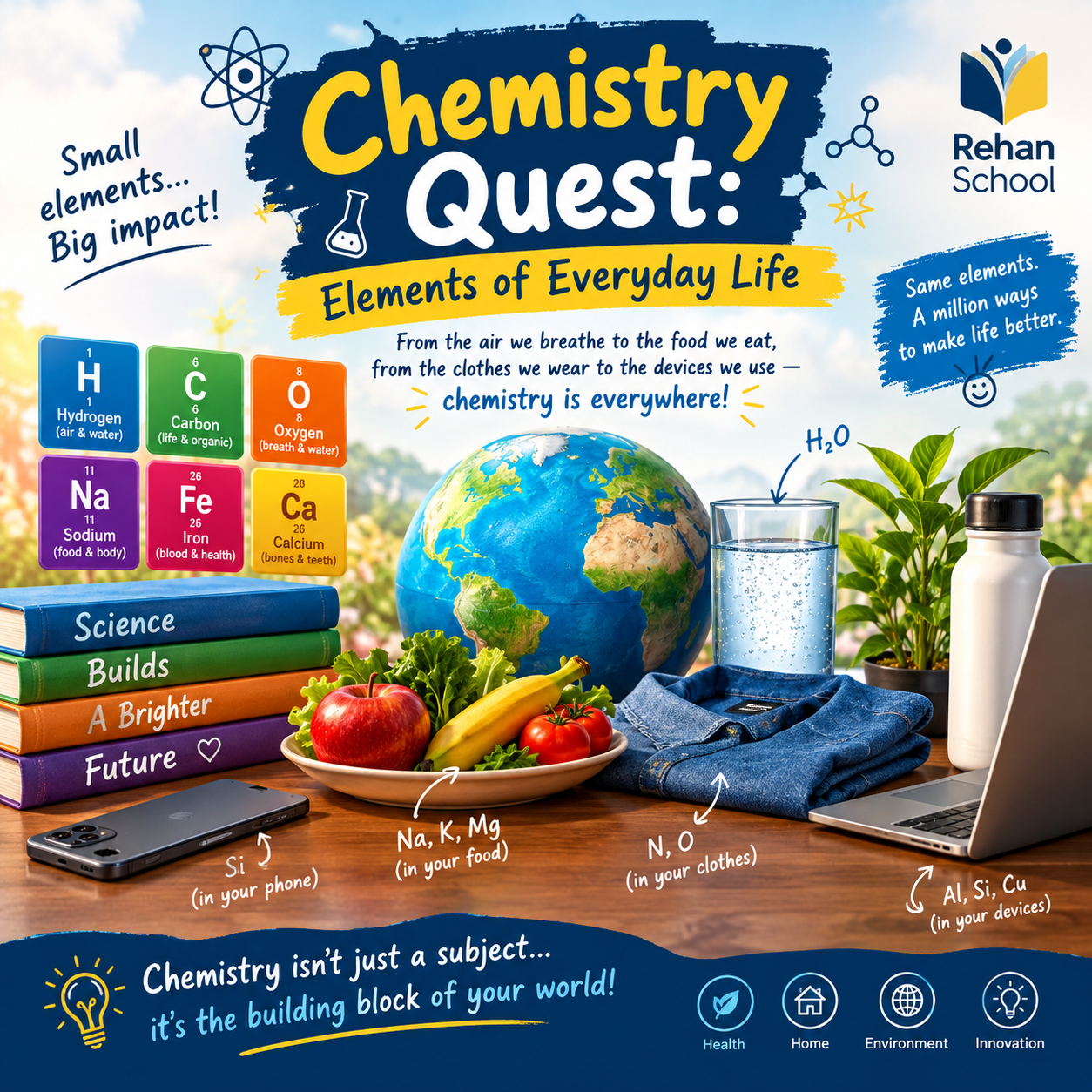
    **Chemistry Quest: Elements of Everyday Life**

    Welcome to an exciting journey into the amazing world of **Chemistry!** Chemistry is not just a subject we study in books—it is all around us, every single day! From the water we drink and the air we breathe to the food we eat , the medicines we use , the clothes we wear , and even the technology we use , chemistry plays an important role in our everyday lives.

    In this **Chemistry Quest**, we explore the fascinating world of **elements, atoms, molecules, compounds, and chemical reactions**. Each element has its own unique properties and characteristics, and together they create the incredible materials and substances that make up our world.

    As we explore, we can discover how **oxygen** helps us breathe, how **hydrogen and oxygen** can form water, how **carbon** is an important part of living things, and how many other elements are connected to the world around us.

    Chemistry helps us understand questions we see every day: Why does food change when it is cooked? Why does iron rust? Why does soap clean? How do batteries produce energy? How are medicines developed? These everyday mysteries become much more interesting when we look at them through the eyes of chemistry!

    This story post is a reminder that **science is everywhere**. Every object, material, and natural process can teach us something new. By asking questions, observing carefully, experimenting safely, and staying curious, we can become better scientists and discover new ideas.

    Let’s continue our **Chemistry Quest** with curiosity, creativity, and a passion for learning! Who knows what amazing discovery might be waiting for us around the next corner?

    **Explore. Observe. Question. Discover. Learn.**

    #ChemistryQuest #Chemistry #Elements #EverydayChemistry #Science #ScienceEverywhere #STEM #STEMEducation #ScienceLearning #LearningIsFun #YoungScientists #FutureScientists #Atoms #Molecules #ChemicalReactions #PeriodicTable #ScienceExplorer #Curiosity #Discovery #Education #LearningJourney #ExploreScience #ScienceForEveryone #EverydayLife #ChemistryIsFun #ExperimentAndLearn #KnowledgeIsPower
    #rsisb Roll no.247 Story no.5 Foundation level 🧪🌟 **Chemistry Quest: Elements of Everyday Life** 🌟🧪 Welcome to an exciting journey into the amazing world of **Chemistry!** 🔬⚗️ Chemistry is not just a subject we study in books—it is all around us, every single day! 🌍✨ From the water we drink 💧 and the air we breathe 🌬️ to the food we eat 🍎, the medicines we use 💊, the clothes we wear 👕, and even the technology we use 📱, chemistry plays an important role in our everyday lives. In this **Chemistry Quest**, we explore the fascinating world of **elements, atoms, molecules, compounds, and chemical reactions**. 🧪🔍 Each element has its own unique properties and characteristics, and together they create the incredible materials and substances that make up our world. 🌎⚛️ As we explore, we can discover how **oxygen** helps us breathe, how **hydrogen and oxygen** can form water, how **carbon** is an important part of living things, and how many other elements are connected to the world around us. 🌱💧🌬️ Chemistry helps us understand questions we see every day: Why does food change when it is cooked? 🍳 Why does iron rust? 🔩 Why does soap clean? 🧼 How do batteries produce energy? 🔋 How are medicines developed? 💊 These everyday mysteries become much more interesting when we look at them through the eyes of chemistry! 👀🔬 This story post is a reminder that **science is everywhere**. 🚀✨ Every object, material, and natural process can teach us something new. By asking questions, observing carefully, experimenting safely, and staying curious, we can become better scientists and discover new ideas. 🧠💡 Let’s continue our **Chemistry Quest** with curiosity, creativity, and a passion for learning! 🧪🌟 Who knows what amazing discovery might be waiting for us around the next corner? 🔍🚀 🔬⚗️ **Explore. Observe. Question. Discover. Learn.** ⚗️🔬 #ChemistryQuest #Chemistry #Elements #EverydayChemistry #Science #ScienceEverywhere #STEM #STEMEducation #ScienceLearning #LearningIsFun #YoungScientists #FutureScientists #Atoms #Molecules #ChemicalReactions #PeriodicTable #ScienceExplorer #Curiosity #Discovery #Education #LearningJourney #ExploreScience #ScienceForEveryone #EverydayLife #ChemistryIsFun #ExperimentAndLearn #KnowledgeIsPower 🧪🔬⚗️🌍💡🚀📚✨
    0 التعليقات 0 المشاركات 3057 مشاهدة
  • #rsisb
    Roll no.247
    song no.25
    Foundation level

    **Energy, Matter, and Transformation: The Philosophy of Chemical Reactions**

    Chemical reactions are happening all around us—even when we cannot see them! From the food we eat and the air we breathe to the growth of plants, the burning of fuels, and the processes inside living cells, chemical reactions are constantly transforming matter and transferring energy.

    **Energy, Matter, and Transformation** takes us on an exciting journey into the fascinating world of chemistry. It explores how substances change, how atoms rearrange themselves, and how energy can be released, absorbed, or transferred during a reaction.

    Matter is never simply “lost” during an ordinary chemical reaction. Instead, atoms are rearranged to form new substances with different properties. This beautiful process shows us one of the fundamental ideas of science: **transformation does not mean disappearance—it means change.**

    Some reactions release energy, such as combustion, while others require energy to proceed. Understanding these energy changes helps us explain everything from everyday cooking to industrial processes and the complex chemistry taking place inside living organisms.

    This topic also encourages us to think beyond chemical formulas. Chemistry can be viewed as a story of **change, balance, interaction, and transformation**. Every molecule has a role, every reaction has a process, and every transformation helps us understand the world around us a little better.

    **What can we learn from chemical reactions?**
    How atoms rearrange to create new substances
    How energy moves during chemical changes
    Why some reactions release energy while others absorb it
    How chemical reactions support life and nature
    How chemistry contributes to technology and industry
    How scientific thinking helps us understand transformation

    Learning chemistry is not just about memorizing equations—it is about discovering the hidden processes that shape our world. Every reaction is a small demonstration of nature’s incredible ability to transform matter and energy.

    **Explore. Question. Experiment. Discover. Transform.**
    Let the fascinating world of chemistry inspire curiosity, creativity, and a deeper appreciation for the science behind everyday life!

    #Energy #Matter #ChemicalReactions #Chemistry #Science #ChemicalTransformation #EnergyTransformation #MatterAndEnergy #ScienceEducation #ChemistryLearning #STEM #STEMEducation #ScienceExperiment #ChemicalScience #LearningIsFun #ExploreScience #ScienceAndNature #YoungScientists #FutureScientists #Education #Knowledge #Curiosity #Innovation #DiscoverScience #ChemistryLovers #ScienceForEveryone
    #rsisb Roll no.247 song no.25 Foundation level ⚗️🔥 **Energy, Matter, and Transformation: The Philosophy of Chemical Reactions** 🌍✨ Chemical reactions are happening all around us—even when we cannot see them! 🌱🧪 From the food we eat and the air we breathe to the growth of plants, the burning of fuels, and the processes inside living cells, chemical reactions are constantly transforming matter and transferring energy. ⚡🔬 **Energy, Matter, and Transformation** takes us on an exciting journey into the fascinating world of chemistry. 🧠⚗️ It explores how substances change, how atoms rearrange themselves, and how energy can be released, absorbed, or transferred during a reaction. 🔥❄️ Matter is never simply “lost” during an ordinary chemical reaction. Instead, atoms are rearranged to form new substances with different properties. 🧩✨ This beautiful process shows us one of the fundamental ideas of science: **transformation does not mean disappearance—it means change.** 🌟 Some reactions release energy, such as combustion, while others require energy to proceed. 🔥⚡ Understanding these energy changes helps us explain everything from everyday cooking to industrial processes and the complex chemistry taking place inside living organisms. 🍳🏭🧬 This topic also encourages us to think beyond chemical formulas. Chemistry can be viewed as a story of **change, balance, interaction, and transformation**. 🌌🔄 Every molecule has a role, every reaction has a process, and every transformation helps us understand the world around us a little better. 🌍💡 🔬 **What can we learn from chemical reactions?** ✨ How atoms rearrange to create new substances ⚡ How energy moves during chemical changes 🧪 Why some reactions release energy while others absorb it 🌱 How chemical reactions support life and nature 🏭 How chemistry contributes to technology and industry 🧠 How scientific thinking helps us understand transformation Learning chemistry is not just about memorizing equations—it is about discovering the hidden processes that shape our world. 🌎📚 Every reaction is a small demonstration of nature’s incredible ability to transform matter and energy. 🚀 **Explore. Question. Experiment. Discover. Transform.** Let the fascinating world of chemistry inspire curiosity, creativity, and a deeper appreciation for the science behind everyday life! 🧪🔬⚡🌟 #Energy #Matter #ChemicalReactions #Chemistry #Science #ChemicalTransformation #EnergyTransformation #MatterAndEnergy #ScienceEducation #ChemistryLearning #STEM #STEMEducation #ScienceExperiment #ChemicalScience #LearningIsFun #ExploreScience #ScienceAndNature #YoungScientists #FutureScientists #Education #Knowledge #Curiosity #Innovation #DiscoverScience #ChemistryLovers #ScienceForEveryone 🧪⚡🌍🔬✨
    0 التعليقات 0 المشاركات 5641 مشاهدة 10
الصفحات المعززة