• ACCL foun da tion level
    rehan school
    roll no . 27
    The Mystery of Life: Exploring the World of Cells

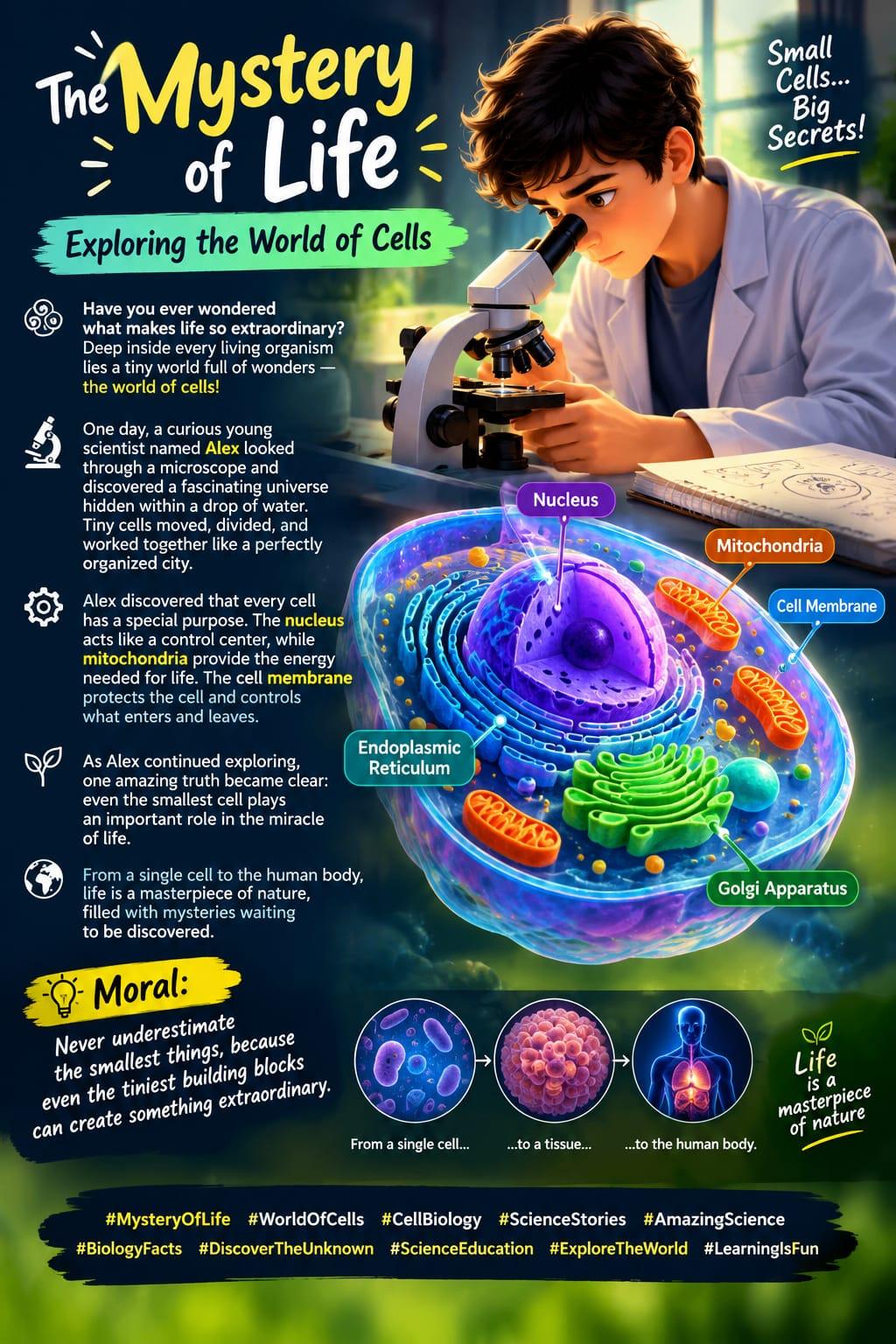
    Have you ever wondered what makes life so extraordinary? Deep inside every living organism lies a tiny world full of wonders — the world of cells!

    One day, a curious young scientist named Alex looked through a microscope and discovered a fascinating universe hidden within a drop of water. Tiny cells moved, divided, and worked together like a perfectly organized city. Some produced energy, others carried important materials, and many worked together to keep living things alive.

    Alex discovered that every cell has a special purpose. The nucleus acts like a control center, while mitochondria provide the energy needed for life. The cell membrane protects the cell and controls what enters and leaves.

    As Alex continued exploring, one amazing truth became clear: even the smallest cell plays an important role in the miracle of life.

    From a single cell to the human body, life is a masterpiece of nature, filled with mysteries waiting to be
    #MysteryOfLife #WorldOfCells #CellBiology #ScienceStories #AmazingScience #BiologyFacts #DiscoverTheUnknown #ScienceEducation #ExploreTheWorld #LearningIsFun
    ACCL foun da tion level rehan school roll no . 27 The Mystery of Life: Exploring the World of Cells Have you ever wondered what makes life so extraordinary? Deep inside every living organism lies a tiny world full of wonders — the world of cells! One day, a curious young scientist named Alex looked through a microscope and discovered a fascinating universe hidden within a drop of water. Tiny cells moved, divided, and worked together like a perfectly organized city. Some produced energy, others carried important materials, and many worked together to keep living things alive. Alex discovered that every cell has a special purpose. The nucleus acts like a control center, while mitochondria provide the energy needed for life. The cell membrane protects the cell and controls what enters and leaves. As Alex continued exploring, one amazing truth became clear: even the smallest cell plays an important role in the miracle of life. From a single cell to the human body, life is a masterpiece of nature, filled with mysteries waiting to be #MysteryOfLife #WorldOfCells #CellBiology #ScienceStories #AmazingScience #BiologyFacts #DiscoverTheUnknown #ScienceEducation #ExploreTheWorld #LearningIsFun
    0 تبصرے 0 شیئرز 1615 ویوز
  • #rsisb
    Roll no. 247
    Story post . 18
    Foundation level

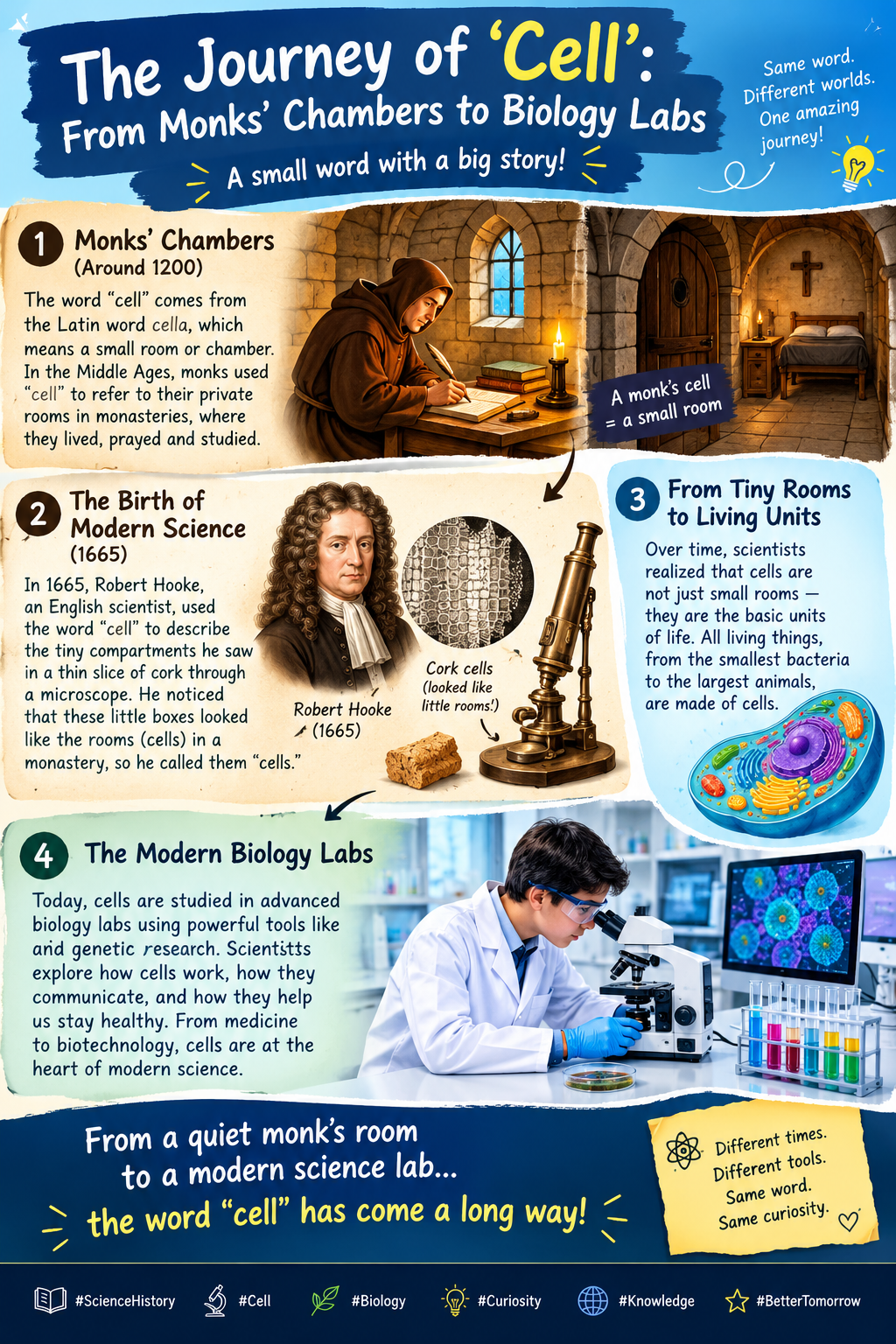
    **The Journey of “Cell”: From Monks’ Chambers to Biology Labs **

    **Have you ever wondered why the tiny building blocks of life are called “cells”?** The story behind this important scientific word takes us on a fascinating journey from the quiet chambers of monks to modern biology laboratories!

    The word **“cell”** comes from the Latin word *cella*, which means a small room or chamber. In the past, monks lived and prayed in small rooms called cells. These simple rooms inspired a name that would later become one of the most important words in biology! ‍

    In 1665, an English scientist named **Robert Hooke** made an important discovery. While examining a thin slice of cork under a microscope, he noticed many tiny, box-like compartments. They reminded him of the small rooms where monks lived, so he called them **“cells.”** This observation was published in his famous book *Micrographia*.

    But the story did not end there! Years later, scientists developed better microscopes and discovered that cells were not just empty compartments. They were the basic units of living things!

    ‍‍ Scientists such as **Antonie van Leeuwenhoek** observed living microscopic organisms, while other researchers helped build our understanding of cells. Over time, scientists developed the **cell theory**, which explains that all living organisms are made of one or more cells and that new cells come from existing cells.

    Today, cells are studied in laboratories all around the world. Scientists explore how cells grow, obtain energy, communicate, reproduce, and help our bodies function. From the cells in plants to the cells in humans , these tiny structures play an enormous role in life!

    **What makes this journey so amazing?** A word that once described a small room became the name for the fundamental unit of life. It reminds us that even the smallest observation can lead to a huge scientific discovery!

    **Learning Message:** Stay curious, keep asking questions, and never underestimate the power of observation. Every great discovery begins with someone noticing something others might overlook!

    **Question for You:** If you could look at any object under a powerful microscope, what would you choose to explore? Share your answer in the comments!

    Like, share, and comment to spread the love of science and learning! Let's inspire more young scientists to explore the amazing world around us.

    #JourneyOfCell #HistoryOfScience #RobertHooke #CellDiscovery #CellTheory #Biology #ScienceEducation #Microscope #ScientificDiscoveries #LearningIsFun #YoungScientists #ExploreAndDiscover #ScienceForEveryone #BiologyFacts #KnowledgeIsPower #Curiosity #STEMEducation #RehanSchool #RSISB #RehanCodingWithAI
    #rsisb Roll no. 247 Story post . 18 Foundation level 🔬📚 **The Journey of “Cell”: From Monks’ Chambers to Biology Labs 🧫✨** 🌍🤔 **Have you ever wondered why the tiny building blocks of life are called “cells”?** The story behind this important scientific word takes us on a fascinating journey from the quiet chambers of monks to modern biology laboratories! 🏛️➡️🔬 📖✨ The word **“cell”** comes from the Latin word *cella*, which means a small room or chamber. In the past, monks lived and prayed in small rooms called cells. These simple rooms inspired a name that would later become one of the most important words in biology! 🧑‍🏫🏛️ 🔍🧪 In 1665, an English scientist named **Robert Hooke** made an important discovery. While examining a thin slice of cork under a microscope, he noticed many tiny, box-like compartments. They reminded him of the small rooms where monks lived, so he called them **“cells.”** 🧫🔬 This observation was published in his famous book *Micrographia*. 🌟🔬 But the story did not end there! Years later, scientists developed better microscopes and discovered that cells were not just empty compartments. They were the basic units of living things! 🦠🌱 👨‍🔬👩‍🔬 Scientists such as **Antonie van Leeuwenhoek** observed living microscopic organisms, while other researchers helped build our understanding of cells. Over time, scientists developed the **cell theory**, which explains that all living organisms are made of one or more cells and that new cells come from existing cells. 🧬💡 🌿🐾 Today, cells are studied in laboratories all around the world. Scientists explore how cells grow, obtain energy, communicate, reproduce, and help our bodies function. From the cells in plants 🌱 to the cells in humans 🧍, these tiny structures play an enormous role in life! 🚀💭 **What makes this journey so amazing?** A word that once described a small room became the name for the fundamental unit of life. It reminds us that even the smallest observation can lead to a huge scientific discovery! 🎯📚 **Learning Message:** Stay curious, keep asking questions, and never underestimate the power of observation. Every great discovery begins with someone noticing something others might overlook! 🌈🔍 💬 **Question for You:** If you could look at any object under a powerful microscope, what would you choose to explore? 🔬🤔 Share your answer in the comments! ❤️👍 Like, share, and comment to spread the love of science and learning! Let's inspire more young scientists to explore the amazing world around us. 🌍🧪✨ #JourneyOfCell #HistoryOfScience #RobertHooke #CellDiscovery #CellTheory #Biology #ScienceEducation #Microscope #ScientificDiscoveries #LearningIsFun #YoungScientists #ExploreAndDiscover #ScienceForEveryone #BiologyFacts #KnowledgeIsPower #Curiosity #STEMEducation #RehanSchool #RSISB #RehanCodingWithAI 📚🔬🌱✨
    0 تبصرے 0 شیئرز 2144 ویوز
  • #rsisb
    Roll NO:232
    Foundation level student.
    Story post:21

    ### Description

    **The Journey of “Cell”: From Monks’ Chambers to Biology Labs**

    Have you ever wondered how the tiny building blocks of life got the name **“cell”**? The story begins with the English scientist **Robert Hooke**, who used a microscope to examine thin slices of cork in the 17th century. He noticed small compartments that reminded him of the tiny rooms, or cells, used by monks.

    Explore how this simple observation helped inspire a word that later became one of the most important concepts in modern biology. From early microscopes to today’s advanced biology laboratories, discover the fascinating journey of the **cell**!

    ### Hashtags

    #Cell #HistoryOfScience #Biology #CellBiology #RobertHooke #Microscope #ScienceHistory #BiologyLab #Science #LifeScience #HumanBiology #Discovery #ScientificDiscovery #Education #Learning #ScienceEducation #BiologyFacts #AmazingScience #Knowledge #ExploreScience

    ### Emojis

    ‍
    #rsisb Roll NO:232 Foundation level student. Story post:21 ### 🔬 Description **The Journey of “Cell”: From Monks’ Chambers to Biology Labs** 🧬📚✨ Have you ever wondered how the tiny building blocks of life got the name **“cell”**? 🤔🔬 The story begins with the English scientist **Robert Hooke**, who used a microscope to examine thin slices of cork in the 17th century. He noticed small compartments that reminded him of the tiny rooms, or cells, used by monks. 🏛️🔎 Explore how this simple observation helped inspire a word that later became one of the most important concepts in modern biology. 🧫🧬 From early microscopes to today’s advanced biology laboratories, discover the fascinating journey of the **cell**! 🌱🔬🚀 ### 🔖 Hashtags #Cell #HistoryOfScience #Biology #CellBiology #RobertHooke #Microscope #ScienceHistory #BiologyLab #Science #LifeScience #HumanBiology #Discovery #ScientificDiscovery #Education #Learning #ScienceEducation #BiologyFacts #AmazingScience #Knowledge #ExploreScience ### 🌟 Emojis 🔬🧬🧫📚✨🔎🏛️🧪🌱🦠🧠💡🚀🌍📖🔬👨‍🔬🌟🧫🔍
    0 تبصرے 0 شیئرز 1956 ویوز
  • #rsisb
    Roll no.239
    Story post no.24
    Foundation Level
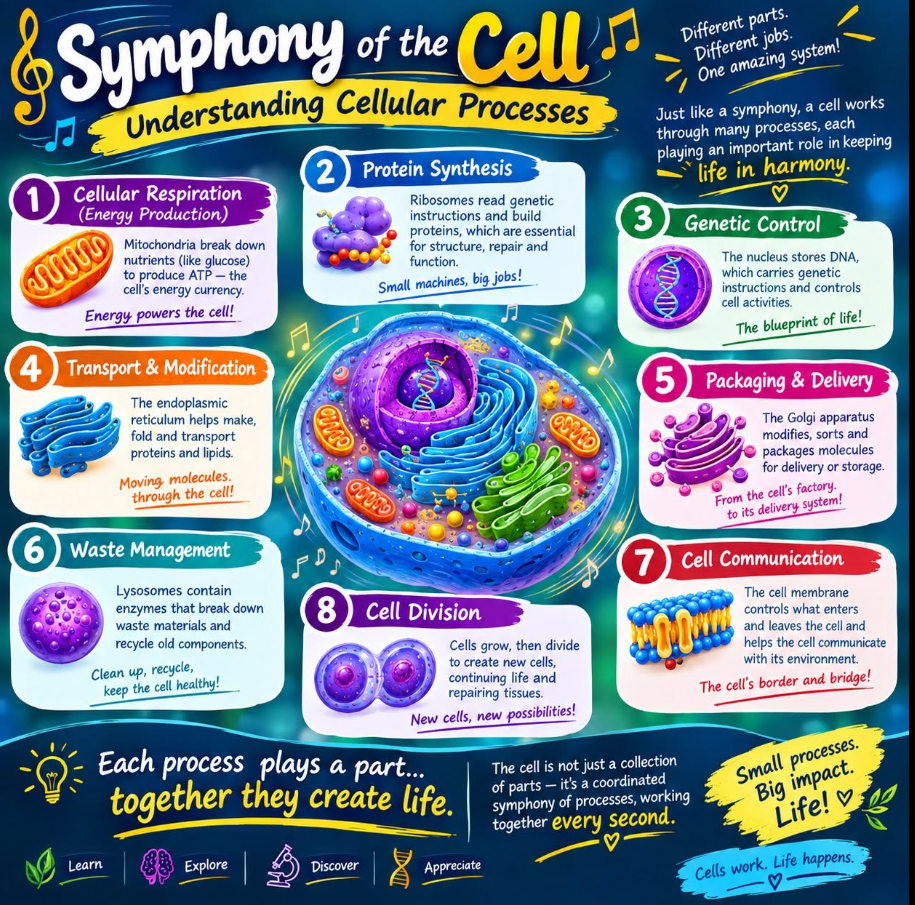
    Imagine a cell as a magnificent orchestra, where every organelle has its own instrument and every cellular process plays an important part. Together, they create the incredible **symphony of life**.
    Just as an orchestra depends on different musicians working together, a cell depends on many specialized structures and processes to stay organized and function properly.
    **Cellular Respiration — The Energy Makers**
    Mitochondria help produce ATP, the usable energy that powers many cellular activities.
    **Genetic Control — The Instructions**
    The nucleus stores DNA, which contains genetic information that helps guide cell activities.
    **Protein Synthesis — The Builders**
    Ribosomes use genetic instructions to build proteins needed for growth, repair, and everyday cellular functions.
    **Transport & Modification — The Delivery Network**
    The endoplasmic reticulum helps produce and transport proteins and lipids within the cell.
    **Packaging & Delivery — The Shipping Center**
    The Golgi apparatus modifies, sorts, and packages molecules so they can reach their proper destinations.
    **Waste Management — The Recycling Team**
    Lysosomes help break down unwanted materials and recycle components within the cell.
    **Cell Communication — The Gatekeeper**
    The cell membrane controls what enters and leaves the cell while helping the cell interact with its surroundings.
    **Cell Division — Creating New Cells**
    Cells can grow and divide, allowing organisms to develop, replace cells, and repair tissues.
    Every process has a role. Every organelle contributes to the performance. And together, they demonstrate one of biology’s most fascinating ideas:
    **A cell is not simply a collection of parts—it is a coordinated system where countless processes work together to support life.**
    **Learn. Explore. Discover. Appreciate the amazing symphony happening inside every living cell.**
    #SymphonyOfTheCell #CellBiology #Biology #CellularProcesses #Organelles #Science #ScienceEducation #BiologyFacts #CellStructure #Mitochondria #DNA #ProteinSynthesis #CellDivision #Microscopy #Learning #DidYouKnow #ScientificDiscovery
    #rsisb Roll no.239 Story post no.24 Foundation Level Imagine a cell as a magnificent orchestra, where every organelle has its own instrument and every cellular process plays an important part. Together, they create the incredible **symphony of life**. 🎼🌱 Just as an orchestra depends on different musicians working together, a cell depends on many specialized structures and processes to stay organized and function properly. ⚡ **Cellular Respiration — The Energy Makers** Mitochondria help produce ATP, the usable energy that powers many cellular activities. 🧬 **Genetic Control — The Instructions** The nucleus stores DNA, which contains genetic information that helps guide cell activities. 🏭 **Protein Synthesis — The Builders** Ribosomes use genetic instructions to build proteins needed for growth, repair, and everyday cellular functions. 🚚 **Transport & Modification — The Delivery Network** The endoplasmic reticulum helps produce and transport proteins and lipids within the cell. 📦 **Packaging & Delivery — The Shipping Center** The Golgi apparatus modifies, sorts, and packages molecules so they can reach their proper destinations. ♻️ **Waste Management — The Recycling Team** Lysosomes help break down unwanted materials and recycle components within the cell. 🚪 **Cell Communication — The Gatekeeper** The cell membrane controls what enters and leaves the cell while helping the cell interact with its surroundings. 🌱 **Cell Division — Creating New Cells** Cells can grow and divide, allowing organisms to develop, replace cells, and repair tissues. Every process has a role. Every organelle contributes to the performance. And together, they demonstrate one of biology’s most fascinating ideas: ✨ **A cell is not simply a collection of parts—it is a coordinated system where countless processes work together to support life.** 🔬 **Learn. Explore. Discover. Appreciate the amazing symphony happening inside every living cell.** #SymphonyOfTheCell #CellBiology #Biology #CellularProcesses #Organelles #Science #ScienceEducation #BiologyFacts #CellStructure #Mitochondria #DNA #ProteinSynthesis #CellDivision #Microscopy #Learning #DidYouKnow #ScientificDiscovery
    0 تبصرے 0 شیئرز 5757 ویوز
  • #rsisb
    Roll no.239
    Story post no.25
    Foundation Level

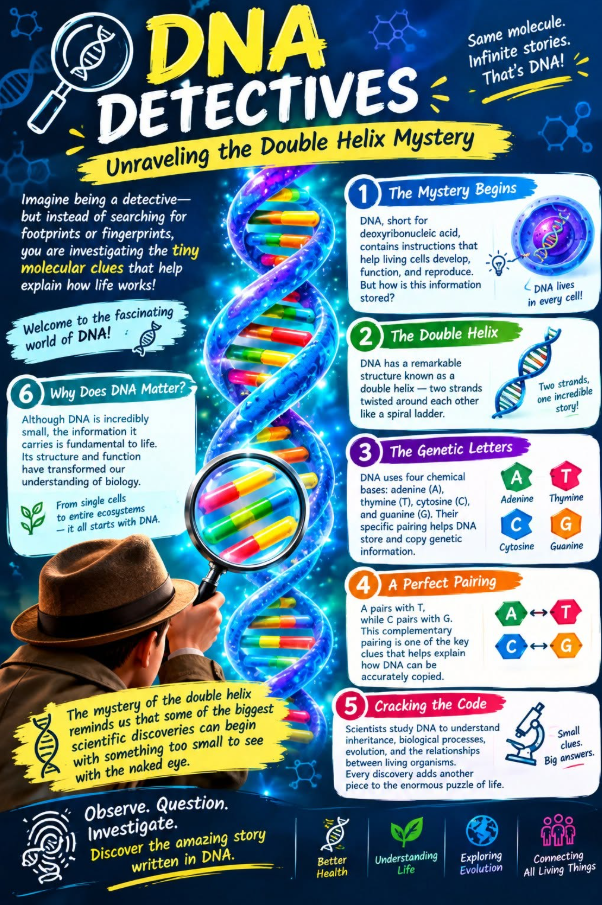
    Imagine being a detective—but instead of searching for footprints or fingerprints, you are investigating the tiny molecular clues that help explain how life works!

    Welcome to the fascinating world of **DNA**, the molecule that carries genetic information in living organisms.

    **The Mystery Begins**
    DNA, short for **deoxyribonucleic acid**, contains instructions that help living cells develop, function, and reproduce. But how is this information stored?

    **The Double Helix**
    DNA has a remarkable structure known as a **double helix**—two strands twisted around each other like a spiral ladder.

    **The Genetic Letters**
    DNA uses four chemical bases: **adenine (A), thymine (T), cytosine (C), and guanine (G)**. Their specific pairing helps DNA store and copy genetic information.

    **A Perfect Pairing**
    A pairs with T, while C pairs with G. This complementary pairing is one of the key clues that helps explain how DNA can be accurately copied.

    **Cracking the Code**
    Scientists study DNA to understand inheritance, biological processes, evolution, and the relationships between living organisms. Every discovery adds another piece to the enormous puzzle of life.

    **Why Does DNA Matter?**
    Although DNA is incredibly small, the information it carries is fundamental to life. Its structure and function have transformed our understanding of biology.

    **The mystery of the double helix reminds us that some of the biggest scientific discoveries can begin with something too small to see with the naked eye.**

    **Observe. Question. Investigate. Discover the amazing story written in DNA.**

    #DNADetectives #DNA #DoubleHelix #Genetics #Biology #Science #MolecularBiology #GeneticCode #ScienceEducation #BiologyFacts

    #rsisb Roll no.239 Story post no.25 Foundation Level Imagine being a detective—but instead of searching for footprints or fingerprints, you are investigating the tiny molecular clues that help explain how life works! Welcome to the fascinating world of **DNA**, the molecule that carries genetic information in living organisms. 🧬 🔍 **The Mystery Begins** DNA, short for **deoxyribonucleic acid**, contains instructions that help living cells develop, function, and reproduce. But how is this information stored? 🧩 **The Double Helix** DNA has a remarkable structure known as a **double helix**—two strands twisted around each other like a spiral ladder. 🪜 **The Genetic Letters** DNA uses four chemical bases: **adenine (A), thymine (T), cytosine (C), and guanine (G)**. Their specific pairing helps DNA store and copy genetic information. 🔗 **A Perfect Pairing** A pairs with T, while C pairs with G. This complementary pairing is one of the key clues that helps explain how DNA can be accurately copied. 🧬 **Cracking the Code** Scientists study DNA to understand inheritance, biological processes, evolution, and the relationships between living organisms. Every discovery adds another piece to the enormous puzzle of life. 💡 **Why Does DNA Matter?** Although DNA is incredibly small, the information it carries is fundamental to life. Its structure and function have transformed our understanding of biology. ✨ **The mystery of the double helix reminds us that some of the biggest scientific discoveries can begin with something too small to see with the naked eye.** 🔎 **Observe. Question. Investigate. Discover the amazing story written in DNA.** #DNADetectives #DNA #DoubleHelix #Genetics #Biology #Science #MolecularBiology #GeneticCode #ScienceEducation #BiologyFacts
    0 تبصرے 0 شیئرز 2040 ویوز
  • #rsisb
    Roll no.239
    Story post no.27
    Foundation Level

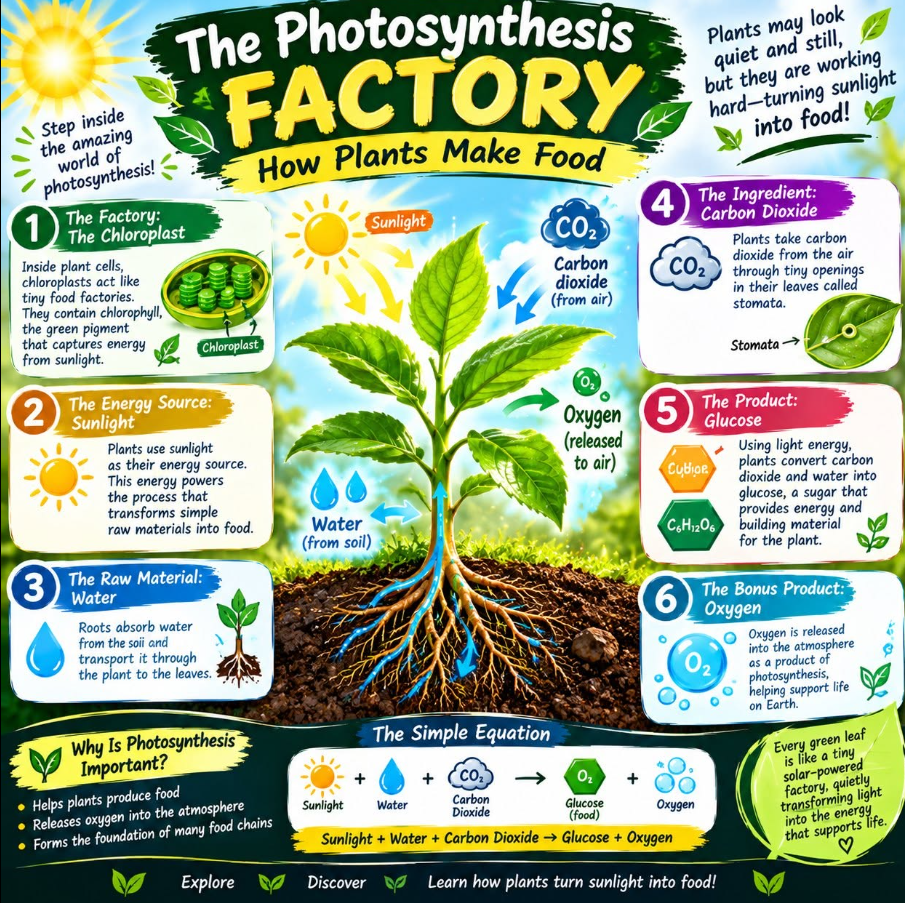
    Have you ever wondered how plants make their own food? Step inside the amazing **Photosynthesis Factory** and discover one of nature’s most important processes!

    **The Factory: The Chloroplast**
    Inside plant cells, chloroplasts act like tiny food factories. They contain **chlorophyll**, the green pigment that captures energy from sunlight.

    **The Energy Source: Sunlight**
    Plants use sunlight as their energy source. This energy powers the process that transforms simple raw materials into food.

    **The Raw Material: Water**
    Roots absorb water from the soil and transport it through the plant to the leaves.

    **The Ingredient: Carbon Dioxide**
    Plants take carbon dioxide from the air through tiny openings in their leaves called **stomata**.

    **The Product: Glucose**
    Using light energy, plants convert carbon dioxide and water into **glucose**, a sugar that provides energy and building material for the plant.

    **The Bonus Product: Oxygen**
    Oxygen is released into the atmosphere as a product of photosynthesis, helping support life on Earth.

    **Why Is Photosynthesis Important?**
    Photosynthesis is fundamental to life because it helps plants produce food and contributes oxygen to Earth’s atmosphere. It also forms the foundation of many food chains.

    **The amazing process can be summarized simply:**
    Sunlight + Water + Carbon Dioxide → Glucose + Oxygen

    **Every green leaf is like a tiny solar-powered factory, quietly transforming light into the energy that supports life.**

    **Explore. Discover. Learn how plants turn sunlight into food!**

    #Photosynthesis #PlantBiology #Biology #Science #Plants #Chloroplasts #Chlorophyll #ScienceEducation #BiologyFacts #Nature #Botany #STEM #Learning #DidYouKnow #ScientificDiscovery
    #rsisb Roll no.239 Story post no.27 Foundation Level Have you ever wondered how plants make their own food? Step inside the amazing **Photosynthesis Factory** and discover one of nature’s most important processes! 🌿✨ 🏭 **The Factory: The Chloroplast** Inside plant cells, chloroplasts act like tiny food factories. They contain **chlorophyll**, the green pigment that captures energy from sunlight. ☀️ **The Energy Source: Sunlight** Plants use sunlight as their energy source. This energy powers the process that transforms simple raw materials into food. 💧 **The Raw Material: Water** Roots absorb water from the soil and transport it through the plant to the leaves. 🌬️ **The Ingredient: Carbon Dioxide** Plants take carbon dioxide from the air through tiny openings in their leaves called **stomata**. 🍬 **The Product: Glucose** Using light energy, plants convert carbon dioxide and water into **glucose**, a sugar that provides energy and building material for the plant. 💨 **The Bonus Product: Oxygen** Oxygen is released into the atmosphere as a product of photosynthesis, helping support life on Earth. 🌱 **Why Is Photosynthesis Important?** Photosynthesis is fundamental to life because it helps plants produce food and contributes oxygen to Earth’s atmosphere. It also forms the foundation of many food chains. 🔬 **The amazing process can be summarized simply:** ☀️ Sunlight + 💧 Water + 🌬️ Carbon Dioxide → 🍬 Glucose + 💨 Oxygen ✨ **Every green leaf is like a tiny solar-powered factory, quietly transforming light into the energy that supports life.** 🌿 **Explore. Discover. Learn how plants turn sunlight into food!** #Photosynthesis #PlantBiology #Biology #Science #Plants #Chloroplasts #Chlorophyll #ScienceEducation #BiologyFacts #Nature #Botany #STEM #Learning #DidYouKnow #ScientificDiscovery
    0 تبصرے 0 شیئرز 2200 ویوز
  • #rsisb
    Roll no.239
    Story post no.23
    Foundation Level


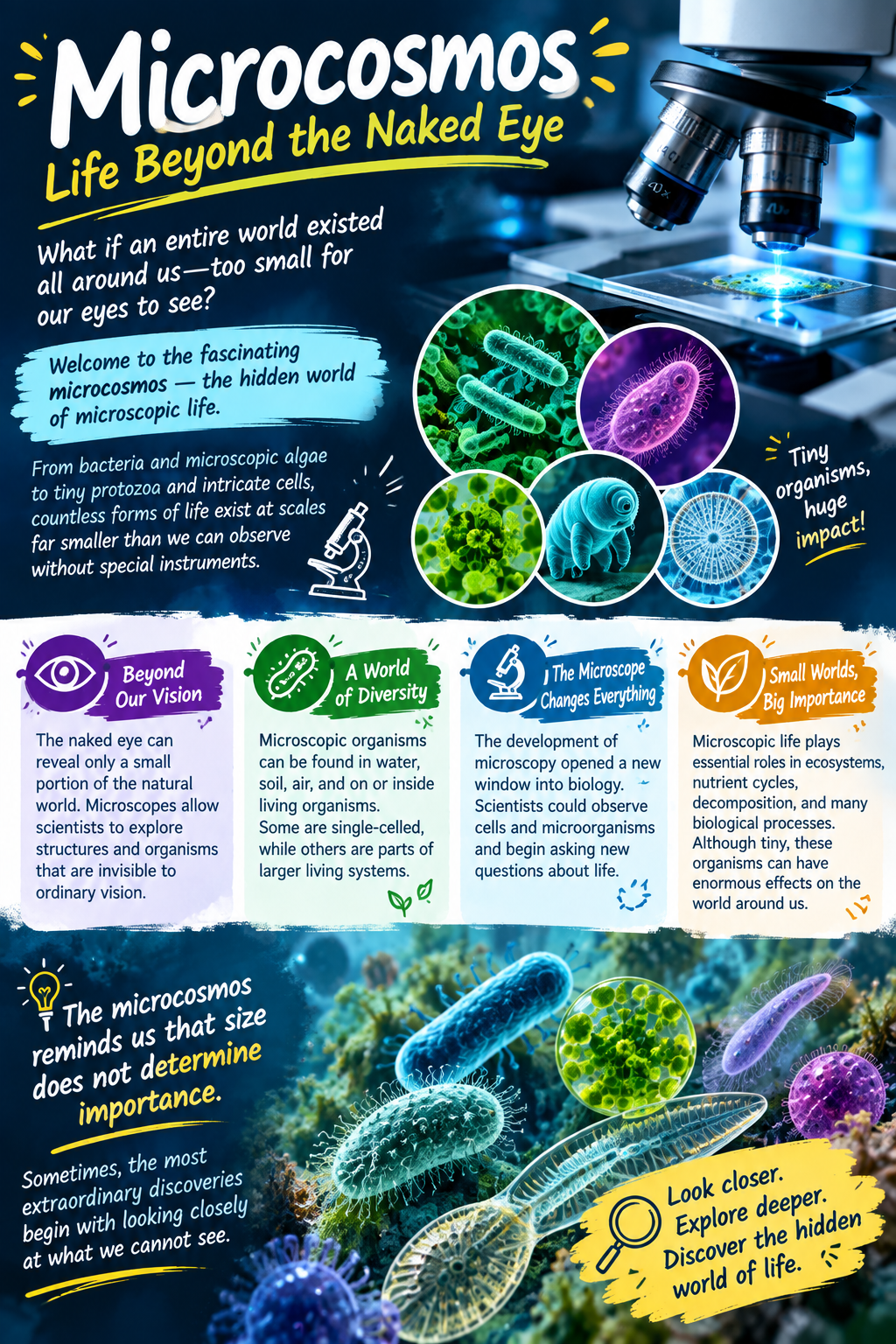
    Welcome to the fascinating **microcosmos**, the hidden world of microscopic life. From bacteria and microscopic algae to tiny protozoa and intricate cells, countless forms of life exist at scales far smaller than we can observe without special instruments.

    **Beyond Our Vision**
    The naked eye can reveal only a small portion of the natural world. Microscopes allow scientists to explore structures and organisms that are invisible to ordinary vision.

    **A World of Diversity**
    Microscopic organisms can be found in water, soil, air, and on or inside living organisms. Some are single-celled, while others are parts of larger living systems.

    **The Microscope Changes Everything**
    The development of microscopy opened a new window into biology. Scientists could observe cells and microorganisms and begin asking new questions about life.

    **Small Worlds, Big Importance**
    Microscopic life plays essential roles in ecosystems, nutrient cycles, decomposition, and many biological processes. Although tiny, these organisms can have enormous effects on the world around us.

    **The microcosmos reminds us that size does not determine importance. Sometimes, the most extraordinary discoveries begin with looking closely at what we cannot see.**

    **Look closer. Explore deeper. Discover the hidden world of life.**

    #Microcosmos #MicroscopicWorld #Microscopy #Biology #Microbiology #Science #Cells #Microorganisms #NaturalWorld #ScienceEducation #BiologyFacts #DidYouKnow #ExploreScience #Learning #ScientificDiscovery
    #rsisb Roll no.239 Story post no.23 Foundation Level Welcome to the fascinating **microcosmos**, the hidden world of microscopic life. From bacteria and microscopic algae to tiny protozoa and intricate cells, countless forms of life exist at scales far smaller than we can observe without special instruments. 🔬 👁️ **Beyond Our Vision** The naked eye can reveal only a small portion of the natural world. Microscopes allow scientists to explore structures and organisms that are invisible to ordinary vision. 🧫 **A World of Diversity** Microscopic organisms can be found in water, soil, air, and on or inside living organisms. Some are single-celled, while others are parts of larger living systems. 🔬 **The Microscope Changes Everything** The development of microscopy opened a new window into biology. Scientists could observe cells and microorganisms and begin asking new questions about life. 🌱 **Small Worlds, Big Importance** Microscopic life plays essential roles in ecosystems, nutrient cycles, decomposition, and many biological processes. Although tiny, these organisms can have enormous effects on the world around us. ✨ **The microcosmos reminds us that size does not determine importance. Sometimes, the most extraordinary discoveries begin with looking closely at what we cannot see.** 🔍 **Look closer. Explore deeper. Discover the hidden world of life.** #Microcosmos #MicroscopicWorld #Microscopy #Biology #Microbiology #Science #Cells #Microorganisms #NaturalWorld #ScienceEducation #BiologyFacts #DidYouKnow #ExploreScience #Learning #ScientificDiscovery
    0 تبصرے 0 شیئرز 2248 ویوز
  • #rsisb
    Roll no.239
    Story post no.22
    Foundation Level


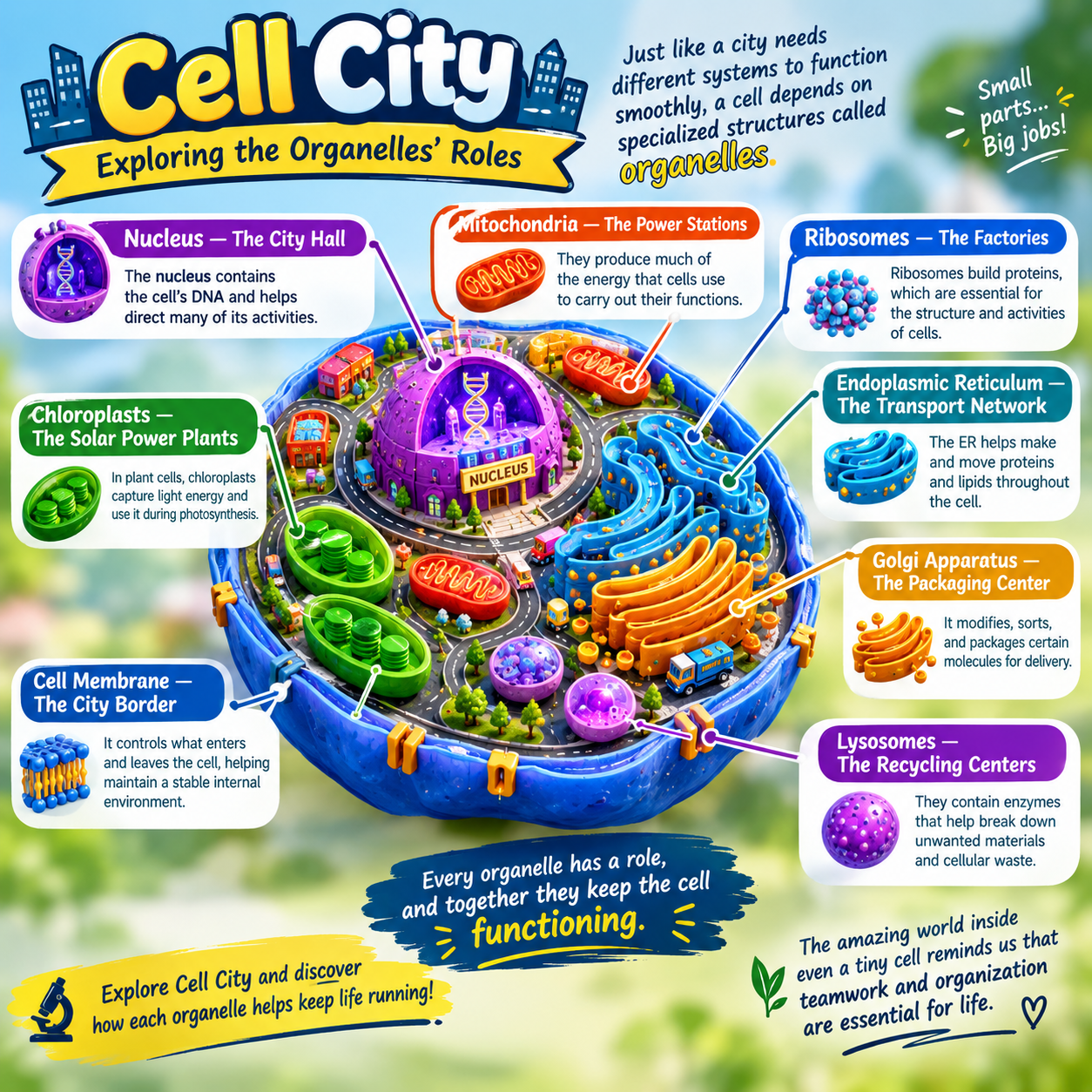
    Imagine a living cell as a busy, well-organized city where every building, worker, and department has an important job. Welcome to **Cell City**!

    Just like a city needs different systems to function smoothly, a cell depends on specialized structures called **organelles**.

    **Nucleus — The City Hall**
    The nucleus contains the cell’s DNA and helps direct many of its activities.

    **Mitochondria — The Power Stations**
    They produce much of the energy that cells use to carry out their functions.

    **Ribosomes — The Factories**
    Ribosomes build proteins, which are essential for the structure and activities of cells.

    **Endoplasmic Reticulum — The Transport Network**
    The ER helps make and move proteins and lipids throughout the cell.

    **Golgi Apparatus — The Packaging Center**
    It modifies, sorts, and packages certain molecules for delivery.

    **Lysosomes — The Recycling Centers**
    They contain enzymes that help break down unwanted materials and cellular waste.

    **Cell Membrane — The City Border**
    It controls what enters and leaves the cell, helping maintain a stable internal environment.

    **Chloroplasts — The Solar Power Plants**
    In plant cells, chloroplasts capture light energy and use it during photosynthesis.

    Every organelle has a role, and together they keep the cell functioning. The amazing world inside even a tiny cell reminds us that **teamwork and organization are essential for life.**

    **Explore Cell City and discover how each organelle helps keep life running!**

    #CellCity #CellBiology #Organelles #Biology #Science #ScienceEducation #BiologyFacts #CellStructure #Mitochondria #Nucleus #Ribosomes #GolgiApparatus #Chloroplasts #Learning #DidYouKnow #education
    #rsisb Roll no.239 Story post no.22 Foundation Level Imagine a living cell as a busy, well-organized city where every building, worker, and department has an important job. Welcome to **Cell City**! 🏙️ Just like a city needs different systems to function smoothly, a cell depends on specialized structures called **organelles**. 🏛️ **Nucleus — The City Hall** The nucleus contains the cell’s DNA and helps direct many of its activities. ⚡ **Mitochondria — The Power Stations** They produce much of the energy that cells use to carry out their functions. 🏭 **Ribosomes — The Factories** Ribosomes build proteins, which are essential for the structure and activities of cells. 🚚 **Endoplasmic Reticulum — The Transport Network** The ER helps make and move proteins and lipids throughout the cell. 📦 **Golgi Apparatus — The Packaging Center** It modifies, sorts, and packages certain molecules for delivery. ♻️ **Lysosomes — The Recycling Centers** They contain enzymes that help break down unwanted materials and cellular waste. 🚪 **Cell Membrane — The City Border** It controls what enters and leaves the cell, helping maintain a stable internal environment. 🌿 **Chloroplasts — The Solar Power Plants** In plant cells, chloroplasts capture light energy and use it during photosynthesis. Every organelle has a role, and together they keep the cell functioning. The amazing world inside even a tiny cell reminds us that **teamwork and organization are essential for life.** 🌱🔬 ✨ **Explore Cell City and discover how each organelle helps keep life running!** #CellCity #CellBiology #Organelles #Biology #Science #ScienceEducation #BiologyFacts #CellStructure #Mitochondria #Nucleus #Ribosomes #GolgiApparatus #Chloroplasts #Learning #DidYouKnow #education
    0 تبصرے 0 شیئرز 4389 ویوز
  • #rsisb
    Roll no.239
    Story post no.20
    Foundation Level

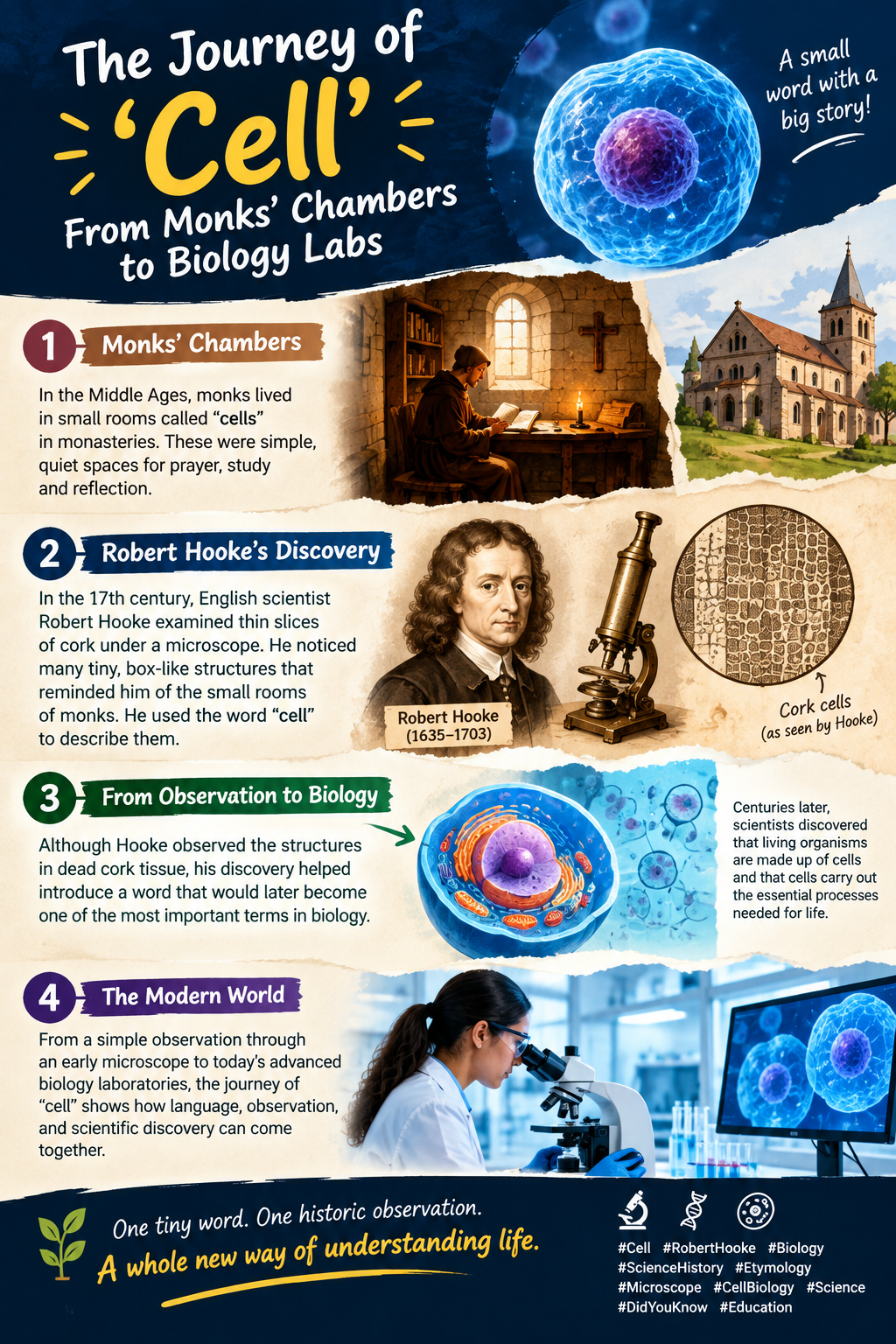
    In the 17th century, English scientist **Robert Hooke** examined thin slices of cork under a microscope. He noticed many tiny, box-like structures that reminded him of the small rooms, or **cells**, occupied by monks. He used the word **“cell”** to describe them.

    Although Hooke observed the structures in dead cork tissue, his discovery helped introduce a word that would later become one of the most important terms in biology.

    Centuries later, scientists discovered that living organisms are made up of cells and that cells carry out the essential processes needed for life. From a simple observation through an early microscope to today’s advanced biology laboratories, the journey of **“cell”** shows how language, observation, and scientific discovery can come together.

    **One tiny word. One historic observation. A whole new way of understanding life.**

    #Cell #RobertHooke #Biology #ScienceHistory #HistoryOfWords #Etymology #Microscope #CellBiology #Science #BiologyFacts #DidYouKnow #Education #Learning #ScientificDiscovery
    #rsisb Roll no.239 Story post no.20 Foundation Level In the 17th century, English scientist **Robert Hooke** examined thin slices of cork under a microscope. He noticed many tiny, box-like structures that reminded him of the small rooms, or **cells**, occupied by monks. He used the word **“cell”** to describe them. Although Hooke observed the structures in dead cork tissue, his discovery helped introduce a word that would later become one of the most important terms in biology. 🧬 Centuries later, scientists discovered that living organisms are made up of cells and that cells carry out the essential processes needed for life. From a simple observation through an early microscope to today’s advanced biology laboratories, the journey of **“cell”** shows how language, observation, and scientific discovery can come together. 🌱 **One tiny word. One historic observation. A whole new way of understanding life.** #Cell #RobertHooke #Biology #ScienceHistory #HistoryOfWords #Etymology #Microscope #CellBiology #Science #BiologyFacts #DidYouKnow #Education #Learning #ScientificDiscovery
    0 تبصرے 0 شیئرز 1461 ویوز
  • RSIF8
    Roll NO 13
    Story Post no 7
    Story post topic **The Mystery of Life: Exploring the World of Cells**

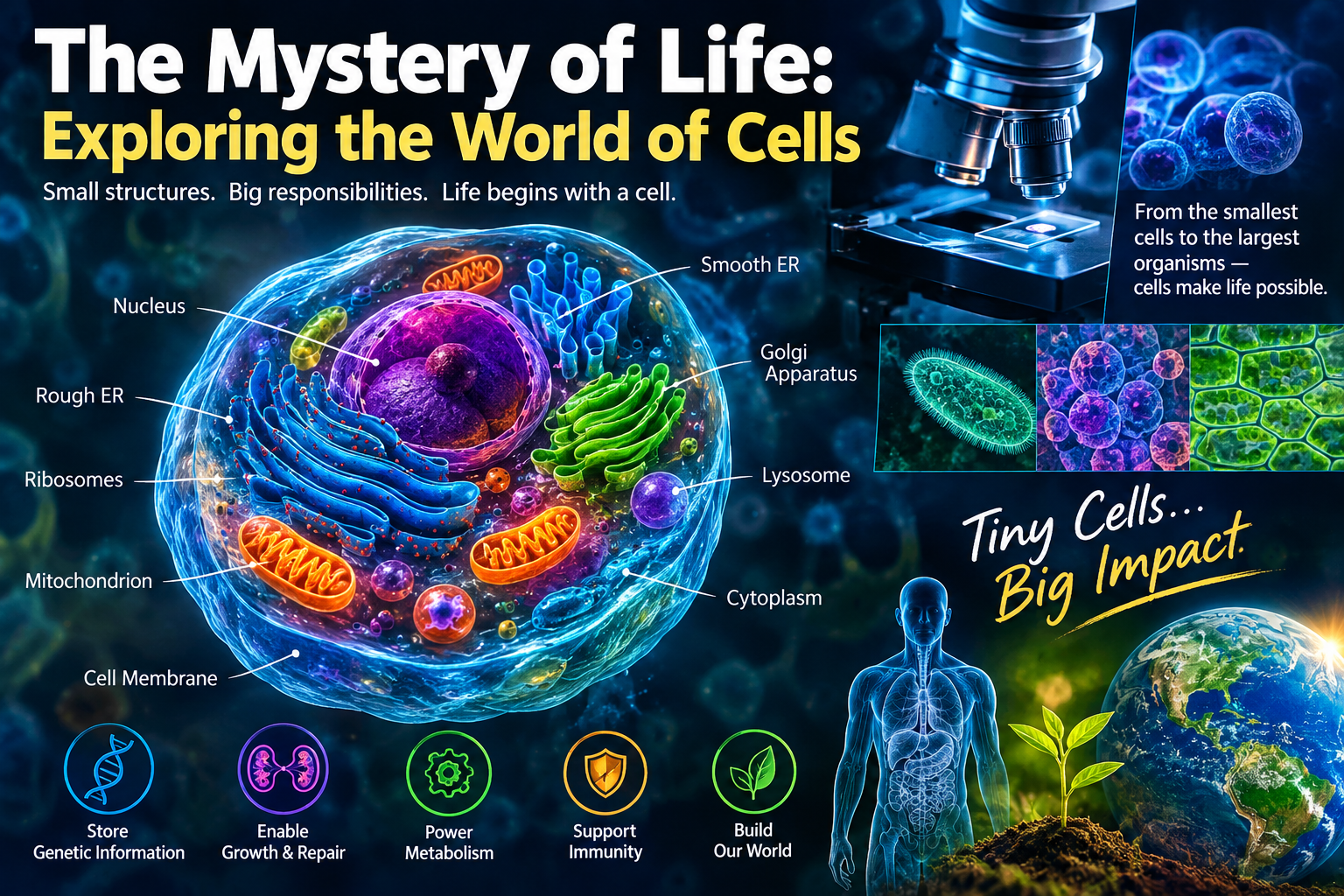
    Have you ever wondered what makes life possible? ‍ At the heart of every living organism is a tiny but incredibly complex structure—the **cell**. Cells are often called the basic building blocks of life, and they carry out countless activities that keep living things alive.

    In this fascinating journey, we explore the **world of cells**, from the cell membrane and nucleus to mitochondria, ribosomes, and other important organelles. We’ll discover how cells produce energy, grow, communicate, reproduce, and work together to form tissues, organs, and complete organisms.

    Whether you’re a student, science enthusiast, or simply curious about how life works, this topic will help you understand the microscopic world that exists all around us—and inside us.

    Join us as we uncover **The Mystery of Life: Exploring the World of Cells!**

    #CellBiology #Cells #Science #Biology #LifeScience #MicroscopicWorld #HumanBody #ScienceEducation #BiologyFacts #Learning #Education #DNA #Mitochondria #Nature #ExploreScience
    RSIF8 Roll NO 13 Story Post no 7 Story post topic 🔬 **The Mystery of Life: Exploring the World of Cells** 🧬 Have you ever wondered what makes life possible? 🌱🧑‍🔬 At the heart of every living organism is a tiny but incredibly complex structure—the **cell**. Cells are often called the basic building blocks of life, and they carry out countless activities that keep living things alive. In this fascinating journey, we explore the **world of cells**, from the cell membrane and nucleus to mitochondria, ribosomes, and other important organelles. 🧫✨ We’ll discover how cells produce energy, grow, communicate, reproduce, and work together to form tissues, organs, and complete organisms. Whether you’re a student, science enthusiast, or simply curious about how life works, this topic will help you understand the microscopic world that exists all around us—and inside us. 🌍🔬 👉 Join us as we uncover **The Mystery of Life: Exploring the World of Cells!** #CellBiology #Cells #Science #Biology #LifeScience #MicroscopicWorld #HumanBody #ScienceEducation #BiologyFacts #Learning #Education #DNA #Mitochondria #Nature #ExploreScience
    0 تبصرے 0 شیئرز 2233 ویوز
More Results