• RSIF8
    Roll no 97
    Task no 10
    Task topic Mulla Nasrudin & the Donkey's Price

    Sometimes, we don’t realize the true value of what we already have until someone else points it out. In this classic tale, Mulla Nasrudin plans to sell his donkey, but after hearing it praised as strong, hardworking, and intelligent, he begins to see it in a whole new light. By the time he reaches the market, he decides to keep it, realizing he would be foolish to part with something so valuable. A humorous and timeless story that reminds us to appreciate the blessings and treasures already in our lives.

    #MullaNasrudin #DonkeysPrice #MoralStory #StoryTime #LifeLessons #WisdomStories #InspirationalStories #ClassicTales #HumorWithWisdom #ValueWhatYouHave #Motivation #PersonalGrowth #PositiveThinking #LearningThroughStories #DailyWisdom #SocialMediaStory #MindsetMatters #Appreciation #Storytelling #MotivationalContent
    RSIF8 Roll no 97 Task no 10 Task topic Mulla Nasrudin & the Donkey's Price Sometimes, we don’t realize the true value of what we already have until someone else points it out. In this classic tale, Mulla Nasrudin plans to sell his donkey, but after hearing it praised as strong, hardworking, and intelligent, he begins to see it in a whole new light. By the time he reaches the market, he decides to keep it, realizing he would be foolish to part with something so valuable. A humorous and timeless story that reminds us to appreciate the blessings and treasures already in our lives. 🌟😊 #MullaNasrudin #DonkeysPrice #MoralStory #StoryTime #LifeLessons #WisdomStories #InspirationalStories #ClassicTales #HumorWithWisdom #ValueWhatYouHave #Motivation #PersonalGrowth #PositiveThinking #LearningThroughStories #DailyWisdom #SocialMediaStory #MindsetMatters #Appreciation #Storytelling #MotivationalContent πŸ΄πŸ“šβœ¨
    0 Commenti 0 condivisioni 908 Views
  • #rsisb
    Roll no.247
    call annie no.18
    Foundation level

    **Water – The Origin of Life and Language | 25-Minute Exploration**

    Water is one of the simplest substances on Earth, yet it plays one of the most extraordinary roles in our existence. From the earliest forms of life to the development of human civilization, water has shaped the story of our planet in countless ways. In this fascinating 25-minute journey, **“Water – The Origin of Life and Language,”** we explore why water is so important to life and how it has influenced human history, culture, communication, and imagination.

    Life as we know it depends on water. Every living organism requires water in some way, and scientists consider liquid water one of the key ingredients necessary for life as we understand it. From microscopic cells to enormous ecosystems, water provides an environment where countless biological processes can occur.

    But water is more than a biological necessity. It has been at the heart of human civilization for thousands of years. Ancient communities developed around rivers, lakes, springs, and coastlines because access to water meant access to food, agriculture, transportation, and survival. The great civilizations of history were deeply connected to waterways, demonstrating how water helped shape where people lived and how societies developed.

    This exploration also takes us into the fascinating relationship between **water and language**. Humans have created thousands of words, expressions, stories, poems, songs, and metaphors inspired by water. Words associated with rivers, rain, oceans, waves, streams, and storms appear throughout languages and cultures around the world.

    Water has also become a powerful symbol in human communication. It can represent life, change, movement, renewal, peace, strength, and transformation. Just as water flows and changes its form, human language constantly evolves and adapts.

    Throughout this 25-minute presentation, we will think about some fascinating questions: **How did water contribute to the development of life? Why did civilizations grow near water? How has water influenced human culture? Why do so many languages contain words connected to water? And what can water teach us about life, change, and human connection?**

    The story of water is ultimately a story about ourselves. It connects science with history, nature with civilization, and biology with language. By understanding water, we gain a deeper appreciation for the remarkable planet we call home.

    So take a moment, relax, and join us on this fascinating journey through the science, history, language, and mystery of **water**.

    **Water gives life. Water shapes civilizations. Water inspires language. Water connects us all.**

    If you enjoyed this educational journey, don't forget to **Like, Share, and Subscribe** for more fascinating topics about science, history, nature, language, and the world around us!

    #Water #OriginOfLife #WaterAndLife #Science #Biology #Nature #Earth #LifeOnEarth #WaterCycle #Oceans #Rivers #HumanCivilization #AncientCivilizations #Language #OriginOfLanguage #HumanHistory #Environment #Education #EducationalVideo #ScienceEducation #NatureLovers #EarthScience #Knowledge #Learning #Curiosity #Discovery #Life #PlanetEarth #SaveWater #WaterIsLife #ExploreScience #AmazingScience #DidYouKnow #EducationalContent #ScienceAndNature
    #rsisb Roll no.247 call annie no.18 Foundation level πŸ’§πŸŒŠ **Water – The Origin of Life and Language | 25-Minute Exploration** 🌍🧬 Water is one of the simplest substances on Earth, yet it plays one of the most extraordinary roles in our existence. πŸ’§βœ¨ From the earliest forms of life to the development of human civilization, water has shaped the story of our planet in countless ways. In this fascinating 25-minute journey, **“Water – The Origin of Life and Language,”** we explore why water is so important to life and how it has influenced human history, culture, communication, and imagination. πŸŒŽπŸ”¬πŸ“– Life as we know it depends on water. πŸŒ±πŸ πŸ¦‹ Every living organism requires water in some way, and scientists consider liquid water one of the key ingredients necessary for life as we understand it. From microscopic cells to enormous ecosystems, water provides an environment where countless biological processes can occur. πŸ§¬πŸ”¬πŸ’¦ But water is more than a biological necessity. It has been at the heart of human civilization for thousands of years. Ancient communities developed around rivers, lakes, springs, and coastlines because access to water meant access to food, agriculture, transportation, and survival. 🏞️🏺🌾🚀 The great civilizations of history were deeply connected to waterways, demonstrating how water helped shape where people lived and how societies developed. This exploration also takes us into the fascinating relationship between **water and language**. πŸ—£οΈπŸ’§ Humans have created thousands of words, expressions, stories, poems, songs, and metaphors inspired by water. Words associated with rivers, rain, oceans, waves, streams, and storms appear throughout languages and cultures around the world. πŸŒ§οΈπŸŒŠπŸ“š Water has also become a powerful symbol in human communication. It can represent life, change, movement, renewal, peace, strength, and transformation. πŸŒŠπŸ•ŠοΈβœ¨ Just as water flows and changes its form, human language constantly evolves and adapts. Throughout this 25-minute presentation, we will think about some fascinating questions: **How did water contribute to the development of life? Why did civilizations grow near water? How has water influenced human culture? Why do so many languages contain words connected to water? And what can water teach us about life, change, and human connection?** πŸ€”πŸ’‘ The story of water is ultimately a story about ourselves. πŸ’™πŸŒ It connects science with history, nature with civilization, and biology with language. By understanding water, we gain a deeper appreciation for the remarkable planet we call home. So take a moment, relax, and join us on this fascinating journey through the science, history, language, and mystery of **water**. πŸ’§πŸŒŠπŸ”¬πŸ“š ✨ **Water gives life. Water shapes civilizations. Water inspires language. Water connects us all.** πŸŒπŸ’™ πŸ‘ If you enjoyed this educational journey, don't forget to **Like, Share, and Subscribe** for more fascinating topics about science, history, nature, language, and the world around us! πŸ””πŸ“šβœ¨ #Water #OriginOfLife #WaterAndLife #Science #Biology #Nature #Earth #LifeOnEarth #WaterCycle #Oceans #Rivers #HumanCivilization #AncientCivilizations #Language #OriginOfLanguage #HumanHistory #Environment #Education #EducationalVideo #ScienceEducation #NatureLovers #EarthScience #Knowledge #Learning #Curiosity #Discovery #Life #PlanetEarth #SaveWater #WaterIsLife #ExploreScience #AmazingScience #DidYouKnow #EducationalContent #ScienceAndNature πŸ’§πŸŒπŸŒŠπŸ§¬πŸ”¬πŸ“šβœ¨
    0 Commenti 0 condivisioni 1567 Views 8
  • #rsisb
    roll no 46
    call ani 8
    “Thank You” is one of the simplest and most meaningful phrases we use every day. But have you ever wondered where these two words came from and how they became a universal expression of gratitude?

    In this 5-minute journey, explore the fascinating history and etymology of “thank”, discover how the word evolved through the English language, and learn how people have expressed appreciation across different cultures and generations.

    From ancient expressions of appreciation to the modern-day “Thank You,” this topic shows how language, kindness, respect, and gratitude are connected. A small phrase can have a big impact—it can make someone feel valued, strengthen relationships, and spread positivity.

    Watch, learn, and discover the story behind one of the most powerful phrases in everyday language!

    Hashtags

    #ThankYou #Etymology #Gratitude #HistoryOfWords #Language #EnglishLanguage #WordOrigins #Thankfulness #Appreciation #Kindness #PositiveWords #Communication #LearnEnglish #InterestingFacts #Education #RehanSchool

    Emojis

    #rsisb roll no 46 call ani 8 “Thank You” is one of the simplest and most meaningful phrases we use every day. πŸŒπŸ’› But have you ever wondered where these two words came from and how they became a universal expression of gratitude? πŸ€” In this 5-minute journey, explore the fascinating history and etymology of “thank”, discover how the word evolved through the English language, and learn how people have expressed appreciation across different cultures and generations. πŸ“šπŸ—£οΈπŸŒŽ From ancient expressions of appreciation to the modern-day “Thank You,” this topic shows how language, kindness, respect, and gratitude are connected. β€οΈπŸ™ A small phrase can have a big impact—it can make someone feel valued, strengthen relationships, and spread positivity. 😊✨ 🎯 Watch, learn, and discover the story behind one of the most powerful phrases in everyday language! 🌟 🏷️ Hashtags #ThankYou #Etymology #Gratitude #HistoryOfWords #Language #EnglishLanguage #WordOrigins #Thankfulness #Appreciation #Kindness #PositiveWords #Communication #LearnEnglish #InterestingFacts #Education #RehanSchool 😊 Emojis πŸ™ ❀️ 🌟 πŸ“š πŸ” πŸ’­ 🌍 πŸ—£οΈ 😊 πŸ’› ✨ 🌱 πŸŽ“ πŸ“– 🀝 πŸ’«
    0 Commenti 0 condivisioni 971 Views 8
  • Day 97
    Task No:97
    Roll No:42
    RSLC
    Foundation Level, Batch#04

    Deep beneath the Earths surface and across its vast oceans, an incredible chemical journey has been shaping life for billions of years. Every drop of water, every mineral in the soil, and every breath of oxygen is part of a natural chemical cycle. These elements combine in perfect balance, creating the conditions that allow plants, animals, and humans to survive. Biology and chemistry work together as natures hidden partners, building the foundation of life on our planet.

    Plants demonstrate this remarkable connection every day by transforming sunlight, water, and carbon dioxide into food through photosynthesis. This amazing biological process depends entirely on chemical reactions that produce oxygen for living organisms. Animals and humans then use this oxygen to release energy from food, while returning carbon dioxide to the atmosphere, creating a continuous cycle that keeps Earths ecosystems healthy and alive.

    The relationship between biology and chemistry reminds us that every living thing is connected through natures invisible processes. From the smallest cell to the largest forest, chemical reactions make life possible and maintain the balance of our environment. By understanding this powerful partnership, we gain a deeper appreciation for our planet and the responsibility we all share to protect the natural world for future generations.

    #TheEarthsChemistry #Biology #Chemistry #Science #Nature #Earth #Photosynthesis #Ecosystem #EnvironmentalScience #STEM #Learning #Education #Knowledge #ScienceFacts #NatureLovers
    Day 97 Task No:97 Roll No:42 RSLC Foundation Level, Batch#04 Deep beneath the Earth's surface and across its vast oceans, an incredible chemical journey has been shaping life for billions of years. Every drop of water, every mineral in the soil, and every breath of oxygen is part of a natural chemical cycle. These elements combine in perfect balance, creating the conditions that allow plants, animals, and humans to survive. Biology and chemistry work together as nature's hidden partners, building the foundation of life on our planet. Plants demonstrate this remarkable connection every day by transforming sunlight, water, and carbon dioxide into food through photosynthesis. This amazing biological process depends entirely on chemical reactions that produce oxygen for living organisms. Animals and humans then use this oxygen to release energy from food, while returning carbon dioxide to the atmosphere, creating a continuous cycle that keeps Earth's ecosystems healthy and alive. The relationship between biology and chemistry reminds us that every living thing is connected through nature's invisible processes. From the smallest cell to the largest forest, chemical reactions make life possible and maintain the balance of our environment. By understanding this powerful partnership, we gain a deeper appreciation for our planet and the responsibility we all share to protect the natural world for future generations. #TheEarthsChemistry #Biology #Chemistry #Science #Nature #Earth #Photosynthesis #Ecosystem #EnvironmentalScience #STEM #Learning #Education #Knowledge #ScienceFacts #NatureLovers
    0 Commenti 0 condivisioni 1049 Views
  • Fondation Level Batch No 4
    Roll RSLC #42
    Task No #139
    Day #139

    # Exploring Life?s Mechanisms Through Experimentation

    Sara was a curious young student who loved discovering how life worked. One day, while studying in her school laboratory, she looked through a microscope and became fascinated by the tiny cells she saw moving beneath the lens. She wondered how something so small could perform such important tasks and keep living organisms alive. Instead of simply memorizing facts from her textbook, Sara decided to investigate through experiments. She carefully planned her work, recorded her observations, and began searching for answers to the mysteries hidden inside living cells.

    At first, Sara?s experiments did not go as planned. Some results were confusing, while others were completely different from what she expected. She became disappointed and thought about giving up, but her teacher encouraged her to look at every mistake as an opportunity to learn. Sara repeated her experiments, checked her measurements, and carefully studied her observations. Gradually, she discovered that cells respond to changes in their environment and that many different processes work together to keep life functioning. Each experiment, even the unsuccessful ones, taught her something valuable.

    As Sara continued her research, she realized that life is a complex system filled with countless interactions. Cells communicate, produce energy, transport materials, grow, repair damage, and respond to their surroundings. She understood that scientific discovery requires more than intelligence; it requires patience, curiosity, careful observation, and the courage to learn from failure. The more she experimented, the more questions she developed, and each question encouraged her to explore even deeper into the fascinating mechanisms of life.

    When Sara finally completed her project, she presented her findings to her classmates. She explained that her greatest discovery was not a single scientific fact, but the understanding that every experiment has something to teach us. Success can give us answers, while failure can show us a better path toward them. Sara left the laboratory with a new appreciation for science and a stronger belief in herself.

    **Moral: Never be afraid of failure, because every mistake can become a lesson, and every lesson can bring you one step closer to discovery.**

    #LifeScience #ScientificResearch #Experimentation #Biology #ScienceExploration #LifeMechanisms #ScientificDiscovery
    Fondation Level Batch No 4 Roll RSLC #42 Task No #139 Day #139 # Exploring Life?s Mechanisms Through Experimentation Sara was a curious young student who loved discovering how life worked. One day, while studying in her school laboratory, she looked through a microscope and became fascinated by the tiny cells she saw moving beneath the lens. She wondered how something so small could perform such important tasks and keep living organisms alive. Instead of simply memorizing facts from her textbook, Sara decided to investigate through experiments. She carefully planned her work, recorded her observations, and began searching for answers to the mysteries hidden inside living cells. At first, Sara?s experiments did not go as planned. Some results were confusing, while others were completely different from what she expected. She became disappointed and thought about giving up, but her teacher encouraged her to look at every mistake as an opportunity to learn. Sara repeated her experiments, checked her measurements, and carefully studied her observations. Gradually, she discovered that cells respond to changes in their environment and that many different processes work together to keep life functioning. Each experiment, even the unsuccessful ones, taught her something valuable. As Sara continued her research, she realized that life is a complex system filled with countless interactions. Cells communicate, produce energy, transport materials, grow, repair damage, and respond to their surroundings. She understood that scientific discovery requires more than intelligence; it requires patience, curiosity, careful observation, and the courage to learn from failure. The more she experimented, the more questions she developed, and each question encouraged her to explore even deeper into the fascinating mechanisms of life. When Sara finally completed her project, she presented her findings to her classmates. She explained that her greatest discovery was not a single scientific fact, but the understanding that every experiment has something to teach us. Success can give us answers, while failure can show us a better path toward them. Sara left the laboratory with a new appreciation for science and a stronger belief in herself. **Moral: Never be afraid of failure, because every mistake can become a lesson, and every lesson can bring you one step closer to discovery.** #LifeScience #ScientificResearch #Experimentation #Biology #ScienceExploration #LifeMechanisms #ScientificDiscovery
    0 Commenti 0 condivisioni 671 Views
  • #rsisb
    Roll no.247
    canva post .31
    Foundation leve

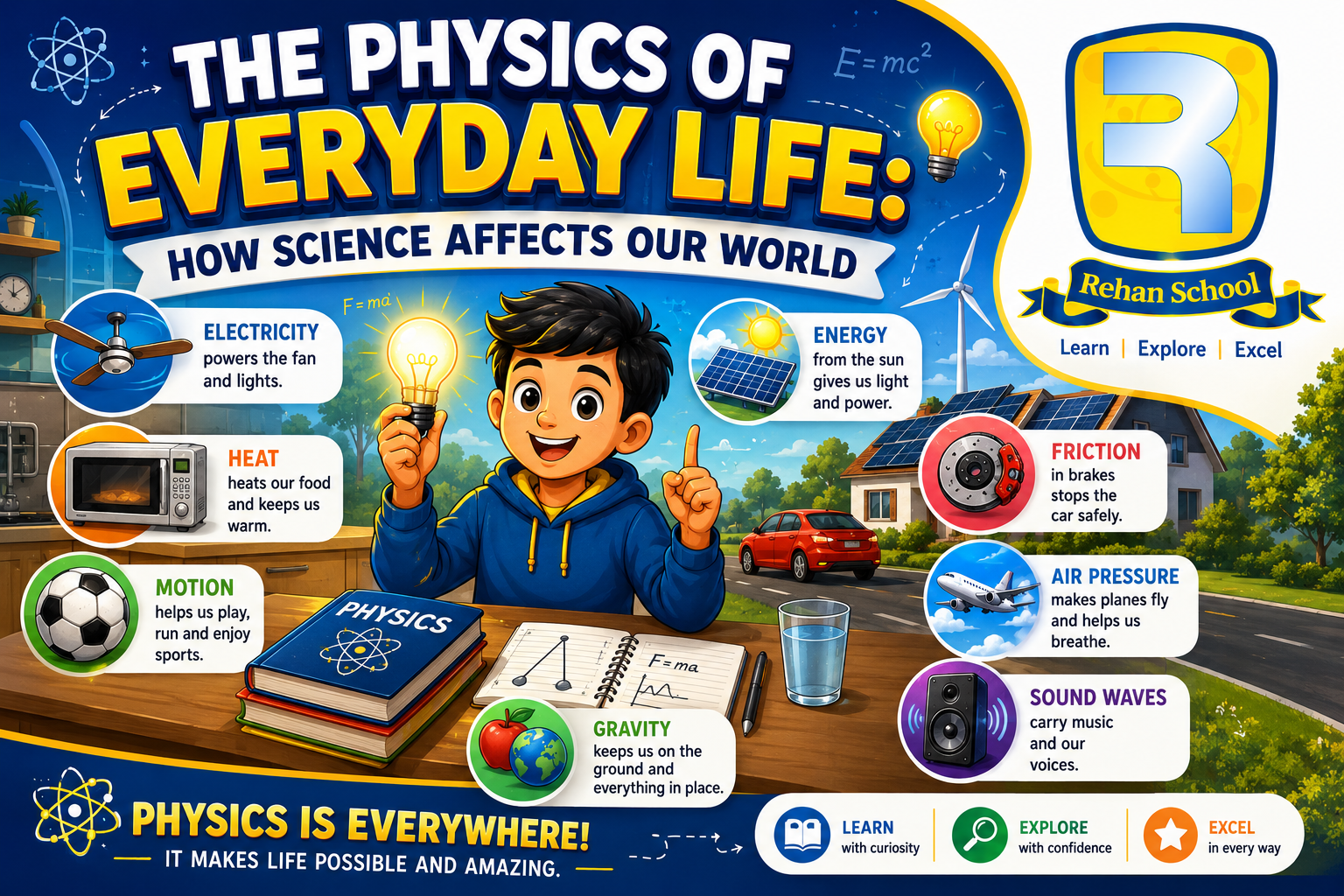
    **The Physics of Everyday Life: How Science Affects Our World**

    Have you ever wondered why a ball falls when you drop it, how a bicycle stays balanced, why a car moves forward, how a fan produces airflow, or how your smartphone communicates with the world around you? All of these everyday experiences are connected to **physics**—the science that helps us understand how the universe works.

    **“The Physics of Everyday Life: How Science Affects Our World”** is an exciting journey into the science behind the ordinary things we see and use every day. From the moment we wake up and switch on a light to the time we travel, study, play, cook, communicate, and relax, physics is constantly working around us.

    **Energy and Electricity:**
    Electricity powers our homes, schools, computers, appliances, and countless modern technologies. Understanding energy helps us see how electrical power is generated, transferred, and transformed into useful forms.

    **Motion and Forces:**
    Whenever something moves, forces are involved. Walking, running, cycling, driving, throwing a ball, or opening a door can all be explained through concepts such as force, motion, friction, and acceleration.

    **Heat and Temperature:**
    From boiling water to cooling food in a refrigerator , heat transfer plays an important role in our daily lives. Physics explains why different materials heat up and cool down at different rates.

    **Light and Sound:**
    The colors we see, the sounds we hear, the mirrors we use, and the cameras in our phones are all connected to fascinating physical principles.

    **Gravity and the Natural World:**
    Gravity keeps us on Earth and influences everything from falling objects to the movement of planets and satellites.

    **Technology and Modern Life:**
    Physics is also behind many technologies we depend on, including smartphones, computers, medical equipment, transportation systems, satellites, and communication devices.

    The most amazing lesson is that **physics is not only something we study in textbooks—it is happening all around us.** When we understand the science behind everyday events, ordinary experiences become opportunities for discovery.

    This topic encourages curiosity, observation, critical thinking, experimentation, and a deeper appreciation for the world around us. It reminds us that asking **“Why?”** can be the beginning of an exciting scientific journey.

    Whether you are a student, teacher, science enthusiast, or simply someone curious about how things work, exploring everyday physics can help you look at the world from a completely new perspective.

    **Observe. Question. Experiment. Discover. Learn.**
    Because science is not far away—it is part of **every moment of our everyday lives!**

    #Physics #EverydayPhysics #Science #PhysicsInEverydayLife #ScienceEducation #STEM #STEMEducation #LearnScience #ScienceEverywhere #PhysicsExplained #ScienceAndTechnology #EverydayScience #LearningIsFun #Curiosity #Discovery #Education #Students #Teachers #ScientificThinking #Experiments #Energy #Motion #Gravity #Electricity #Light #Sound #Technology #Innovation #ExploreScience #KnowledgeIsPower
    #rsisb Roll no.247 canva post .31 Foundation leve πŸŒβš›οΈ **The Physics of Everyday Life: How Science Affects Our World** πŸ”¬βœ¨ Have you ever wondered why a ball falls when you drop it, how a bicycle stays balanced, why a car moves forward, how a fan produces airflow, or how your smartphone communicates with the world around you? πŸ€”πŸ“±πŸš— All of these everyday experiences are connected to **physics**—the science that helps us understand how the universe works. πŸŒŒπŸ”­ **“The Physics of Everyday Life: How Science Affects Our World”** is an exciting journey into the science behind the ordinary things we see and use every day. From the moment we wake up and switch on a light πŸ’‘ to the time we travel, study, play, cook, communicate, and relax, physics is constantly working around us. ⚑ **Energy and Electricity:** Electricity powers our homes, schools, computers, appliances, and countless modern technologies. Understanding energy helps us see how electrical power is generated, transferred, and transformed into useful forms. πŸš— **Motion and Forces:** Whenever something moves, forces are involved. Walking, running, cycling, driving, throwing a ball, or opening a door can all be explained through concepts such as force, motion, friction, and acceleration. πŸƒ‍β™‚οΈβš½πŸš² 🌑️ **Heat and Temperature:** From boiling water β˜• to cooling food in a refrigerator ❄️, heat transfer plays an important role in our daily lives. Physics explains why different materials heat up and cool down at different rates. πŸ’‘ **Light and Sound:** The colors we see, the sounds we hear, the mirrors we use, and the cameras in our phones are all connected to fascinating physical principles. πŸŒˆπŸ‘‚πŸ“· 🌍 **Gravity and the Natural World:** Gravity keeps us on Earth and influences everything from falling objects to the movement of planets and satellites. πŸͺπŸŒŽ πŸ“± **Technology and Modern Life:** Physics is also behind many technologies we depend on, including smartphones, computers, medical equipment, transportation systems, satellites, and communication devices. πŸš€πŸ’»πŸ“‘ The most amazing lesson is that **physics is not only something we study in textbooks—it is happening all around us.** πŸ“šβœ¨ When we understand the science behind everyday events, ordinary experiences become opportunities for discovery. This topic encourages curiosity, observation, critical thinking, experimentation, and a deeper appreciation for the world around us. πŸ”¬πŸ§ πŸŒŸ It reminds us that asking **“Why?”** can be the beginning of an exciting scientific journey. Whether you are a student, teacher, science enthusiast, or simply someone curious about how things work, exploring everyday physics can help you look at the world from a completely new perspective. πŸŒŽπŸ’« πŸ”­ **Observe. Question. Experiment. Discover. Learn.** Because science is not far away—it is part of **every moment of our everyday lives!** βš›οΈβ€οΈ #Physics #EverydayPhysics #Science #PhysicsInEverydayLife #ScienceEducation #STEM #STEMEducation #LearnScience #ScienceEverywhere #PhysicsExplained #ScienceAndTechnology #EverydayScience #LearningIsFun #Curiosity #Discovery #Education #Students #Teachers #ScientificThinking #Experiments #Energy #Motion #Gravity #Electricity #Light #Sound #Technology #Innovation #ExploreScience #KnowledgeIsPower πŸŒπŸ”¬βš‘πŸš€πŸ“šβœ¨
    0 Commenti 0 condivisioni 2767 Views
  • #rsisb
    Roll no 248
    Foundation level
    song no 17
    **Learning Through Layers: The Importance of Animal Anatomy Studies**

    Animal anatomy studies help us understand how living organisms are built, how their body systems work, and how different structures support life. By exploring anatomy, students can develop scientific thinking, observation skills, and a deeper appreciation for the complexity of living things.

    From bones and muscles to organs and tissues, every part has an important role. Studying these structures can help us better understand biology, health, evolution, and the incredible diversity of life on Earth.

    Learning anatomy is more than memorizing names—it is about discovering **how life works, layer by layer.**

    #AnimalAnatomy #Biology #ScienceLearning #AnatomyStudies #LearningThroughLayers #AnimalScience #Education #ScienceEducation #BiologyStudents #LifeScience #ScientificLearning #ExploreScience #Curiosity #Learning #Nature #STEM
    #rsisb Roll no 248 Foundation level song no 17 πŸΎπŸ”¬ **Learning Through Layers: The Importance of Animal Anatomy Studies** πŸ§¬πŸ“š Animal anatomy studies help us understand how living organisms are built, how their body systems work, and how different structures support life. πŸ«€πŸ¦΄πŸ« By exploring anatomy, students can develop scientific thinking, observation skills, and a deeper appreciation for the complexity of living things. 🌱✨ From bones and muscles to organs and tissues, every part has an important role. Studying these structures can help us better understand biology, health, evolution, and the incredible diversity of life on Earth. 🌍🐾 Learning anatomy is more than memorizing names—it is about discovering **how life works, layer by layer.** πŸ”πŸ’‘ #AnimalAnatomy #Biology #ScienceLearning #AnatomyStudies #LearningThroughLayers #AnimalScience #Education #ScienceEducation #BiologyStudents #LifeScience #ScientificLearning #ExploreScience #Curiosity #Learning #Nature #STEM 🧬
    0 Commenti 0 condivisioni 1604 Views 5
  • #rsisb
    Roll no.247
    Foundation level

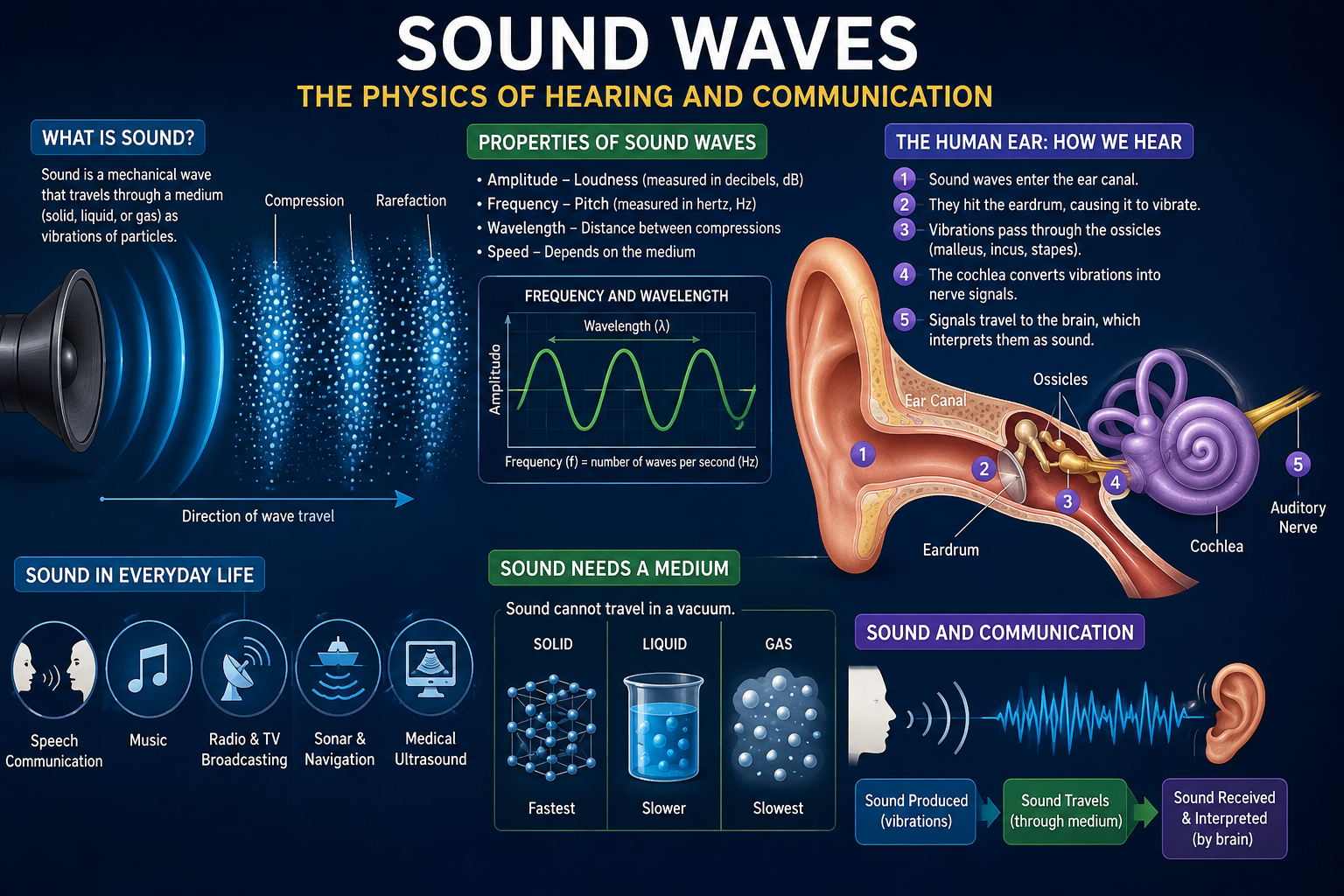
    # Sound Waves: The Physics of Hearing and Communication

    Have you ever wondered how a sound travels from one place to another? How does a musical instrument produce beautiful melodies? How can we hear someone speaking from across a room? The fascinating answer lies in the science of **sound waves!**

    In this exciting exploration of **“Sound Waves: The Physics of Hearing and Communication,”** we dive into the amazing world of sound and discover the physics behind one of the most important ways humans experience and understand the world around them.

    Sound is a form of energy that travels through a medium such as air, water, or solids. When an object vibrates, it causes nearby particles to vibrate, creating a wave that carries energy from one location to another. These vibrations eventually reach our ears, allowing our brains to recognize sounds.

    We’ll explore important concepts such as **frequency, wavelength, amplitude, speed, and pitch**. Understanding these properties helps explain why some sounds are high or low, loud or soft.

    The journey of sound into the human ear is equally fascinating! Sound waves enter the ear and cause tiny structures to vibrate. These vibrations are transformed into electrical signals that travel to the brain, where they are interpreted as meaningful sounds. This incredible process allows us to enjoy music , understand speech , recognize familiar sounds , and communicate with people around us.

    Communication depends heavily on sound. From everyday conversations to public speaking, telephone calls, radio broadcasts, and educational videos, sound allows information to travel between people. Modern technology also uses the principles of sound waves in microphones, speakers, headphones, medical imaging, and many other applications.

    This topic is a wonderful opportunity for students, science lovers, and curious minds to connect **physics with everyday life**. Instead of thinking of sound as something we simply hear, we can understand it as a physical phenomenon involving vibrations, energy, waves, and the remarkable human hearing system.

    **In this learning journey, you can discover:**
    What sound waves are
    How vibrations create sound
    How sound travels through different materials
    The relationship between frequency and pitch
    How amplitude affects loudness
    How the human ear detects sound
    How the brain interprets sound signals
    How sound enables communication
    How microphones and speakers work
    Everyday applications of sound-wave technology

    **Sound is everywhere!** From the gentle sound of rain to birds singing , from the voices of our friends to the music we enjoy , sound surrounds us every day. By understanding its physics, we gain a deeper appreciation for the invisible waves that connect our world.

    So get ready to listen, learn, explore, and discover the fascinating science behind the sounds we hear every day!

    **Learn the science. Understand the waves. Discover the power of sound!**

    #SoundWaves #Physics #Science #PhysicsOfSound #Hearing #Communication #Waves #SoundPhysics #ScienceEducation #PhysicsEducation #LearnScience #STEM #STEMEducation #HumanEar #Frequency #Amplitude #Wavelength #Pitch #Vibrations #ScienceForStudents #EducationalVideo #Learning #ScienceExploration #Technology #Acoustics #SoundAndCommunication #Curiosity #Knowledge #Education #ExploreScience
    #rsisb Roll no.247 Foundation level # πŸ”Š Sound Waves: The Physics of Hearing and Communication 🎧🌊 Have you ever wondered how a sound travels from one place to another? πŸ€”πŸ”Š How does a musical instrument produce beautiful melodies? 🎡 How can we hear someone speaking from across a room? πŸ—£οΈπŸ‘‚ The fascinating answer lies in the science of **sound waves!** 🌊✨ In this exciting exploration of **“Sound Waves: The Physics of Hearing and Communication,”** we dive into the amazing world of sound and discover the physics behind one of the most important ways humans experience and understand the world around them. πŸŒπŸ”¬ Sound is a form of energy that travels through a medium such as air, water, or solids. πŸŒ¬οΈπŸ’§πŸͺ¨ When an object vibrates, it causes nearby particles to vibrate, creating a wave that carries energy from one location to another. These vibrations eventually reach our ears, allowing our brains to recognize sounds. πŸ§ πŸ‘‚πŸ’‘ We’ll explore important concepts such as **frequency, wavelength, amplitude, speed, and pitch**. πŸ“šπŸ“ Understanding these properties helps explain why some sounds are high or low, loud or soft. πŸŽΆπŸ”‰πŸ”Š The journey of sound into the human ear is equally fascinating! πŸ‘‚βœ¨ Sound waves enter the ear and cause tiny structures to vibrate. These vibrations are transformed into electrical signals that travel to the brain, where they are interpreted as meaningful sounds. 🧠⚑ This incredible process allows us to enjoy music 🎼, understand speech πŸ—£οΈ, recognize familiar sounds πŸ‘‹, and communicate with people around us. ❀️🌎 Communication depends heavily on sound. From everyday conversations to public speaking, telephone calls, radio broadcasts, and educational videos, sound allows information to travel between people. πŸ“žπŸ“»πŸŽ™οΈ Modern technology also uses the principles of sound waves in microphones, speakers, headphones, medical imaging, and many other applications. πŸ’»πŸŽ§πŸ”¬ This topic is a wonderful opportunity for students, science lovers, and curious minds to connect **physics with everyday life**. πŸŒŸπŸ“– Instead of thinking of sound as something we simply hear, we can understand it as a physical phenomenon involving vibrations, energy, waves, and the remarkable human hearing system. πŸŒŠβš›οΈπŸ‘‚ 🎯 **In this learning journey, you can discover:** πŸ”Ή What sound waves are πŸ”Ή How vibrations create sound πŸ”Ή How sound travels through different materials πŸ”Ή The relationship between frequency and pitch πŸ”Ή How amplitude affects loudness πŸ”Ή How the human ear detects sound πŸ”Ή How the brain interprets sound signals πŸ”Ή How sound enables communication πŸ”Ή How microphones and speakers work πŸ”Ή Everyday applications of sound-wave technology 🌈 **Sound is everywhere!** From the gentle sound of rain 🌧️ to birds singing 🐦, from the voices of our friends πŸ—£οΈ to the music we enjoy 🎡, sound surrounds us every day. By understanding its physics, we gain a deeper appreciation for the invisible waves that connect our world. 🌍🌊✨ So get ready to listen, learn, explore, and discover the fascinating science behind the sounds we hear every day! πŸ”ŠπŸŽ§πŸ”¬πŸ“š πŸ’‘ **Learn the science. Understand the waves. Discover the power of sound!** πŸŒŠπŸ”Šβœ¨ #SoundWaves #Physics #Science #PhysicsOfSound #Hearing #Communication #Waves #SoundPhysics #ScienceEducation #PhysicsEducation #LearnScience #STEM #STEMEducation #HumanEar #Frequency #Amplitude #Wavelength #Pitch #Vibrations #ScienceForStudents #EducationalVideo #Learning #ScienceExploration #Technology #Acoustics #SoundAndCommunication #Curiosity #Knowledge #Education #ExploreScience πŸ”¬πŸ“šπŸŒπŸŽ§πŸ”Šβœ¨
    0 Commenti 0 condivisioni 4646 Views
  • #rsisb
    Roll no.246
    Foundation level

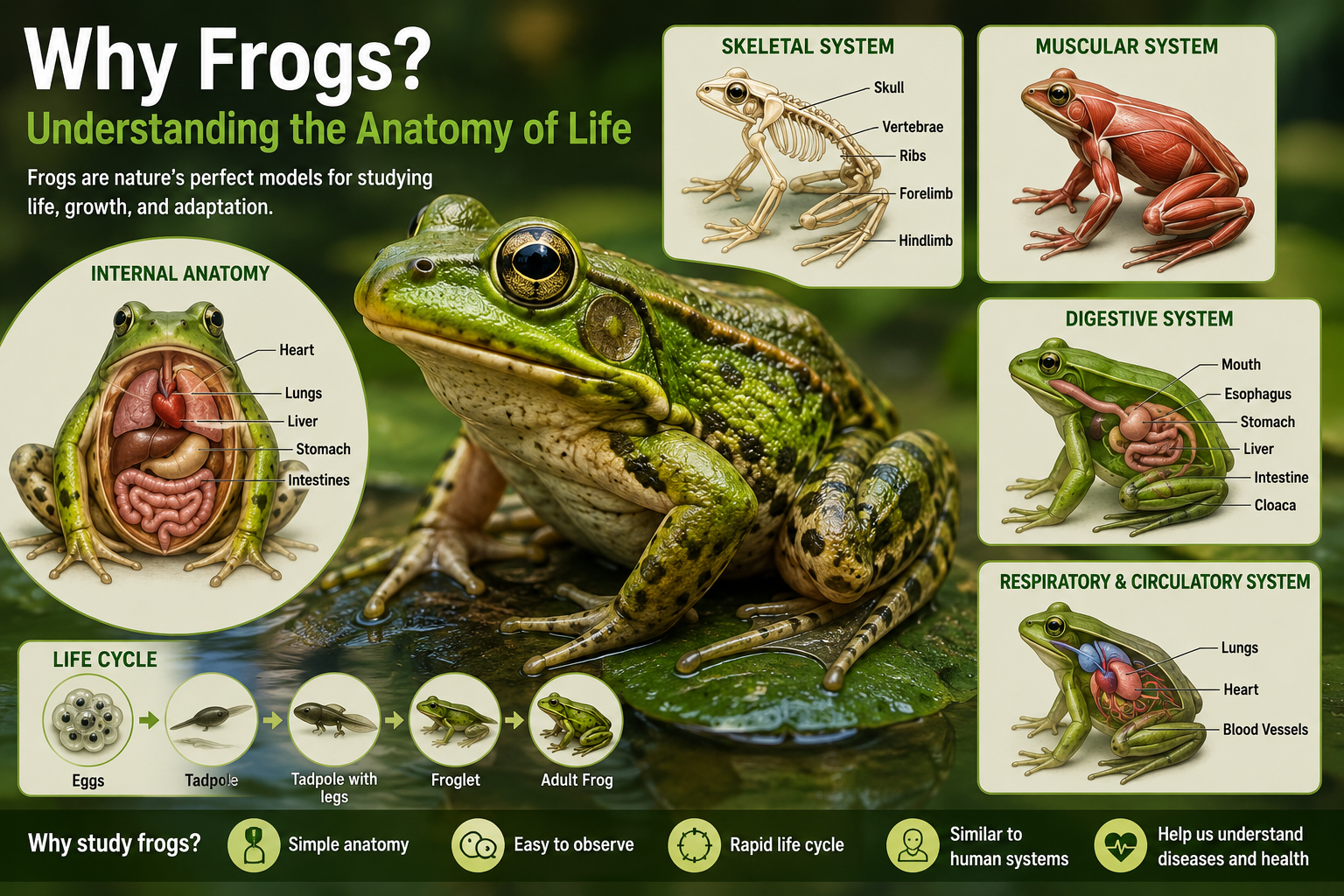
    # Why Frogs? Understanding the Anatomy of Life

    Why study frogs? Because these fascinating amphibians provide an excellent way to explore the incredible organization and complexity of living organisms. From their powerful hind legs and unique skeletal structure to their remarkable organs, muscles, nervous system, and respiratory adaptations, frogs offer a wonderful window into the basic principles of anatomy and biology.

    In this educational exploration, **“Why Frogs? Understanding the Anatomy of Life,”** we discover how different body systems work together to keep an organism alive. We can learn how a frog moves, breathes, senses its environment, obtains nutrients, circulates blood, and responds to changes around it. Studying frog anatomy also helps us understand broader biological concepts that apply to many other animals, including humans.

    Frogs are especially interesting because they live both in water and on land, making them excellent examples of adaptation. Their life cycle—from egg to tadpole to adult frog—demonstrates how living organisms can undergo remarkable changes as they develop. Their anatomy reflects their lifestyle, showing how body structures are connected to survival and environmental challenges.

    Exploring anatomy encourages students to ask important scientific questions: How does each organ function? Why are certain body structures shaped the way they are? How do different systems cooperate? By investigating these questions, we develop observation skills, scientific curiosity, and a deeper appreciation for the complexity of life.

    Most importantly, studying frogs reminds us that biology is not simply about memorizing names of organs—it is about understanding **how life works as a connected system.** Every bone, muscle, organ, and tissue has a role, and together they create a living organism capable of movement, growth, reproduction, and interaction with its environment.

    Join us on this fascinating scientific journey and discover how the anatomy of a frog can open the door to understanding the amazing mechanisms of life!

    #WhyFrogs #FrogAnatomy #UnderstandingLife #Biology #ScienceEducation #Anatomy #Amphibians #FrogLifeCycle #AnimalBiology #HumanAnatomy #LifeScience #ScienceLearning #BiologyStudents #ScientificDiscovery #ExploreScience #Nature #Wildlife #Evolution #Adaptation #STEM #STEMEducation #ScienceIsAmazing #LearningIsFun #Curiosity #ExploreNature
    #rsisb Roll no.246 Foundation level # Why Frogs? Understanding the Anatomy of Life πŸΈπŸ”¬ Why study frogs? 🐸 Because these fascinating amphibians provide an excellent way to explore the incredible organization and complexity of living organisms. From their powerful hind legs and unique skeletal structure to their remarkable organs, muscles, nervous system, and respiratory adaptations, frogs offer a wonderful window into the basic principles of anatomy and biology. 🌿🧬 In this educational exploration, **“Why Frogs? Understanding the Anatomy of Life,”** we discover how different body systems work together to keep an organism alive. πŸ«€πŸ«πŸ§  We can learn how a frog moves, breathes, senses its environment, obtains nutrients, circulates blood, and responds to changes around it. Studying frog anatomy also helps us understand broader biological concepts that apply to many other animals, including humans. 🌎✨ Frogs are especially interesting because they live both in water and on land, making them excellent examples of adaptation. πŸ’§πŸŒ± Their life cycle—from egg to tadpole to adult frog—demonstrates how living organisms can undergo remarkable changes as they develop. πŸ”„πŸΈ Their anatomy reflects their lifestyle, showing how body structures are connected to survival and environmental challenges. Exploring anatomy encourages students to ask important scientific questions: How does each organ function? Why are certain body structures shaped the way they are? How do different systems cooperate? πŸ€”πŸ”¬ By investigating these questions, we develop observation skills, scientific curiosity, and a deeper appreciation for the complexity of life. Most importantly, studying frogs reminds us that biology is not simply about memorizing names of organs—it is about understanding **how life works as a connected system.** ❀️🧬 Every bone, muscle, organ, and tissue has a role, and together they create a living organism capable of movement, growth, reproduction, and interaction with its environment. 🐸🌿 Join us on this fascinating scientific journey and discover how the anatomy of a frog can open the door to understanding the amazing mechanisms of life! #WhyFrogs #FrogAnatomy #UnderstandingLife #Biology #ScienceEducation #Anatomy #Amphibians #FrogLifeCycle #AnimalBiology #HumanAnatomy #LifeScience #ScienceLearning #BiologyStudents #ScientificDiscovery #ExploreScience #Nature #Wildlife #Evolution #Adaptation #STEM #STEMEducation #ScienceIsAmazing #LearningIsFun #Curiosity #ExploreNature πŸΈπŸ”¬πŸŒΏπŸ§¬πŸ«€πŸ§ πŸŒŽβœ¨
    0 Commenti 0 condivisioni 2868 Views
  • #rsisb
    Roll no.239
    Story Post no.3
    Foundation Level
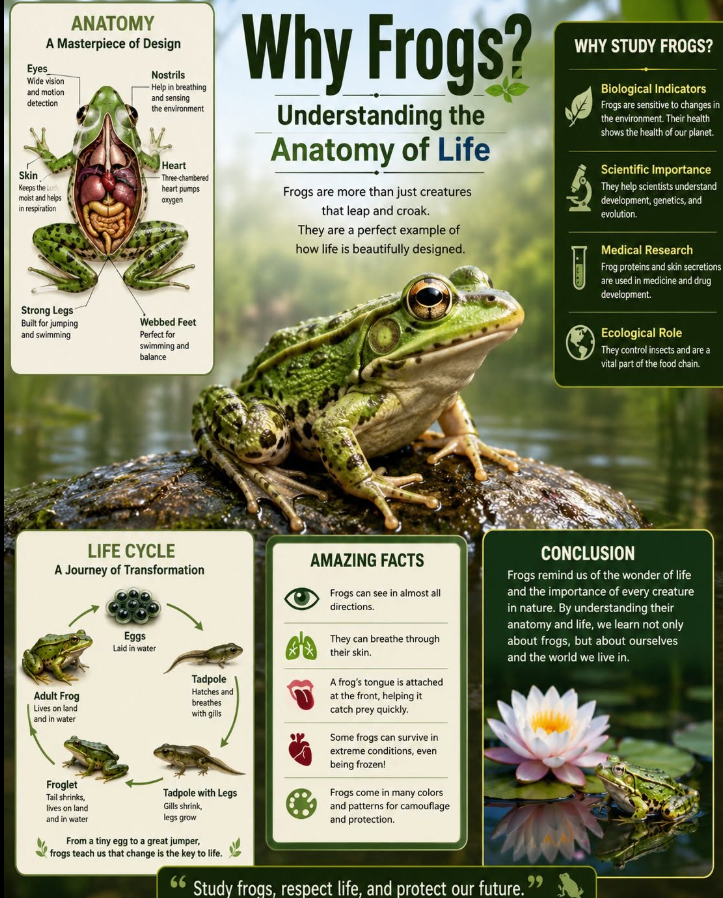
    **Why Frogs? Understanding the Anatomy of Life**

    Frogs are much more than fascinating creatures found near ponds and wetlands. They provide scientists and students with a simple yet powerful way to understand the **anatomy, biology, and complexity of life**.

    From their powerful hind legs to their unique respiratory system , sensitive eyes , strong hearts , and specialized skin, frogs have body structures that demonstrate how different organs work together to keep an organism alive.

    Studying frog anatomy can help us understand important biological concepts such as **organs, muscles, bones, digestion, circulation, respiration, and nervous systems**. It also gives us a deeper appreciation for how living organisms adapt to their environments.

    Frogs are often studied in biology because their anatomy provides an accessible example of the basic principles shared by many vertebrates. By exploring their bodies, we can discover how structure and function are connected—and how every part of a living organism has an important role.

    **Explore the frog. Discover anatomy. Understand life.**

    #WhyFrogs #FrogAnatomy #UnderstandingLife #Anatomy #Biology #Science #LifeScience #BiologyEducation #ScienceEducation #Frogs #Amphibians #AnimalAnatomy #HumanBiology #Vertebrates #Organs #Muscles #Bones #Heart #RespiratorySystem #DigestiveSystem #NervousSystem #BiologicalScience #Nature #Wildlife #Ecology #Learning #Education #STEM #ScienceForStudents #BiologyStudents #StudyScience #ScienceIsAmazing #ExploreScience #DiscoverBiology #Knowledge #LearningJourney #EducationalContent #ScienceLovers #NatureLovers
    #rsisb Roll no.239 Story Post no.3 Foundation Level πŸΈπŸ”¬ **Why Frogs? Understanding the Anatomy of Life** 🌿🧬 Frogs are much more than fascinating creatures found near ponds and wetlands. 🐸🌊 They provide scientists and students with a simple yet powerful way to understand the **anatomy, biology, and complexity of life**. πŸ”¬πŸ“š From their powerful hind legs 🦡 to their unique respiratory system 🫁, sensitive eyes πŸ‘€, strong hearts ❀️, and specialized skin, frogs have body structures that demonstrate how different organs work together to keep an organism alive. 🌱✨ Studying frog anatomy can help us understand important biological concepts such as **organs, muscles, bones, digestion, circulation, respiration, and nervous systems**. 🧠🦴❀️ It also gives us a deeper appreciation for how living organisms adapt to their environments. 🌍🌿 Frogs are often studied in biology because their anatomy provides an accessible example of the basic principles shared by many vertebrates. πŸ§ͺπŸ” By exploring their bodies, we can discover how structure and function are connected—and how every part of a living organism has an important role. 🐸 **Explore the frog. Discover anatomy. Understand life.** πŸ”¬πŸŒβœ¨ #WhyFrogs #FrogAnatomy #UnderstandingLife #Anatomy #Biology #Science #LifeScience #BiologyEducation #ScienceEducation #Frogs #Amphibians #AnimalAnatomy #HumanBiology #Vertebrates #Organs #Muscles #Bones #Heart #RespiratorySystem #DigestiveSystem #NervousSystem #BiologicalScience #Nature #Wildlife #Ecology #Learning #Education #STEM #ScienceForStudents #BiologyStudents #StudyScience #ScienceIsAmazing #ExploreScience #DiscoverBiology #Knowledge #LearningJourney #EducationalContent #ScienceLovers #NatureLovers πŸΈπŸ”¬πŸ§¬πŸŒΏπŸ“šβœ¨
    0 Commenti 0 condivisioni 5579 Views
Pagine in Evidenza