• RSIF8
    Roll no:17
    Story post no:34
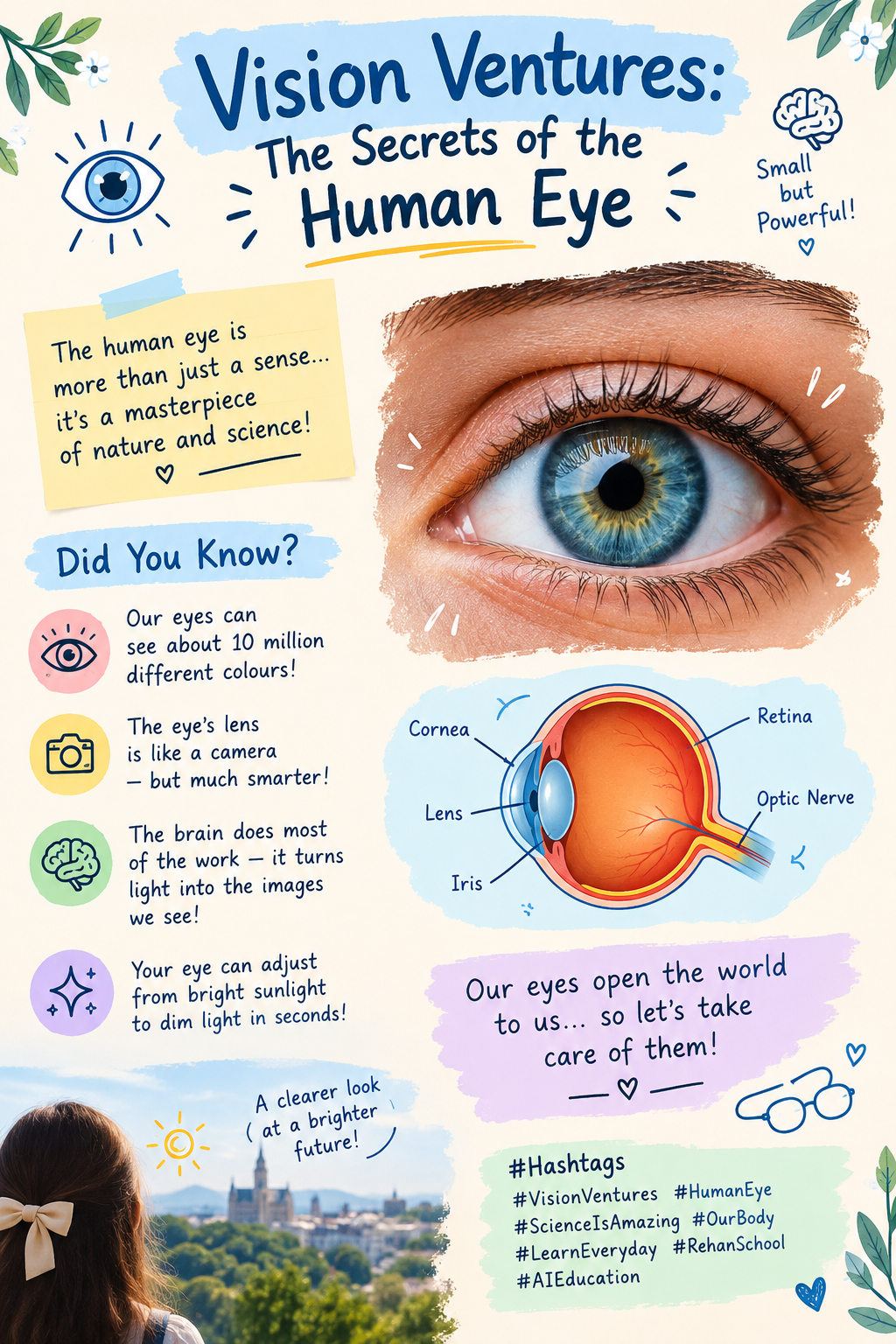
    Topic:Story Post — "Vision Ventures: The Secrets of the Human Eye".

    **Explore the amazing secrets of the human eye!** Our eyes are incredible organs that help us see the beautiful world around us. From the cornea and iris to the retina and optic nerve, every part plays an important role in vision. Through this story, I learned some fascinating facts about how our eyes work and why we should take care of them.

    **Let’s discover, learn, and protect our precious eyesight!**

    **#️⃣ Hashtags:**

    #VisionVentures #HumanEye #ScienceIsAmazing #OurBody #LearnEveryday #ScienceLearning #EyeFacts #Biology #RehanSchool #AIEducation
    RSIF8 Roll no:17 Story post no:34 Topic:Story Post — "Vision Ventures: The Secrets of the Human Eye". 👁️✨ **Explore the amazing secrets of the human eye!** 🌍💙 Our eyes are incredible organs that help us see the beautiful world around us. From the cornea and iris to the retina and optic nerve, every part plays an important role in vision. 🧠🔬 Through this story, I learned some fascinating facts about how our eyes work and why we should take care of them. 💖📚 🌈 **Let’s discover, learn, and protect our precious eyesight!** 👓💫 **#️⃣ Hashtags:** #VisionVentures #HumanEye #ScienceIsAmazing #OurBody #LearnEveryday #ScienceLearning #EyeFacts #Biology #RehanSchool #AIEducation 📚🔬👁️💙
    0 Comentários 0 Compartilhamentos 1859 Visualizações
  • #rsisb
    Roll no.247
    Story post .7
    Foundation level

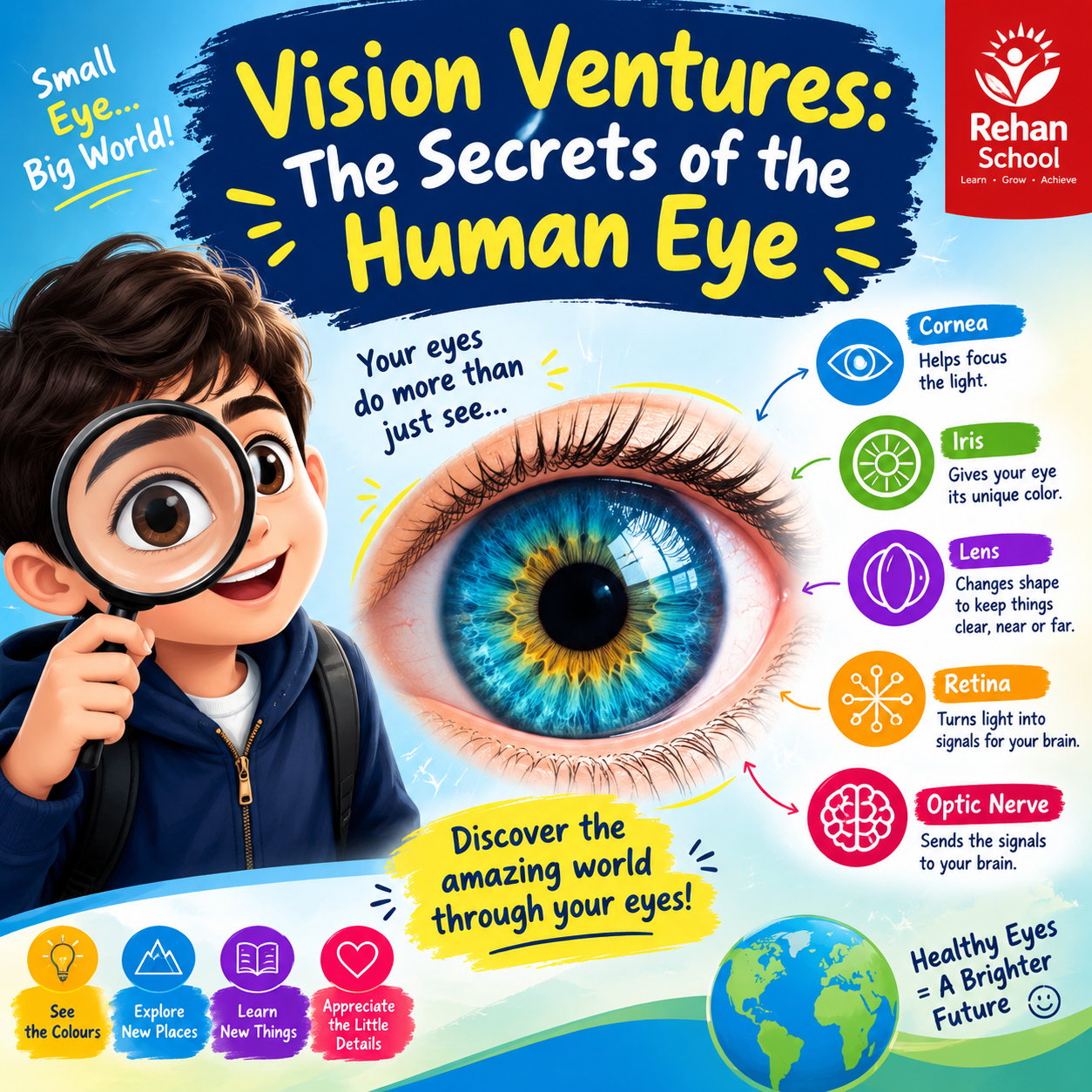
    **Vision Ventures: The Secrets of the Human Eye**

    Welcome to an exciting journey into one of the most amazing parts of the human body — **the human eye!** Our eyes help us see the colorful world around us, recognize faces, read books, explore nature, and experience countless beautiful moments.

    In **“Vision Ventures: The Secrets of the Human Eye,”** we explore the fascinating science behind vision and discover how this incredible organ works. From light entering the eye to the brain processing the information, every step is an amazing example of how the human body works together.

    **What makes the eye so special?**
    The eye contains several important parts, including the **cornea, iris, pupil, lens, retina, and optic nerve**. Each part has an important job in helping us see. The iris controls how much light enters through the pupil, while the lens helps focus light onto the retina. The retina then helps send visual information to the brain through the optic nerve.

    This story post is not just about science — it is about **curiosity, discovery, and the amazing world inside us!** Every time we look at a sunset , admire a beautiful painting , read a story , or smile at a friend , our eyes are helping us experience that moment.

    **Vision Ventures** reminds us that science can be found everywhere — even in something as familiar as seeing the world around us! Keep asking questions, keep exploring, and keep discovering the incredible secrets of the human body.

    **Learn. Explore. Discover. Imagine.**
    The more we learn about ourselves, the more amazing the world becomes!

    #VisionVentures #HumanEye #EyeScience #ScienceStory #HumanBody #Biology #ScienceForKids #LearningIsFun #ScienceIsAmazing #ExploreScience #DiscoverScience #Curiosity #Education #EducationalPost #Knowledge #AmazingScience #HumanBodyFacts #EyeFacts #BiologyForKids #STEM #STEMLearning #YoungScientist #ScienceExplorer #LearningJourney #CreativeLearning #FutureScientist #KeepLearning #KeepExploring #ScienceEverywhere
    #rsisb Roll no.247 Story post .7 Foundation level 👁️🔬 **Vision Ventures: The Secrets of the Human Eye** 🌟 Welcome to an exciting journey into one of the most amazing parts of the human body — **the human eye!** 👀✨ Our eyes help us see the colorful world around us, recognize faces, read books, explore nature, and experience countless beautiful moments. 🌈🌍📚 In **“Vision Ventures: The Secrets of the Human Eye,”** we explore the fascinating science behind vision and discover how this incredible organ works. 🧠👁️ From light entering the eye to the brain processing the information, every step is an amazing example of how the human body works together. 🔦➡️👁️➡️🧠 🔍 **What makes the eye so special?** The eye contains several important parts, including the **cornea, iris, pupil, lens, retina, and optic nerve**. Each part has an important job in helping us see. The iris controls how much light enters through the pupil, while the lens helps focus light onto the retina. The retina then helps send visual information to the brain through the optic nerve. 🧠💡 🌟 This story post is not just about science — it is about **curiosity, discovery, and the amazing world inside us!** Every time we look at a sunset 🌅, admire a beautiful painting 🎨, read a story 📖, or smile at a friend 😊, our eyes are helping us experience that moment. 🚀 **Vision Ventures** reminds us that science can be found everywhere — even in something as familiar as seeing the world around us! Keep asking questions, keep exploring, and keep discovering the incredible secrets of the human body. 🔬🌍✨ 📚👁️ **Learn. Explore. Discover. Imagine.** The more we learn about ourselves, the more amazing the world becomes! 🌟🧠💫 #VisionVentures #HumanEye #EyeScience #ScienceStory #HumanBody #Biology #ScienceForKids #LearningIsFun #ScienceIsAmazing #ExploreScience #DiscoverScience #Curiosity #Education #EducationalPost #Knowledge #AmazingScience #HumanBodyFacts #EyeFacts #BiologyForKids #STEM #STEMLearning #YoungScientist #ScienceExplorer #LearningJourney #CreativeLearning #FutureScientist #KeepLearning #KeepExploring #ScienceEverywhere 👁️🔬🌈🧠🚀✨
    0 Comentários 0 Compartilhamentos 4524 Visualizações
  • #rsisb
    Roll no 248
    Foundation level
    Story post no 25
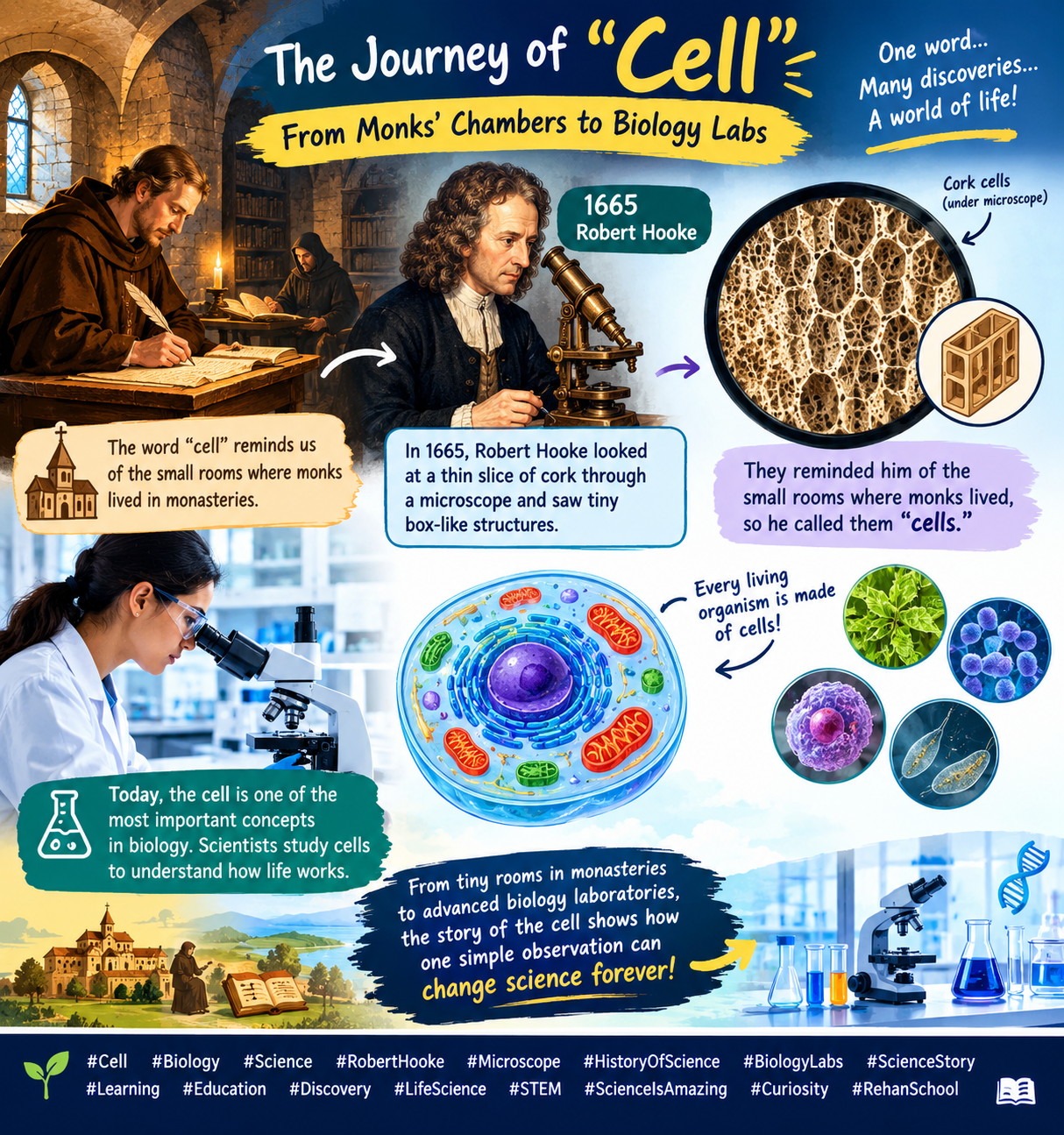
    **Story Post — The Journey of “Cell”: From Monks’ Chambers to Biology Labs!**

    Have you ever wondered where the word **“cell”** came from? The journey of this amazing word connects history, science, and the discovery of life itself!

    In 1665, **Robert Hooke** looked at a thin slice of cork through a microscope and saw tiny box-like structures. They reminded him of the small rooms where monks lived, so he called them **“cells.”**

    Today, the cell is one of the most important concepts in biology. Every living organism is made of cells, and modern scientists study cells to understand how life works.

    From tiny rooms in monasteries to advanced biology laboratories, the story of the **cell** shows how one simple observation can change science forever!

    #Cell #Biology #Science #RobertHooke #Microscope #HistoryOfScience #BiologyLabs #ScienceStory #Learning #Education #Discovery #LifeScience #STEM #ScienceIsAmazing #Curiosity #RehanSchool
    #rsisb Roll no 248 Foundation level Story post no 25 🔬🧫 **Story Post — The Journey of “Cell”: From Monks’ Chambers to Biology Labs!** 🧬✨ Have you ever wondered where the word **“cell”** came from? 🤔📖 The journey of this amazing word connects history, science, and the discovery of life itself! 🌱🔬 In 1665, **Robert Hooke** looked at a thin slice of cork through a microscope and saw tiny box-like structures. 🪵🔍 They reminded him of the small rooms where monks lived, so he called them **“cells.”** 🏠➡️🧫 Today, the cell is one of the most important concepts in biology. Every living organism is made of cells, and modern scientists study cells to understand how life works. 🌍❤️🧬 From tiny rooms in monasteries to advanced biology laboratories, the story of the **cell** shows how one simple observation can change science forever! 🚀🔬✨ #Cell #Biology #Science #RobertHooke #Microscope #HistoryOfScience #BiologyLabs #ScienceStory #Learning #Education #Discovery #LifeScience #STEM #ScienceIsAmazing #Curiosity #RehanSchool 📚🔬🌟
    1
    0 Comentários 0 Compartilhamentos 1647 Visualizações
  • RSIF 8

    Roll no 93

    Story post no 33

    Story post topic: "Bio Detectives: Unveiling the DNA Code". **Bio Detectives: Unveiling the DNA Code**


    What if the smallest molecule in our body could reveal some of the biggest mysteries of life? Welcome to the fascinating world of **DNA**, where scientists become real-life bio detectives!


    DNA, or deoxyribonucleic acid, contains the biological instructions that help make each living organism unique. It acts like a remarkable biological blueprint, carrying information that is passed from one generation to the next.


    In this story, we follow the journey of **Bio Detectives** as they explore the hidden clues inside DNA. By studying genetic information, scientists can learn more about living organisms, investigate inherited conditions, support medical research, identify species, and help solve forensic mysteries.


    **DNA can help us explore:**

    Identifying different species

    Understanding inherited conditions and diseases

    Supporting forensic investigations

    Learning about evolution and biodiversity

    Discovering how living organisms work


    Imagine a tiny code containing clues about life itself. Every DNA sequence is part of a much bigger biological story, and modern science gives researchers powerful tools to read and understand those clues.


    **Key Message:**

    Science teaches us that even the smallest structures can hold incredible information. By studying DNA, we can better understand where life comes from, how organisms change, and how biological discoveries can help humanity.


    **Explore. Discover. Learn.**

    The code of life is waiting to be uncovered!


    #BioDetectives #DNA #DNACode #Genetics #Biology #Science #ScienceEducation #Biotechnology #Forensics #Evolution #MedicalScience #LifeScience #GeneticResearch #STEM #ScienceIsAmazing #Learning #Education #DiscoverScience #DNAResearch #FutureOfScience
    RSIF 8 Roll no 93 Story post no 33 Story post topic: "Bio Detectives: Unveiling the DNA Code".🧬🔍 **Bio Detectives: Unveiling the DNA Code** What if the smallest molecule in our body could reveal some of the biggest mysteries of life? Welcome to the fascinating world of **DNA**, where scientists become real-life bio detectives! 🧪🔬 DNA, or deoxyribonucleic acid, contains the biological instructions that help make each living organism unique. It acts like a remarkable biological blueprint, carrying information that is passed from one generation to the next. In this story, we follow the journey of **Bio Detectives** as they explore the hidden clues inside DNA. By studying genetic information, scientists can learn more about living organisms, investigate inherited conditions, support medical research, identify species, and help solve forensic mysteries. 🧬 **DNA can help us explore:** 🔎 Identifying different species 🏥 Understanding inherited conditions and diseases 🕵️ Supporting forensic investigations 🌱 Learning about evolution and biodiversity 🔬 Discovering how living organisms work Imagine a tiny code containing clues about life itself. Every DNA sequence is part of a much bigger biological story, and modern science gives researchers powerful tools to read and understand those clues. 🌟 **Key Message:** Science teaches us that even the smallest structures can hold incredible information. By studying DNA, we can better understand where life comes from, how organisms change, and how biological discoveries can help humanity. 🚀 **Explore. Discover. Learn.** The code of life is waiting to be uncovered! #BioDetectives #DNA #DNACode #Genetics #Biology #Science #ScienceEducation #Biotechnology #Forensics #Evolution #MedicalScience #LifeScience #GeneticResearch #STEM #ScienceIsAmazing #Learning #Education #DiscoverScience #DNAResearch #FutureOfScience
    0 Comentários 0 Compartilhamentos 3905 Visualizações
  • #rsisb
    Roll no.247
    song .23
    Foundation level

    **The Story of Elements: From Carbon to Gold**

    The world around us is made from a fascinating collection of chemical elements, each with its own unique properties, history, and role in nature. From the carbon in living organisms to the gold found deep within the Earth, every element tells a remarkable story about how our universe works.

    **Carbon** is one of the most important elements for life. It forms the foundation of countless molecules, including those that make up living things. Carbon can also appear in very different forms, from soft graphite to brilliant diamond.

    As we explore the periodic table, we discover elements with completely different characteristics. Oxygen helps living organisms release energy. Iron is essential in many biological processes and has shaped human civilization through tools and technology. Copper has been used for thousands of years and remains important in electrical systems.

    And then there is **gold**—a rare, beautiful, and chemically fascinating element. Its resistance to corrosion and distinctive appearance have made it valuable throughout human history. But gold is more than something beautiful; it also has important scientific and technological applications.

    This journey from **carbon to gold** reminds us that the periodic table is not simply a list of symbols. It is a story of matter, stars, planets, life, discovery, and human curiosity. Every element contributes a small but important piece to the incredible story of our universe.

    Learning about elements helps us understand what everything is made of—from our bodies and oceans to rocks, stars, and modern technology. The deeper we explore chemistry, the more we discover that even the smallest building blocks of matter can tell enormous stories.

    **Explore the periodic table. Discover the elements. Understand the matter that makes our world!**

    #TheStoryOfElements #CarbonToGold #Elements #Chemistry #PeriodicTable #Science #ChemistryEducation #ScienceExploration #ChemicalElements #Carbon #Gold #Matter #Atoms #Molecules #ScienceLearning #STEM #STEMEducation #YoungScientists #ExploreScience #LearnChemistry #ScienceIsAmazing #Universe #Discovery #Education #Knowledge #Curiosity #FutureScientists
    #rsisb Roll no.247 song .23 Foundation level 🌟🧪 **The Story of Elements: From Carbon to Gold** 🪙✨ The world around us is made from a fascinating collection of chemical elements, each with its own unique properties, history, and role in nature. 🌍🔬 From the carbon in living organisms to the gold found deep within the Earth, every element tells a remarkable story about how our universe works. 🌌⚛️ 🖤 **Carbon** is one of the most important elements for life. It forms the foundation of countless molecules, including those that make up living things. 🌱🧬 Carbon can also appear in very different forms, from soft graphite to brilliant diamond. 💎 As we explore the periodic table, we discover elements with completely different characteristics. Oxygen helps living organisms release energy. 🌬️🔥 Iron is essential in many biological processes and has shaped human civilization through tools and technology. ⚙️🏗️ Copper has been used for thousands of years and remains important in electrical systems. 🔌⚡ And then there is **gold**—a rare, beautiful, and chemically fascinating element. 🪙✨ Its resistance to corrosion and distinctive appearance have made it valuable throughout human history. But gold is more than something beautiful; it also has important scientific and technological applications. 🔬💻 This journey from **carbon to gold** reminds us that the periodic table is not simply a list of symbols. It is a story of matter, stars, planets, life, discovery, and human curiosity. 🌌⭐🌍 Every element contributes a small but important piece to the incredible story of our universe. 🔬📚 Learning about elements helps us understand what everything is made of—from our bodies and oceans to rocks, stars, and modern technology. The deeper we explore chemistry, the more we discover that even the smallest building blocks of matter can tell enormous stories. ⚛️🌟 🚀 **Explore the periodic table. Discover the elements. Understand the matter that makes our world!** 🧪🌍✨ #TheStoryOfElements #CarbonToGold #Elements #Chemistry #PeriodicTable #Science #ChemistryEducation #ScienceExploration #ChemicalElements #Carbon #Gold #Matter #Atoms #Molecules #ScienceLearning #STEM #STEMEducation #YoungScientists #ExploreScience #LearnChemistry #ScienceIsAmazing #Universe #Discovery #Education #Knowledge #Curiosity #FutureScientists 🧪⚛️🌌🔬📚✨
    0 Comentários 0 Compartilhamentos 5245 Visualizações 8
  • RSIF8
    Roll No: 112
    Story Post No: 6
    Story Post Topic: The Journey of Dinosaurs: A Scientific Perspective
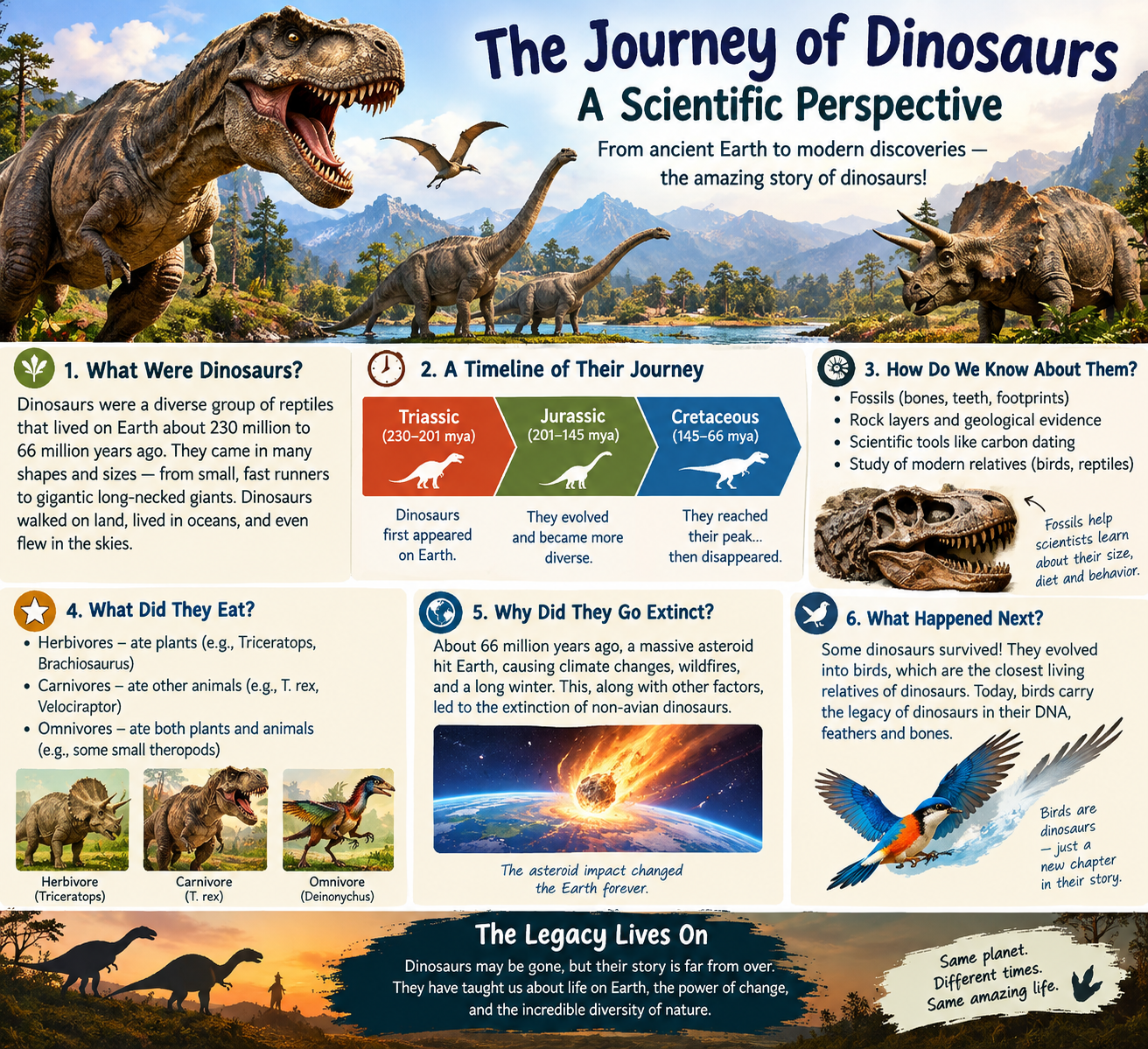
    **The Journey of Dinosaurs: A Scientific Perspective**
    Today, I completed an interesting and educational task about **The Journey of Dinosaurs: A Scientific Perspective**. This activity gave me the opportunity to explore the fascinating history of dinosaurs and understand how scientists learn about these incredible creatures that lived millions of years ago.
    Dinosaurs first appeared on Earth more than **230 million years ago** during the Triassic Period. Over millions of years, they evolved into many different species with different sizes, shapes, diets, and ways of living. Some dinosaurs were small and fast, while others were enormous plant-eaters.
    During the **Jurassic Period**, dinosaurs became even more diverse and widespread. They lived in many different environments and developed different adaptations that helped them survive. The **Cretaceous Period** was another important stage in their history, when many well-known dinosaur species lived.
    One of the most important things I learned is how scientists discover information about dinosaurs. Scientists study fossils such as bones, teeth, footprints, and eggs. They also examine rock layers and use different scientific methods to understand when dinosaurs lived and how they behaved.
    Dinosaurs had different diets. Some were **herbivores** that ate plants, while others were **carnivores** that ate other animals. There were also dinosaurs with more varied diets. Studying their teeth, bones, and fossil evidence helps scientists understand what they may have eaten.
    One of the most important events in dinosaur history happened about **66 million years ago**. A large asteroid struck Earth, causing major environmental and climate changes. This event contributed to the extinction of the non-avian dinosaurs.
    However, the dinosaur story did not completely end. Scientists have found strong evidence that **modern birds are living descendants of theropod dinosaurs**. This means that dinosaurs still have a living connection to the world today!
    This task helped me understand that fossils are like pieces of a giant scientific puzzle. Each fossil can provide clues about ancient life, and scientists carefully study these clues to build a better understanding of Earth's history.
    I also learned that science is constantly developing. New fossil discoveries, improved technology, and new research can help scientists learn more about dinosaurs and correct or improve our understanding of the past.
    **My key learning from this task:**
    Dinosaurs lived millions of years ago.
    Their history covered a huge period of Earth's history.
    Fossils provide important evidence about ancient life.
    Scientists use evidence and research to study dinosaurs.
    Dinosaurs had different diets and lifestyles.
    A major asteroid impact occurred around 66 million years ago.
    Birds are living descendants of theropod dinosaurs.
    Studying dinosaurs helps us understand Earth's changing environment.
    Overall, this task was a fascinating journey into the ancient world. It helped me appreciate the importance of science, fossils, research, and evidence in understanding our planet's past.
    The story of dinosaurs reminds us that Earth has changed dramatically over time and that life continues to evolve and adapt. Their fossils allow us to look into the distant past and discover how incredible the history of life on our planet really is.
    **Learning about the past helps us understand the present and inspires us to explore the future!**
    #RSIF8 #RollNo112 #Dinosaurs #DinosaurJourney #ScientificPerspective #DinosaurScience #Paleontology #Fossils #DinosaurFossils #AncientEarth #EarthHistory #ScienceLearning #ScientificDiscovery #Jurassic #Triassic #Cretaceous #Evolution #NaturalHistory #AncientLife #LearningJourney #StudentLearning #ScienceProject #Research #Curiosity #KeepLearning #LearnAndGrow #ScienceIsAmazing #HistoryOfLife #ExploreScience #Education
    RSIF8 Roll No: 112 Story Post No: 6 Story Post Topic: The Journey of Dinosaurs: A Scientific Perspective 🦕🌟 **The Journey of Dinosaurs: A Scientific Perspective** 🌟🦖 Today, I completed an interesting and educational task about **The Journey of Dinosaurs: A Scientific Perspective**. 🦖🔬📚 This activity gave me the opportunity to explore the fascinating history of dinosaurs and understand how scientists learn about these incredible creatures that lived millions of years ago. 🌍⏳ Dinosaurs first appeared on Earth more than **230 million years ago** during the Triassic Period. 🦕🌿 Over millions of years, they evolved into many different species with different sizes, shapes, diets, and ways of living. Some dinosaurs were small and fast, while others were enormous plant-eaters. 🦖🌱 During the **Jurassic Period**, dinosaurs became even more diverse and widespread. 🌎🦕 They lived in many different environments and developed different adaptations that helped them survive. The **Cretaceous Period** was another important stage in their history, when many well-known dinosaur species lived. 🦖🌿✨ One of the most important things I learned is how scientists discover information about dinosaurs. 🔬🦴 Scientists study fossils such as bones, teeth, footprints, and eggs. They also examine rock layers and use different scientific methods to understand when dinosaurs lived and how they behaved. 🧪🪨📖 Dinosaurs had different diets. 🌱🍖 Some were **herbivores** that ate plants, while others were **carnivores** that ate other animals. There were also dinosaurs with more varied diets. Studying their teeth, bones, and fossil evidence helps scientists understand what they may have eaten. 🦷🔬 One of the most important events in dinosaur history happened about **66 million years ago**. ☄️🌍 A large asteroid struck Earth, causing major environmental and climate changes. This event contributed to the extinction of the non-avian dinosaurs. 🌎⏳ However, the dinosaur story did not completely end. 🐦✨ Scientists have found strong evidence that **modern birds are living descendants of theropod dinosaurs**. This means that dinosaurs still have a living connection to the world today! 🦖➡️🐦🌍 This task helped me understand that fossils are like pieces of a giant scientific puzzle. 🧩🦴 Each fossil can provide clues about ancient life, and scientists carefully study these clues to build a better understanding of Earth's history. 🔬📚 I also learned that science is constantly developing. New fossil discoveries, improved technology, and new research can help scientists learn more about dinosaurs and correct or improve our understanding of the past. 🧠🔍🚀 ✨ **My key learning from this task:** 🦖 Dinosaurs lived millions of years ago. ⏳ Their history covered a huge period of Earth's history. 🦴 Fossils provide important evidence about ancient life. 🔬 Scientists use evidence and research to study dinosaurs. 🌱 Dinosaurs had different diets and lifestyles. ☄️ A major asteroid impact occurred around 66 million years ago. 🐦 Birds are living descendants of theropod dinosaurs. 🌍 Studying dinosaurs helps us understand Earth's changing environment. Overall, this task was a fascinating journey into the ancient world. 🦕🌍 It helped me appreciate the importance of science, fossils, research, and evidence in understanding our planet's past. 🔬📚✨ The story of dinosaurs reminds us that Earth has changed dramatically over time and that life continues to evolve and adapt. 🌱🌎🦖 Their fossils allow us to look into the distant past and discover how incredible the history of life on our planet really is. 🌟🔬 📚 **Learning about the past helps us understand the present and inspires us to explore the future!** 🚀🌍✨ #RSIF8 #RollNo112 #Dinosaurs #DinosaurJourney #ScientificPerspective #DinosaurScience #Paleontology #Fossils #DinosaurFossils #AncientEarth #EarthHistory #ScienceLearning #ScientificDiscovery #Jurassic #Triassic #Cretaceous #Evolution #NaturalHistory #AncientLife #LearningJourney #StudentLearning #ScienceProject #Research #Curiosity #KeepLearning #LearnAndGrow #ScienceIsAmazing #HistoryOfLife #ExploreScience #Education 🦖🦕🔬🦴🌍⏳☄️🐦🌱📚🧪🪨🧩💡✨🌟🚀🌿🌎❤️👏🎓

    0 Comentários 0 Compartilhamentos 6065 Visualizações
  • #rsisb
    Roll no.247
    song .5
    Foundation level

    **The Human Body: A Marvel of Creation**

    The human body is one of the most fascinating and complex systems in the natural world. From the tiny cells that build our tissues to the powerful organs that keep us alive, every part of the body has an important role to play.

    **The brain** helps us think, learn, remember, communicate, and understand the world around us.
    **The heart** continuously pumps blood throughout the body, delivering oxygen and nutrients to cells.
    **The lungs** allow us to breathe and exchange oxygen and carbon dioxide.
    **The blood** transports oxygen, nutrients, hormones, and other essential substances.
    **The skeleton** provides structure and protects important organs, while **muscles** help us move and perform everyday activities.

    At the microscopic level, billions of cells work together in an incredible network. Cells form tissues, tissues form organs, and organs work together as interconnected systems. The body constantly maintains balance through processes such as temperature regulation, digestion, breathing, circulation, and immune responses.

    What makes the human body especially remarkable is its ability to adapt, repair, learn, and respond to its environment. Every heartbeat, breath, movement, and thought represents a complex interaction between biological systems.

    Studying the human body teaches us not only about anatomy and biology but also about the importance of health, nutrition, exercise, rest, hygiene, and taking care of ourselves.

    **The Human Body: A Marvel of Creation** reminds us that science can reveal the amazing complexity of life. Every cell has a story, every organ has a purpose, and every system contributes to the extraordinary experience of being alive.

    #TheHumanBody #MarvelOfCreation #HumanAnatomy #Biology #Science #HumanBodyScience #AnatomyAndPhysiology #Cells #Brain #Heart #Lungs #HumanHealth #ScienceEducation #Learning #ExploreScience #BiologyEducation #AmazingScience #LifeScience #Knowledge #Education #DiscoverSc ience #ScienceIsAmazing
    #rsisb Roll no.247 song .5 Foundation level 🧬✨ **The Human Body: A Marvel of Creation** 🫀🧠 The human body is one of the most fascinating and complex systems in the natural world. From the tiny cells that build our tissues to the powerful organs that keep us alive, every part of the body has an important role to play. 🌍🔬 🧠 **The brain** helps us think, learn, remember, communicate, and understand the world around us. ❤️ **The heart** continuously pumps blood throughout the body, delivering oxygen and nutrients to cells. 🫁 **The lungs** allow us to breathe and exchange oxygen and carbon dioxide. 🩸 **The blood** transports oxygen, nutrients, hormones, and other essential substances. 🦴 **The skeleton** provides structure and protects important organs, while **muscles** help us move and perform everyday activities. 💪 At the microscopic level, billions of cells work together in an incredible network. 🧫✨ Cells form tissues, tissues form organs, and organs work together as interconnected systems. The body constantly maintains balance through processes such as temperature regulation, digestion, breathing, circulation, and immune responses. ⚙️🌡️ What makes the human body especially remarkable is its ability to adapt, repair, learn, and respond to its environment. Every heartbeat, breath, movement, and thought represents a complex interaction between biological systems. 🔬💫 Studying the human body teaches us not only about anatomy and biology but also about the importance of health, nutrition, exercise, rest, hygiene, and taking care of ourselves. 📚🥗💧😴 🌟 **The Human Body: A Marvel of Creation** reminds us that science can reveal the amazing complexity of life. Every cell has a story, every organ has a purpose, and every system contributes to the extraordinary experience of being alive. 🧬❤️🌎 #TheHumanBody #MarvelOfCreation #HumanAnatomy #Biology #Science #HumanBodyScience #AnatomyAndPhysiology #Cells #Brain #Heart #Lungs #HumanHealth #ScienceEducation #Learning #ExploreScience #BiologyEducation #AmazingScience #LifeScience #Knowledge #Education #DiscoverSc ience #ScienceIsAmazing 🧬🔬🧠❤️🫁🦴💪🌍✨
    0 Comentários 0 Compartilhamentos 5329 Visualizações 4
  • RSIF8
    Roll no:09
    Song no: 08
    Song topic: Chemical Reactions: The Engine of Life **Chemical Reactions: The Engine of Life**

    Discover the amazing world of chemical reactions through music! From digestion and breathing to photosynthesis and energy production, chemical reactions are happening all around us and inside our bodies every day. Let’s explore how these tiny changes help create and sustain life!

    #ChemicalReactions #EngineOfLife #Chemistry #Science #Photosynthesis #Energy #LifeScience #LearningIsFun #ScienceIsAmazing
    RSIF8 Roll no:09 Song no: 08 Song topic: Chemical Reactions: The Engine of Life🎵 **Chemical Reactions: The Engine of Life** 🧪🌱 Discover the amazing world of chemical reactions through music! 🎶⚡ From digestion and breathing to photosynthesis and energy production, chemical reactions are happening all around us and inside our bodies every day. 🌿❤️ Let’s explore how these tiny changes help create and sustain life! 🔬✨ #ChemicalReactions #EngineOfLife #Chemistry #Science #Photosynthesis #Energy #LifeScience #LearningIsFun #ScienceIsAmazing 🧪🌍⚡🌱
    0 Comentários 0 Compartilhamentos 1603 Visualizações 8
  • #rsisb
    Roll no.247
    story post .24
    Foundation level

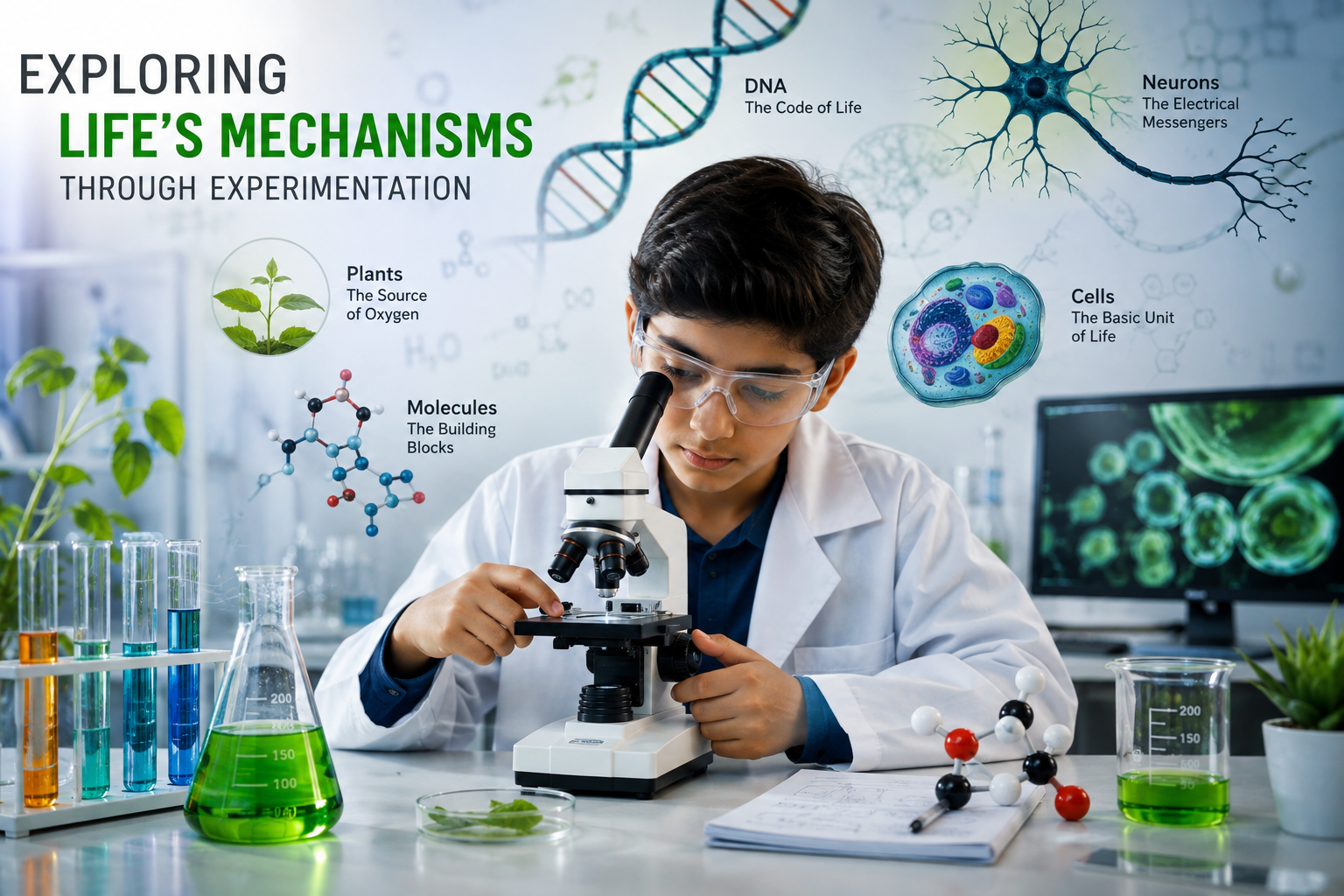
    **Exploring Life’s Mechanisms Through Experimentation**

    Life is full of fascinating mysteries, and science gives us the tools to explore them! **“Exploring Life’s Mechanisms Through Experimentation”** takes us on an exciting journey into the world of biology, where observation, questions, experiments, and discoveries help us understand how living things work.

    From the tiny structures inside cells to the complex systems that allow plants, animals, and humans to grow and survive ‍, experimentation helps scientists uncover the mechanisms behind life. By carefully designing experiments, collecting evidence, analyzing results, and learning from unexpected outcomes, we can turn curiosity into knowledge.

    This topic highlights the importance of the **scientific method**—asking meaningful questions, forming hypotheses, conducting fair tests, recording observations, and drawing conclusions based on evidence. Every experiment, whether successful or not, can teach us something valuable and lead to new questions.

    **Cells and their functions**
    **DNA and genetic information**
    **Plant growth and photosynthesis**
    **How body systems work together**
    **Microorganisms and their environments**
    **Chemical processes involved in life**
    **How living organisms interact with their surroundings**

    Experimentation also teaches important skills such as critical thinking, patience, teamwork, creativity, problem-solving, and careful observation. Science is not simply about memorizing facts—it is about discovering *why* and *how* things happen.

    Every observation can inspire a question.
    Every question can lead to an investigation.
    Every experiment can reveal something new.
    And every discovery can help us understand life a little better.

    Join us as we explore the amazing mechanisms that make life possible and discover how scientific experimentation continues to expand our understanding of the natural world!

    #ExploringLife #LifeScience #Biology #ScienceExperiment #ScientificMethod #ScienceEducation #BiologyExperiments #CellBiology #DNA #Genetics #Photosynthesis #HumanBiology #Microbiology #ScienceLearning #STEM #STEMEducation #YoungScientists #ScienceDiscovery #Experimentation #ScientificDiscovery #Curiosity #CriticalThinking #LearningScience #Nature #LivingThings #ScienceIsAmazing
    #rsisb Roll no.247 story post .24 Foundation level 🔬🧬 **Exploring Life’s Mechanisms Through Experimentation** 🌱✨ Life is full of fascinating mysteries, and science gives us the tools to explore them! 🔍🧪 **“Exploring Life’s Mechanisms Through Experimentation”** takes us on an exciting journey into the world of biology, where observation, questions, experiments, and discoveries help us understand how living things work. 🌍🔬 From the tiny structures inside cells 🦠 to the complex systems that allow plants, animals, and humans to grow and survive 🌿🧑‍🔬, experimentation helps scientists uncover the mechanisms behind life. By carefully designing experiments, collecting evidence, analyzing results, and learning from unexpected outcomes, we can turn curiosity into knowledge. 💡📊 This topic highlights the importance of the **scientific method**—asking meaningful questions, forming hypotheses, conducting fair tests, recording observations, and drawing conclusions based on evidence. 📝🔎 Every experiment, whether successful or not, can teach us something valuable and lead to new questions. 🧫 **Cells and their functions** 🧬 **DNA and genetic information** 🌱 **Plant growth and photosynthesis** 🫀 **How body systems work together** 🦠 **Microorganisms and their environments** ⚗️ **Chemical processes involved in life** 🌎 **How living organisms interact with their surroundings** Experimentation also teaches important skills such as critical thinking, patience, teamwork, creativity, problem-solving, and careful observation. 🧠🤝✨ Science is not simply about memorizing facts—it is about discovering *why* and *how* things happen. 🌟 Every observation can inspire a question. 🔍 Every question can lead to an investigation. 🧪 Every experiment can reveal something new. 💡 And every discovery can help us understand life a little better. Join us as we explore the amazing mechanisms that make life possible and discover how scientific experimentation continues to expand our understanding of the natural world! 🚀🔬🌿 #ExploringLife #LifeScience #Biology #ScienceExperiment #ScientificMethod #ScienceEducation #BiologyExperiments #CellBiology #DNA #Genetics #Photosynthesis #HumanBiology #Microbiology #ScienceLearning #STEM #STEMEducation #YoungScientists #ScienceDiscovery #Experimentation #ScientificDiscovery #Curiosity #CriticalThinking #LearningScience #Nature #LivingThings #ScienceIsAmazing 🔬🧬🌱🧪✨
    0 Comentários 0 Compartilhamentos 7059 Visualizações
  • #rsisb
    Roll no.246
    Foundation level

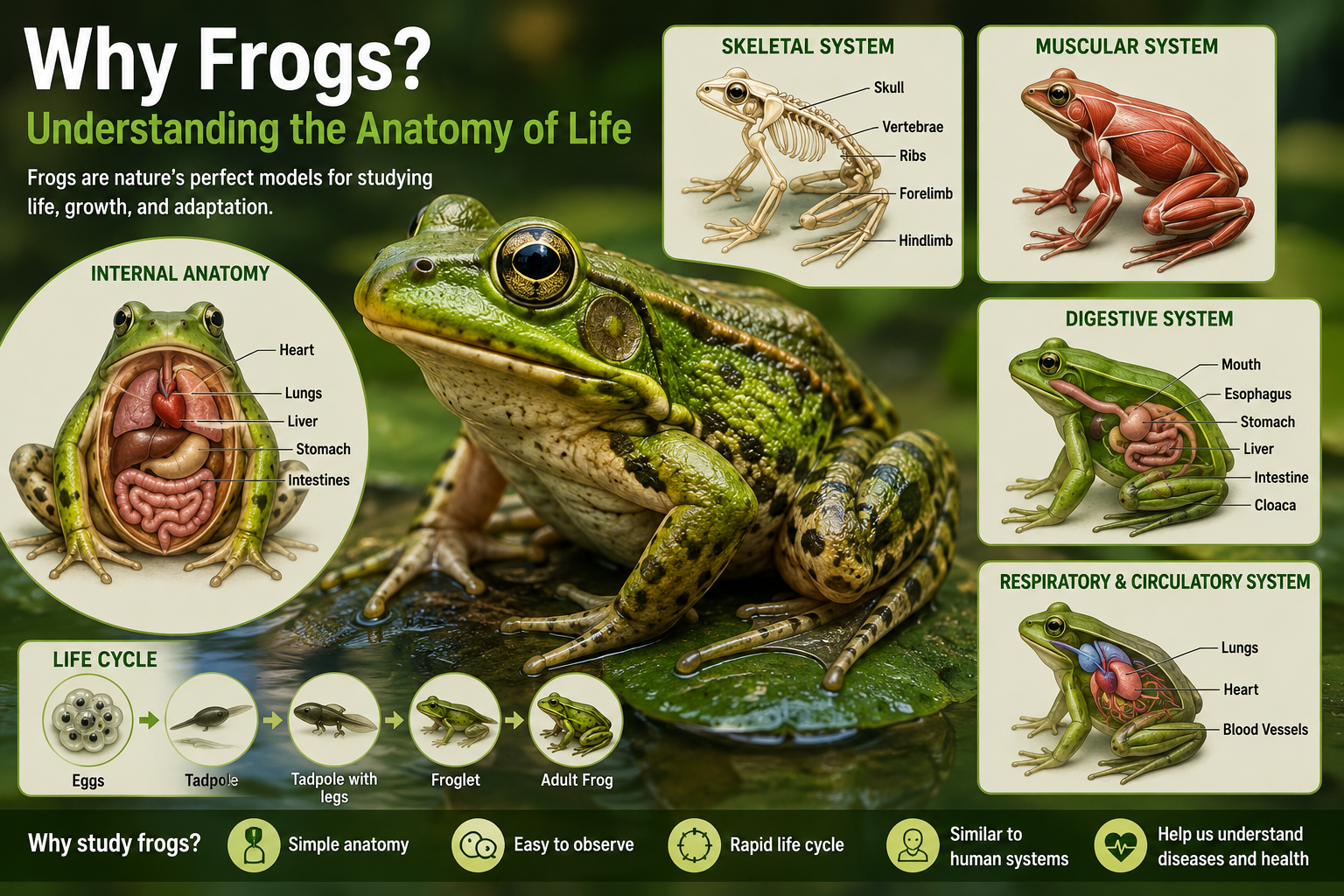
    # Why Frogs? Understanding the Anatomy of Life

    Why study frogs? Because these fascinating amphibians provide an excellent way to explore the incredible organization and complexity of living organisms. From their powerful hind legs and unique skeletal structure to their remarkable organs, muscles, nervous system, and respiratory adaptations, frogs offer a wonderful window into the basic principles of anatomy and biology.

    In this educational exploration, **“Why Frogs? Understanding the Anatomy of Life,”** we discover how different body systems work together to keep an organism alive. We can learn how a frog moves, breathes, senses its environment, obtains nutrients, circulates blood, and responds to changes around it. Studying frog anatomy also helps us understand broader biological concepts that apply to many other animals, including humans.

    Frogs are especially interesting because they live both in water and on land, making them excellent examples of adaptation. Their life cycle—from egg to tadpole to adult frog—demonstrates how living organisms can undergo remarkable changes as they develop. Their anatomy reflects their lifestyle, showing how body structures are connected to survival and environmental challenges.

    Exploring anatomy encourages students to ask important scientific questions: How does each organ function? Why are certain body structures shaped the way they are? How do different systems cooperate? By investigating these questions, we develop observation skills, scientific curiosity, and a deeper appreciation for the complexity of life.

    Most importantly, studying frogs reminds us that biology is not simply about memorizing names of organs—it is about understanding **how life works as a connected system.** Every bone, muscle, organ, and tissue has a role, and together they create a living organism capable of movement, growth, reproduction, and interaction with its environment.

    Join us on this fascinating scientific journey and discover how the anatomy of a frog can open the door to understanding the amazing mechanisms of life!

    #WhyFrogs #FrogAnatomy #UnderstandingLife #Biology #ScienceEducation #Anatomy #Amphibians #FrogLifeCycle #AnimalBiology #HumanAnatomy #LifeScience #ScienceLearning #BiologyStudents #ScientificDiscovery #ExploreScience #Nature #Wildlife #Evolution #Adaptation #STEM #STEMEducation #ScienceIsAmazing #LearningIsFun #Curiosity #ExploreNature
    #rsisb Roll no.246 Foundation level # Why Frogs? Understanding the Anatomy of Life 🐸🔬 Why study frogs? 🐸 Because these fascinating amphibians provide an excellent way to explore the incredible organization and complexity of living organisms. From their powerful hind legs and unique skeletal structure to their remarkable organs, muscles, nervous system, and respiratory adaptations, frogs offer a wonderful window into the basic principles of anatomy and biology. 🌿🧬 In this educational exploration, **“Why Frogs? Understanding the Anatomy of Life,”** we discover how different body systems work together to keep an organism alive. 🫀🫁🧠 We can learn how a frog moves, breathes, senses its environment, obtains nutrients, circulates blood, and responds to changes around it. Studying frog anatomy also helps us understand broader biological concepts that apply to many other animals, including humans. 🌎✨ Frogs are especially interesting because they live both in water and on land, making them excellent examples of adaptation. 💧🌱 Their life cycle—from egg to tadpole to adult frog—demonstrates how living organisms can undergo remarkable changes as they develop. 🔄🐸 Their anatomy reflects their lifestyle, showing how body structures are connected to survival and environmental challenges. Exploring anatomy encourages students to ask important scientific questions: How does each organ function? Why are certain body structures shaped the way they are? How do different systems cooperate? 🤔🔬 By investigating these questions, we develop observation skills, scientific curiosity, and a deeper appreciation for the complexity of life. Most importantly, studying frogs reminds us that biology is not simply about memorizing names of organs—it is about understanding **how life works as a connected system.** ❤️🧬 Every bone, muscle, organ, and tissue has a role, and together they create a living organism capable of movement, growth, reproduction, and interaction with its environment. 🐸🌿 Join us on this fascinating scientific journey and discover how the anatomy of a frog can open the door to understanding the amazing mechanisms of life! #WhyFrogs #FrogAnatomy #UnderstandingLife #Biology #ScienceEducation #Anatomy #Amphibians #FrogLifeCycle #AnimalBiology #HumanAnatomy #LifeScience #ScienceLearning #BiologyStudents #ScientificDiscovery #ExploreScience #Nature #Wildlife #Evolution #Adaptation #STEM #STEMEducation #ScienceIsAmazing #LearningIsFun #Curiosity #ExploreNature 🐸🔬🌿🧬🫀🧠🌎✨
    0 Comentários 0 Compartilhamentos 5995 Visualizações
Páginas impulsionada