• #rsisb Roll No.240 Song No.8 Foundation Level # **Black Holes and Beyond: Exploring the Limits of Physics 🌌** What happens when gravity becomes so powerful that even light cannot escape? **Black holes** are among the most mysterious objects in the universe, challenging our understanding of space, time, gravity, and physics. In this fascinating **25-minute journey**, we explore how black holes form, what happens near the **event horizon**, why time behaves strangely around extreme gravity, and what scientists are still trying to understand about these cosmic giants. We’ll also go beyond black holes and explore some of the biggest questions in modern physics: **What happens inside a black hole? Can information disappear? What is the nature of space and time? And where do the known laws of physics reach their limits?** ✨ **In this episode:** * What is a black hole? * How black holes are formed * The power of extreme gravity * Understanding the event horizon * Time and space near black holes * What could be inside a black hole? * The mysteries of singularities * Einstein’s ideas about gravity * The search for new physics * What lies beyond our current understanding? 🌠 **Black holes remind us that the universe is full of mysteries—and every mystery gives science a new question to explore.** #BlackHoles #Physics #Space #Universe #Science #Astronomy #Cosmos #Einstein #Gravity #EventHorizon #Singularity #SpaceTime #ScienceDocumentary #Educational #AmazingUniverse Rehan School Islamabad Campus Asma Shaheen EducationWali Irum Asim Saima Happinesswali https://www.facebook.com/share/v/1DfpqL92EN/
    WWW.FACEBOOK.COM
    Facebook
    #rsisb Roll No.240 Song No.8 Foundation Level # **Black Holes and Beyond: Exploring the Limits of Physics 🌌** What happens when gravity becomes so powerful that even light cannot escape? **Black...
    0 Comments 0 Shares 28 Views
  • The Birth of "Scientist": From Philosophy to Modern Terminology

    The word "Scientist" has a fascinating history that reflects the evolution of human knowledge and discovery. Before the modern scientific world existed, people who studied nature were often known as philosophers, natural philosophers, scholars, or thinkers. Over time, the search for knowledge became more specialized, leading to the birth of the term "scientist."

    In this fascinating topic, we explore how the word "scientist" emerged and how its meaning developed alongside the growth of modern science. Discover how curiosity, observation, experimentation, and critical thinking transformed the way humanity understands the world around us.

    From ancient thinkers to today's researchers and innovators , the journey of the word "scientist" tells a powerful story about our endless desire to question, discover, and understand.

    Join us on this exciting journey through the history of science and language, and discover how one word came to represent the people who continue to expand the boundaries of human knowledge!

    #Scientist #HistoryOfScience #WordHistory #Etymology #Science #Philosophy #ScientificRevolution #ModernScience #Scientists #Knowledge #Discovery #Curiosity #CriticalThinking #Education #Learning #Innovation #Research #Language #Linguistics #HumanKnowledge


    RSISB
    Roll No:#209
    Story Post No.26
    πŸ”¬πŸ“š The Birth of "Scientist": From Philosophy to Modern Terminology 🌍✨ The word "Scientist" has a fascinating history that reflects the evolution of human knowledge and discovery. πŸ§ πŸ’‘ Before the modern scientific world existed, people who studied nature were often known as philosophers, natural philosophers, scholars, or thinkers. Over time, the search for knowledge became more specialized, leading to the birth of the term "scientist." πŸ”¬πŸŒŸ In this fascinating topic, we explore how the word "scientist" emerged and how its meaning developed alongside the growth of modern science. πŸ“–πŸ•°οΈ Discover how curiosity, observation, experimentation, and critical thinking transformed the way humanity understands the world around us. πŸŒŽπŸ” From ancient thinkers to today's researchers and innovators πŸš€, the journey of the word "scientist" tells a powerful story about our endless desire to question, discover, and understand. πŸ’­βœ¨ πŸ’¬ Join us on this exciting journey through the history of science and language, and discover how one word came to represent the people who continue to expand the boundaries of human knowledge! πŸŒŸπŸ”¬ #Scientist #HistoryOfScience #WordHistory #Etymology #Science #Philosophy #ScientificRevolution #ModernScience #Scientists #Knowledge #Discovery #Curiosity #CriticalThinking #Education #Learning #Innovation #Research #Language #Linguistics #HumanKnowledge πŸ”¬πŸ“šπŸ§ πŸ’‘πŸŒβœ¨πŸ•°οΈπŸ”πŸš€πŸŒŸπŸ“–πŸ’­πŸŒŽπŸ§ͺπŸ‘ RSISB Roll No:#209 Story Post No.26
    0 Comments 0 Shares 131 Views
  • #rsisb
    roll no.247
    Coding task no.7
    Foundation Level
    # The Ethics and Education of Animal Dissections
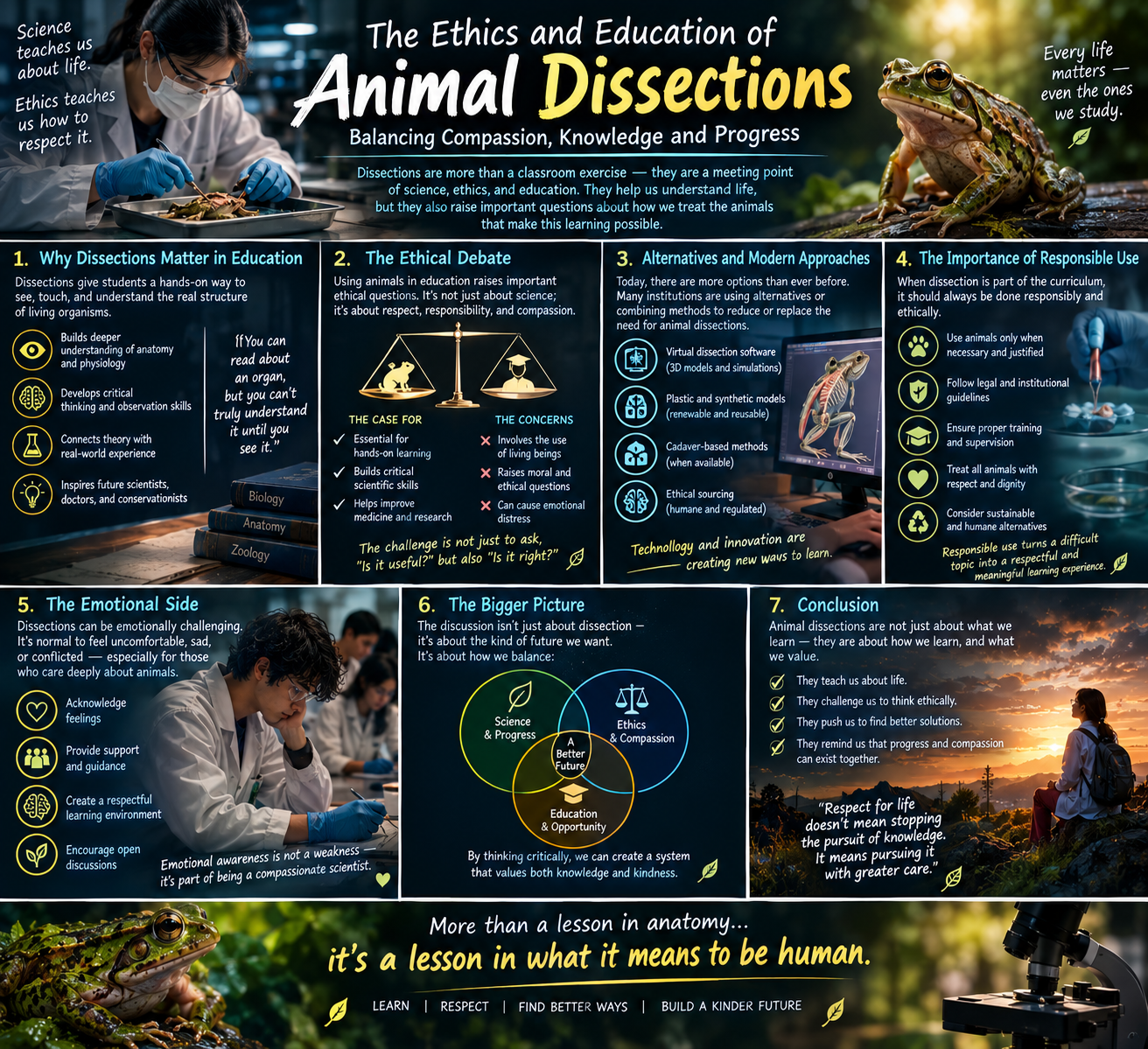
    Animal dissection has been an important part of science education for many years, especially in biology and anatomy classes. It allows students to observe the structure of organisms directly and understand how different body parts work together. However, the practice also raises important ethical questions about animal welfare, respect for living beings, and whether there are better educational alternatives.
    From an educational perspective, dissections can provide students with a hands-on learning experience that textbooks and diagrams cannot always provide. Students may develop a clearer understanding of anatomy, biological organization, and scientific observation. Practical activities can also encourage curiosity, careful observation, teamwork, and responsible scientific thinking.
    At the same time, ethical considerations should be taken seriously. Animals should not be treated simply as objects for classroom activities. Their use should follow appropriate welfare standards, and students should be encouraged to think about why an animal is being used and whether the educational objective could be achieved through another method.
    Modern education offers several alternatives, including high-quality anatomical models, computer simulations, virtual dissection programs, videos, and interactive digital resources. These approaches can sometimes provide detailed visual information while reducing or eliminating the need to use animals. For some students, alternatives may also make learning more comfortable and accessible.
    The most responsible approach is to balance educational value with ethical responsibility. Schools and teachers can carefully evaluate whether dissection is necessary, explain the ethical issues to students, follow proper guidelines, and provide suitable alternatives when appropriate.
    Ultimately, science education should not only teach students about biology—it should also teach them values such as compassion, responsibility, critical thinking, and respect for life. By combining scientific knowledge with ethical awareness, students can become better scientists, thoughtful citizens, and responsible stewards of the natural world.
    ### Key Message
    Animal dissection can offer valuable educational experiences, but it should always be considered alongside animal welfare, ethical responsibility, and modern alternatives. The goal of education should be to develop both **scientific understanding and compassion**.
    ### Hashtags
    #AnimalDissection #EthicsInScience #ScienceEducation #AnimalWelfare #BiologyEducation #EthicalScience #HandsOnLearning #VirtualLearning #ScienceAndEthics #StudentLearning #Biology #Anatomy #ScientificThinking #ResponsibleScience #EducationMatters #CompassionAndScience #STEMEducation #LearningThroughScience #RespectForLife #FutureScientists
    #rsisb roll no.247 Coding task no.7 Foundation Level # The Ethics and Education of Animal Dissections πŸ§ͺπŸΎπŸ“š Animal dissection has been an important part of science education for many years, especially in biology and anatomy classes. It allows students to observe the structure of organisms directly and understand how different body parts work together. However, the practice also raises important ethical questions about animal welfare, respect for living beings, and whether there are better educational alternatives. βš–οΈπŸΎ From an educational perspective, dissections can provide students with a hands-on learning experience that textbooks and diagrams cannot always provide. Students may develop a clearer understanding of anatomy, biological organization, and scientific observation. πŸ”¬πŸ“–βœ¨ Practical activities can also encourage curiosity, careful observation, teamwork, and responsible scientific thinking. At the same time, ethical considerations should be taken seriously. Animals should not be treated simply as objects for classroom activities. Their use should follow appropriate welfare standards, and students should be encouraged to think about why an animal is being used and whether the educational objective could be achieved through another method. ❀️🐾🌱 Modern education offers several alternatives, including high-quality anatomical models, computer simulations, virtual dissection programs, videos, and interactive digital resources. πŸ’»πŸ§¬ These approaches can sometimes provide detailed visual information while reducing or eliminating the need to use animals. For some students, alternatives may also make learning more comfortable and accessible. The most responsible approach is to balance educational value with ethical responsibility. Schools and teachers can carefully evaluate whether dissection is necessary, explain the ethical issues to students, follow proper guidelines, and provide suitable alternatives when appropriate. πŸŒβš–οΈ Ultimately, science education should not only teach students about biology—it should also teach them values such as compassion, responsibility, critical thinking, and respect for life. πŸ§ πŸ’šπŸΎ By combining scientific knowledge with ethical awareness, students can become better scientists, thoughtful citizens, and responsible stewards of the natural world. πŸŒ±πŸ”¬βœ¨ ### 🌟 Key Message Animal dissection can offer valuable educational experiences, but it should always be considered alongside animal welfare, ethical responsibility, and modern alternatives. The goal of education should be to develop both **scientific understanding and compassion**. πŸΎβ€οΈπŸ“š ### 🏷️ Hashtags #AnimalDissection #EthicsInScience #ScienceEducation #AnimalWelfare #BiologyEducation #EthicalScience #HandsOnLearning #VirtualLearning #ScienceAndEthics #StudentLearning #Biology #Anatomy #ScientificThinking #ResponsibleScience #EducationMatters #CompassionAndScience #STEMEducation #LearningThroughScience #RespectForLife #FutureScientists
    0 Comments 0 Shares 2341 Views
  • #rsisb
    Roll No.247
    foundation level
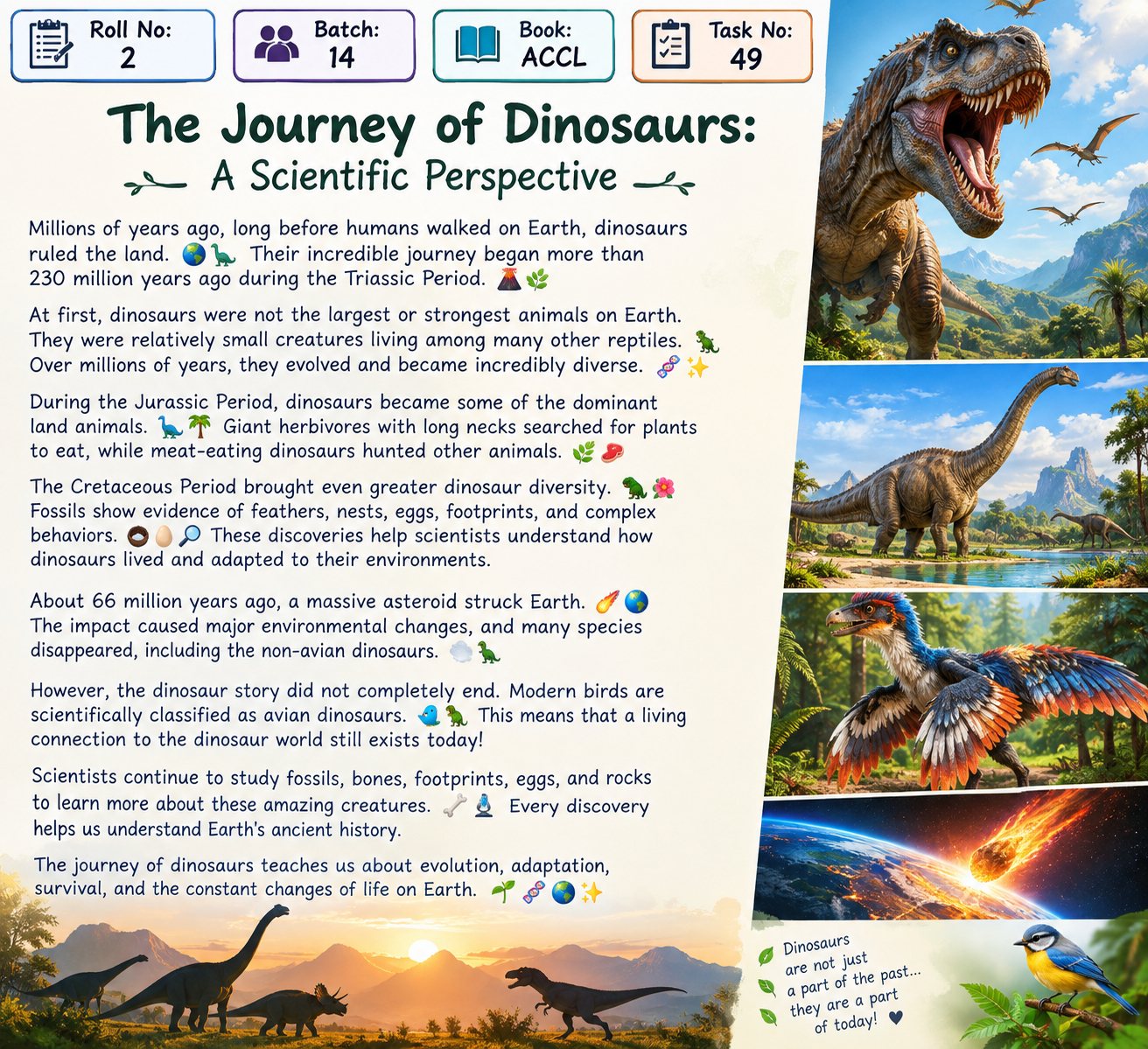
    # The Journey of Dinosaurs: A Scientific Perspective

    Step into the fascinating world of dinosaurs and explore one of the most remarkable chapters in the history of life on Earth! Dinosaurs ruled many of the planet’s ecosystems for more than 160 million years, appearing during the Triassic Period and continuing through the Jurassic and Cretaceous Periods. Their incredible diversity included enormous plant-eaters, powerful predators, swift hunters, armored species, and many other extraordinary creatures.

    From a scientific perspective, the story of dinosaurs is not simply a tale of giant creatures—it is a story of evolution, adaptation, survival, extinction, and discovery. Scientists learn about dinosaurs through fossils, including bones, teeth, footprints, eggs, nests, and even traces of skin and feathers. By carefully studying these clues, paleontologists can reconstruct how dinosaurs lived, what they ate, how they moved, and how different species changed over millions of years.

    Dinosaurs first appeared roughly 230 million years ago. Over time, they adapted to changing environments and became one of the most successful groups of land animals in Earth's history. Some developed long necks and enormous bodies to reach vegetation, while others evolved sharp teeth and strong jaws for hunting. Their fossils have been discovered on every continent, showing just how widely they were distributed.

    The Jurassic Period is often remembered as a time when giant dinosaurs became especially prominent. Huge sauropods walked across ancient landscapes, while theropods hunted or scavenged. During the Cretaceous Period, dinosaurs continued to diversify, and many familiar species appeared. At the same time, flowering plants became increasingly important parts of many ecosystems.

    One of the most important scientific discoveries is that birds are living dinosaurs. Evidence from fossils, anatomy, and evolutionary studies shows that modern birds descended from theropod dinosaurs. This means that although non-avian dinosaurs disappeared from the fossil record about 66 million years ago, the dinosaur lineage continues today in the form of birds.

    The end of the Cretaceous Period brought a dramatic change. A large asteroid struck what is now the Yucatán Peninsula, contributing to major environmental disruptions around the world. This event, together with other environmental changes, played a major role in the extinction of non-avian dinosaurs. However, many other organisms survived, including early mammals, reptiles, and birds.

    Today, dinosaur research continues to evolve. New fossils, improved imaging technologies, computer modeling, and advances in genetics and evolutionary biology are helping scientists understand these ancient animals more accurately. Every newly discovered fossil can provide another piece of the enormous puzzle of Earth's past.

    The journey of dinosaurs reminds us that Earth has changed dramatically over geological time. Their story teaches us about adaptation, biodiversity, environmental change, and extinction. Most importantly, it shows how scientific evidence can help us understand a world that existed millions of years before humans appeared.

    Whether you are fascinated by enormous herbivores, fearsome predators, ancient ecosystems, or the origins of modern birds, the scientific journey of dinosaurs offers endless opportunities for discovery. Their fossils connect us to a distant past and inspire scientists, students, and curious minds to keep asking questions about the incredible history of life on our planet.

    #Dinosaurs #DinosaurJourney #Paleontology #Science #Fossils #Evolution #EarthHistory #JurassicPeriod #CretaceousPeriod #TriassicPeriod #DinosaurScience #AncientEarth #NaturalHistory #PrehistoricLife #ScientificDiscovery #Paleontologist #Biodiversity #Extinction #BirdsAreDinosaurs #LearnScience #ScienceEducation
    #rsisb Roll No.247 foundation level # The Journey of Dinosaurs: A Scientific Perspective πŸ¦–πŸŒπŸ”¬ Step into the fascinating world of dinosaurs and explore one of the most remarkable chapters in the history of life on Earth! πŸŒŽπŸ¦• Dinosaurs ruled many of the planet’s ecosystems for more than 160 million years, appearing during the Triassic Period and continuing through the Jurassic and Cretaceous Periods. Their incredible diversity included enormous plant-eaters, powerful predators, swift hunters, armored species, and many other extraordinary creatures. 🦴✨ From a scientific perspective, the story of dinosaurs is not simply a tale of giant creatures—it is a story of evolution, adaptation, survival, extinction, and discovery. Scientists learn about dinosaurs through fossils, including bones, teeth, footprints, eggs, nests, and even traces of skin and feathers. πŸ”¬πŸ¦΄ By carefully studying these clues, paleontologists can reconstruct how dinosaurs lived, what they ate, how they moved, and how different species changed over millions of years. Dinosaurs first appeared roughly 230 million years ago. πŸŒ‹πŸŒΏ Over time, they adapted to changing environments and became one of the most successful groups of land animals in Earth's history. Some developed long necks and enormous bodies to reach vegetation, while others evolved sharp teeth and strong jaws for hunting. πŸ¦•πŸŒ±πŸ¦– Their fossils have been discovered on every continent, showing just how widely they were distributed. The Jurassic Period is often remembered as a time when giant dinosaurs became especially prominent. πŸŒ΄β˜€οΈ Huge sauropods walked across ancient landscapes, while theropods hunted or scavenged. During the Cretaceous Period, dinosaurs continued to diversify, and many familiar species appeared. At the same time, flowering plants became increasingly important parts of many ecosystems. πŸŒΈπŸ¦– One of the most important scientific discoveries is that birds are living dinosaurs. πŸ¦πŸ¦• Evidence from fossils, anatomy, and evolutionary studies shows that modern birds descended from theropod dinosaurs. This means that although non-avian dinosaurs disappeared from the fossil record about 66 million years ago, the dinosaur lineage continues today in the form of birds. πŸŒπŸ”¬ The end of the Cretaceous Period brought a dramatic change. A large asteroid struck what is now the Yucatán Peninsula, contributing to major environmental disruptions around the world. 🌠🌎 This event, together with other environmental changes, played a major role in the extinction of non-avian dinosaurs. However, many other organisms survived, including early mammals, reptiles, and birds. Today, dinosaur research continues to evolve. πŸ§‘‍πŸ”¬πŸ”Ž New fossils, improved imaging technologies, computer modeling, and advances in genetics and evolutionary biology are helping scientists understand these ancient animals more accurately. Every newly discovered fossil can provide another piece of the enormous puzzle of Earth's past. 🦴🧩 The journey of dinosaurs reminds us that Earth has changed dramatically over geological time. 🌎⏳ Their story teaches us about adaptation, biodiversity, environmental change, and extinction. Most importantly, it shows how scientific evidence can help us understand a world that existed millions of years before humans appeared. Whether you are fascinated by enormous herbivores, fearsome predators, ancient ecosystems, or the origins of modern birds, the scientific journey of dinosaurs offers endless opportunities for discovery. πŸ¦–πŸ”¬πŸŒΏ Their fossils connect us to a distant past and inspire scientists, students, and curious minds to keep asking questions about the incredible history of life on our planet. 🌍✨ #Dinosaurs πŸ¦– #DinosaurJourney πŸ¦• #Paleontology πŸ”¬ #Science πŸ§ͺ #Fossils 🦴 #Evolution 🧬 #EarthHistory 🌍 #JurassicPeriod 🌿 #CretaceousPeriod πŸŒ‹ #TriassicPeriod 🌎 #DinosaurScience πŸ”Ž #AncientEarth ⏳ #NaturalHistory 🏞️ #PrehistoricLife πŸ¦• #ScientificDiscovery πŸ’‘ #Paleontologist πŸ§‘‍πŸ”¬ #Biodiversity 🌱 #Extinction 🌠 #BirdsAreDinosaurs 🐦 #LearnScience πŸ“š #ScienceEducation πŸ”¬βœ¨
    0 Comments 0 Shares 3083 Views
  • #rsisb
    Roll no.247
    Foundation# The Blueprint of Existence: Unraveling DNA and the Origins of Life

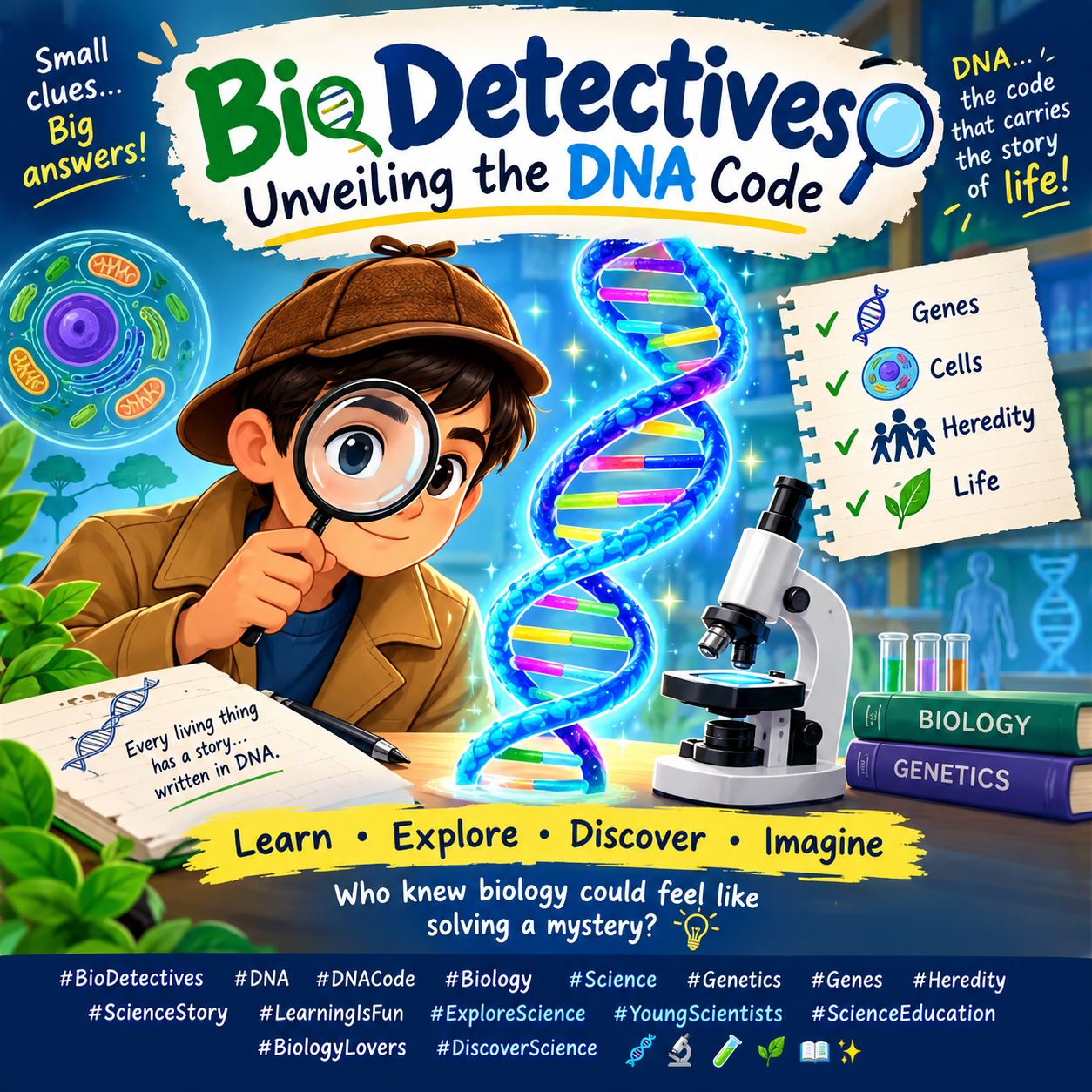
    **The Blueprint of Existence: Unraveling DNA and the Origins of Life** is a fascinating journey into one of science’s greatest mysteries: **How did life begin, and how does living matter carry the instructions needed to grow, function, and reproduce?** From microscopic cells to complex organisms, DNA plays a remarkable role in storing and passing on biological information.

    **DNA, or deoxyribonucleic acid,** can be thought of as a biological instruction manual. It contains genetic information that helps cells build proteins, regulate their activities, and pass characteristics from one generation to the next. Its famous double-helix structure, made from complementary nucleotide bases, allows genetic information to be copied and transmitted with extraordinary precision.

    But DNA also raises a deeper question: **Where did the first genetic information come from?** Scientists have been investigating the origins of life for decades. While there is no single confirmed explanation for exactly how life began, several scientific ideas explore how simple chemicals on the early Earth might have interacted, formed increasingly complex molecules, and eventually contributed to the emergence of systems capable of reproduction and evolution.

    One important idea in origin-of-life research is the possibility that **RNA may have played an early role** because it can both store information and participate in chemical reactions. Over immense periods of time, chemical systems may have become increasingly sophisticated, eventually leading toward the molecular machinery found in modern cells.

    The story of DNA is also connected to **evolution**. Small changes in genetic information can occur over generations, while natural selection and other evolutionary processes influence which traits become more or less common in populations. This helps explain the incredible diversity of life on Earth—from tiny microorganisms to plants, animals, and humans.

    Exploring DNA and the origins of life reminds us that science is not simply about memorizing facts. It is about asking questions, examining evidence, testing ideas, and remaining curious about the natural world. Every discovery about cells, genes, molecules, and ancient environments gives us another piece of the enormous puzzle of existence.

    **The blueprint of life is more than a molecule—it is part of a remarkable scientific story about information, chemistry, evolution, and the extraordinary diversity of living systems.** The more we learn about DNA and life's origins, the more we appreciate both the complexity of life today and the fascinating scientific questions that remain unanswered.

    Whether you are a student, science enthusiast, researcher, or simply someone curious about the world around you, this topic offers an exciting opportunity to explore biology, genetics, chemistry, evolution, and the origins of life.

    ### Key Topics

    Structure and function of DNA
    Genetic information and inheritance
    Chemistry and the origins of life
    Early Earth environments
    RNA and early molecular systems
    Evolution and natural selection
    The diversity of life
    Unanswered questions in modern biology

    ### Hashtags

    #BlueprintOfExistence #DNA #Genetics #OriginsOfLife #Science #Biology #MolecularBiology #Evolution #GeneticCode #LifeOnEarth #EarlyEarth #RNA #CellBiology #ScientificDiscovery #STEM #ScienceEducation #Biotechnology #Nature #Learning #Curiosity
    #rsisb Roll no.247 Foundation# The Blueprint of Existence: Unraveling DNA and the Origins of Life 🧬🌍✨ πŸ”¬ **The Blueprint of Existence: Unraveling DNA and the Origins of Life** is a fascinating journey into one of science’s greatest mysteries: **How did life begin, and how does living matter carry the instructions needed to grow, function, and reproduce?** 🌱🧬 From microscopic cells to complex organisms, DNA plays a remarkable role in storing and passing on biological information. 🧬 **DNA, or deoxyribonucleic acid,** can be thought of as a biological instruction manual. It contains genetic information that helps cells build proteins, regulate their activities, and pass characteristics from one generation to the next. Its famous double-helix structure, made from complementary nucleotide bases, allows genetic information to be copied and transmitted with extraordinary precision. 🌍 But DNA also raises a deeper question: **Where did the first genetic information come from?** Scientists have been investigating the origins of life for decades. While there is no single confirmed explanation for exactly how life began, several scientific ideas explore how simple chemicals on the early Earth might have interacted, formed increasingly complex molecules, and eventually contributed to the emergence of systems capable of reproduction and evolution. πŸ§ͺ🌊⚑ One important idea in origin-of-life research is the possibility that **RNA may have played an early role** because it can both store information and participate in chemical reactions. Over immense periods of time, chemical systems may have become increasingly sophisticated, eventually leading toward the molecular machinery found in modern cells. πŸ§«πŸ”¬ The story of DNA is also connected to **evolution**. Small changes in genetic information can occur over generations, while natural selection and other evolutionary processes influence which traits become more or less common in populations. This helps explain the incredible diversity of life on Earth—from tiny microorganisms to plants, animals, and humans. πŸŒ³πŸ¦ πŸ¦‹πŸ˜ ✨ Exploring DNA and the origins of life reminds us that science is not simply about memorizing facts. It is about asking questions, examining evidence, testing ideas, and remaining curious about the natural world. Every discovery about cells, genes, molecules, and ancient environments gives us another piece of the enormous puzzle of existence. πŸ”πŸŒŒ πŸš€ **The blueprint of life is more than a molecule—it is part of a remarkable scientific story about information, chemistry, evolution, and the extraordinary diversity of living systems.** The more we learn about DNA and life's origins, the more we appreciate both the complexity of life today and the fascinating scientific questions that remain unanswered. πŸ“š Whether you are a student, science enthusiast, researcher, or simply someone curious about the world around you, this topic offers an exciting opportunity to explore biology, genetics, chemistry, evolution, and the origins of life. πŸ§¬πŸ”¬πŸŒπŸ’‘ ### 🌟 Key Topics 🧬 Structure and function of DNA πŸ”¬ Genetic information and inheritance πŸ§ͺ Chemistry and the origins of life 🌊 Early Earth environments 🧫 RNA and early molecular systems 🌱 Evolution and natural selection 🌍 The diversity of life πŸš€ Unanswered questions in modern biology ### πŸ”– Hashtags #BlueprintOfExistence #DNA #Genetics #OriginsOfLife #Science #Biology #MolecularBiology #Evolution #GeneticCode #LifeOnEarth #EarlyEarth #RNA #CellBiology #ScientificDiscovery #STEM #ScienceEducation #Biotechnology #Nature #Learning #Curiosity πŸ§¬πŸ”¬πŸŒβœ¨
    0 Comments 0 Shares 2550 Views
  • #rsisb
    Roll No.240
    Story No.14
    Foundation Level

    **Sound Waves: The Physics of Hearing and Communication**

    Sound waves are invisible vibrations that travel through air, water, and solids, allowing us to hear and communicate with the world around us. Every sound begins when an object vibrates, creating waves that move through a medium until they reach our ears. These waves carry energy, not matter, and their frequency determines the pitch while their amplitude controls the loudness of the sound.

    Inside the human ear, sound waves follow an incredible journey. They enter through the outer ear, vibrate the eardrum, and pass through three tiny bones called the ossicles. These vibrations then reach the cochlea, where thousands of tiny hair cells convert them into electrical signals. The auditory nerve carries these signals to the brain, which interprets them as speech, music, or other familiar sounds.

    Sound plays a vital role in communication, education, entertainment, medicine, and technology. From conversations and musical performances to ultrasound imaging, sonar systems, and hearing aids, the science of sound has transformed countless aspects of modern life. Understanding how sound waves travel and interact with different materials helps scientists and engineers develop better communication systems and innovative technologies.

    The study of sound waves demonstrates the fascinating connection between physics and everyday life. By exploring concepts such as vibration, frequency, wavelength, amplitude, and wave speed, we gain a deeper appreciation of how hearing works and how sound enables people to connect, learn, and share ideas across the world.

    Rehan School Islamabad Campus
    Asma Shaheen EducationWali
    Irum Asim
    Saima Happinesswali
    #rsisb Roll No.240 Story No.14 Foundation Level **Sound Waves: The Physics of Hearing and Communication** Sound waves are invisible vibrations that travel through air, water, and solids, allowing us to hear and communicate with the world around us. Every sound begins when an object vibrates, creating waves that move through a medium until they reach our ears. These waves carry energy, not matter, and their frequency determines the pitch while their amplitude controls the loudness of the sound. Inside the human ear, sound waves follow an incredible journey. They enter through the outer ear, vibrate the eardrum, and pass through three tiny bones called the ossicles. These vibrations then reach the cochlea, where thousands of tiny hair cells convert them into electrical signals. The auditory nerve carries these signals to the brain, which interprets them as speech, music, or other familiar sounds. Sound plays a vital role in communication, education, entertainment, medicine, and technology. From conversations and musical performances to ultrasound imaging, sonar systems, and hearing aids, the science of sound has transformed countless aspects of modern life. Understanding how sound waves travel and interact with different materials helps scientists and engineers develop better communication systems and innovative technologies. The study of sound waves demonstrates the fascinating connection between physics and everyday life. By exploring concepts such as vibration, frequency, wavelength, amplitude, and wave speed, we gain a deeper appreciation of how hearing works and how sound enables people to connect, learn, and share ideas across the world. Rehan School Islamabad Campus Asma Shaheen EducationWali Irum Asim Saima Happinesswali
    0 Comments 0 Shares 1673 Views
  • #rsisb
    Roll No.240
    Story No.15
    Foundation Level

    ### **The Nature of Light: Exploring Waves and Particles**

    Light is one of the most fascinating phenomena in the universe, playing a vital role in everything from vision and communication to modern technology and scientific discovery. Unlike ordinary objects, light exhibits a remarkable property known as **wave-particle duality**, meaning it behaves both as a wave and as a stream of tiny particles called **photons**. This unique characteristic has transformed our understanding of physics and the fundamental laws that govern the universe.

    As a wave, light travels through space in the form of electromagnetic waves, displaying properties such as reflection, refraction, interference, diffraction, and polarization. These wave behaviors explain everyday phenomena like rainbows, mirrors, lenses, and the colors we observe in nature. As particles, photons carry discrete amounts of energy, allowing light to interact with matter in ways that explain the photoelectric effect, lasers, and many modern technologies. Together, these two perspectives provide a complete understanding of how light behaves under different conditions.

    Exploring the nature of light helps us appreciate the incredible discoveries made by scientists such as Isaac Newton, Thomas Young, James Clerk Maxwell, Albert Einstein, and Max Planck. Their groundbreaking work laid the foundation for quantum mechanics, optics, telecommunications, medical imaging, fiber-optic communication, astronomy, and renewable energy technologies. From illuminating our homes to enabling space exploration, light continues to shape the modern world in extraordinary ways.

    **#NatureOfLight #Physics #Science #WaveParticleDuality #Light #Photons #ElectromagneticWaves #QuantumPhysics #Optics #STEM #Education #ScientificDiscovery #Technology #Learning #ExploreScience **

    Rehan School Islamabad Campus
    Asma Shaheen EducationWali
    Irum Asim
    Saima Happinesswali
    #rsisb Roll No.240 Story No.15 Foundation Level ### **The Nature of Light: Exploring Waves and Particles** Light is one of the most fascinating phenomena in the universe, playing a vital role in everything from vision and communication to modern technology and scientific discovery. Unlike ordinary objects, light exhibits a remarkable property known as **wave-particle duality**, meaning it behaves both as a wave and as a stream of tiny particles called **photons**. This unique characteristic has transformed our understanding of physics and the fundamental laws that govern the universe. As a wave, light travels through space in the form of electromagnetic waves, displaying properties such as reflection, refraction, interference, diffraction, and polarization. These wave behaviors explain everyday phenomena like rainbows, mirrors, lenses, and the colors we observe in nature. As particles, photons carry discrete amounts of energy, allowing light to interact with matter in ways that explain the photoelectric effect, lasers, and many modern technologies. Together, these two perspectives provide a complete understanding of how light behaves under different conditions. Exploring the nature of light helps us appreciate the incredible discoveries made by scientists such as Isaac Newton, Thomas Young, James Clerk Maxwell, Albert Einstein, and Max Planck. Their groundbreaking work laid the foundation for quantum mechanics, optics, telecommunications, medical imaging, fiber-optic communication, astronomy, and renewable energy technologies. From illuminating our homes to enabling space exploration, light continues to shape the modern world in extraordinary ways. **#NatureOfLight #Physics #Science #WaveParticleDuality #Light #Photons #ElectromagneticWaves #QuantumPhysics #Optics #STEM #Education #ScientificDiscovery #Technology #Learning #ExploreScience πŸŒˆπŸ’‘πŸ”¬βš›οΈπŸ“š** Rehan School Islamabad Campus Asma Shaheen EducationWali Irum Asim Saima Happinesswali
    0 Comments 0 Shares 3036 Views
  • #rsisb
    Roll no.239
    Foundation Level


    **Dissection** is an important method used in biology to understand the internal structure of living organisms. By carefully examining organs, tissues, and body systems, students and scientists can learn how different parts of an organism are arranged and how they work together.

    Dissections provide a practical experience that books and diagrams cannot always provide. For example, studying a frog dissection can help students understand the **heart, lungs, liver, stomach, intestines, and other organs** in their natural positions. This hands-on learning can make biological concepts easier to understand and remember.

    Dissection also plays a role in **medical education and scientific research**. It has helped humans develop a deeper understanding of anatomy, disease, and the relationships between different body systems.

    However, dissections should always be performed responsibly, following **ethical guidelines, safety procedures, and respect for living organisms**. Modern alternatives, such as digital simulations and 3D anatomical models, can also provide valuable learning experiences.

    Overall, dissections help us **“peer inside” life** and transform biological knowledge from something we simply read about into something we can observe and understand more clearly.
    #rsisb Roll no.239 Foundation Level **Dissection** is an important method used in biology to understand the internal structure of living organisms. By carefully examining organs, tissues, and body systems, students and scientists can learn how different parts of an organism are arranged and how they work together. Dissections provide a practical experience that books and diagrams cannot always provide. For example, studying a frog dissection can help students understand the **heart, lungs, liver, stomach, intestines, and other organs** in their natural positions. This hands-on learning can make biological concepts easier to understand and remember. Dissection also plays a role in **medical education and scientific research**. It has helped humans develop a deeper understanding of anatomy, disease, and the relationships between different body systems. However, dissections should always be performed responsibly, following **ethical guidelines, safety procedures, and respect for living organisms**. Modern alternatives, such as digital simulations and 3D anatomical models, can also provide valuable learning experiences. Overall, dissections help us **“peer inside” life** and transform biological knowledge from something we simply read about into something we can observe and understand more clearly.
    0 Comments 0 Shares 1688 Views
  • #rsisb
    Roll No.240
    Story No.17
    Foundation level

    ### **The Ethics and Education of Animal Dissections**

    Animal dissection has long been an important part of biology and medical education, helping students understand anatomy, physiology, and the complex structures of living organisms. By examining real biological specimens, learners gain hands-on experience that strengthens their observation, critical thinking, and scientific investigation skills. For many years, dissections have played a significant role in preparing future doctors, veterinarians, scientists, and researchers by providing practical knowledge that complements classroom learning.

    At the same time, animal dissections raise important ethical questions about animal welfare, responsible scientific practice, and the balance between educational benefits and respect for living creatures. Modern education encourages students to consider these ethical perspectives while learning about science. Many schools and universities now offer alternatives such as virtual dissections, 3D anatomical models, computer simulations, and interactive digital laboratories. These innovative tools provide effective learning experiences while reducing the need for animal specimens in many educational settings.

    Understanding the ethics of animal dissection helps students develop not only scientific knowledge but also compassion, responsibility, and respect for life. By combining ethical awareness with scientific inquiry, educators can inspire future generations to pursue discovery in ways that are both innovative and humane. This balanced approach promotes critical thinking, responsible decision-making, and a deeper appreciation for the relationship between science, education, and the living world.

    **#AnimalDissection #Biology #ScienceEducation #Ethics #STEM #BiologyLab #Anatomy #LifeSciences #ScientificLearning #AnimalWelfare #Education #MedicalScience #CriticalThinking #Research #Science **

    Rehan School Islamabad Campus
    Asma Shaheen EducationWali
    Irum Asim
    Saima Happinesswali
    #rsisb Roll No.240 Story No.17 Foundation level ### **The Ethics and Education of Animal Dissections** Animal dissection has long been an important part of biology and medical education, helping students understand anatomy, physiology, and the complex structures of living organisms. By examining real biological specimens, learners gain hands-on experience that strengthens their observation, critical thinking, and scientific investigation skills. For many years, dissections have played a significant role in preparing future doctors, veterinarians, scientists, and researchers by providing practical knowledge that complements classroom learning. At the same time, animal dissections raise important ethical questions about animal welfare, responsible scientific practice, and the balance between educational benefits and respect for living creatures. Modern education encourages students to consider these ethical perspectives while learning about science. Many schools and universities now offer alternatives such as virtual dissections, 3D anatomical models, computer simulations, and interactive digital laboratories. These innovative tools provide effective learning experiences while reducing the need for animal specimens in many educational settings. Understanding the ethics of animal dissection helps students develop not only scientific knowledge but also compassion, responsibility, and respect for life. By combining ethical awareness with scientific inquiry, educators can inspire future generations to pursue discovery in ways that are both innovative and humane. This balanced approach promotes critical thinking, responsible decision-making, and a deeper appreciation for the relationship between science, education, and the living world. **#AnimalDissection #Biology #ScienceEducation #Ethics #STEM #BiologyLab #Anatomy #LifeSciences #ScientificLearning #AnimalWelfare #Education #MedicalScience #CriticalThinking #Research #Science πŸŒΏπŸ”¬πŸ§¬πŸΈπŸ“š** Rehan School Islamabad Campus Asma Shaheen EducationWali Irum Asim Saima Happinesswali
    0 Comments 0 Shares 4445 Views
  • #rsisb
    Roll No.240
    Story No.18
    Foundation Level

    ### **Exploring Life’s Mechanisms Through Experimentation**

    Scientific experimentation is one of the most powerful ways to understand the complex processes that sustain life. From the smallest microscopic cells to entire ecosystems, experiments allow scientists to observe, test, and explain how living organisms grow, reproduce, respond to their environment, and maintain balance. Through careful observation, data collection, and analysis, researchers uncover the biological mechanisms that drive life and contribute to advances in medicine, agriculture, biotechnology, and environmental conservation.

    Biological experiments help students and scientists explore essential topics such as genetics, cell biology, microbiology, physiology, ecology, and evolution. By forming hypotheses, conducting controlled experiments, and interpreting results, learners develop critical thinking, problem-solving, and analytical skills. Laboratory investigations also demonstrate the importance of accuracy, ethical responsibility, and evidence-based conclusions in scientific research.

    Modern technology has transformed biological experimentation through advanced microscopes, DNA sequencing, computer simulations, molecular biology techniques, and artificial intelligence. These innovations enable researchers to study diseases, develop life-saving medicines, improve crop production, protect endangered species, and better understand the incredible complexity of living organisms. Every experiment, whether simple or advanced, contributes valuable knowledge that helps improve human health and our understanding of the natural world.

    Exploring life's mechanisms through experimentation inspires curiosity, encourages innovation, and highlights the importance of scientific discovery. By combining observation, creativity, and rigorous testing, scientists continue to unlock the mysteries of life and create solutions to global challenges, paving the way for a healthier, more sustainable future.

    **#Biology #LifeScience #ScientificExperiment #Laboratory #STEM #ScienceEducation #Research #Biotechnology #CellBiology #Genetics #Microbiology #Innovation #ScientificDiscovery #Education #ExploreScience **

    Rehan School Islamabad Campus
    Asma Shaheen EducationWali
    Irum Asim
    Saima Happinesswali
    #rsisb Roll No.240 Story No.18 Foundation Level ### **Exploring Life’s Mechanisms Through Experimentation** Scientific experimentation is one of the most powerful ways to understand the complex processes that sustain life. From the smallest microscopic cells to entire ecosystems, experiments allow scientists to observe, test, and explain how living organisms grow, reproduce, respond to their environment, and maintain balance. Through careful observation, data collection, and analysis, researchers uncover the biological mechanisms that drive life and contribute to advances in medicine, agriculture, biotechnology, and environmental conservation. Biological experiments help students and scientists explore essential topics such as genetics, cell biology, microbiology, physiology, ecology, and evolution. By forming hypotheses, conducting controlled experiments, and interpreting results, learners develop critical thinking, problem-solving, and analytical skills. Laboratory investigations also demonstrate the importance of accuracy, ethical responsibility, and evidence-based conclusions in scientific research. Modern technology has transformed biological experimentation through advanced microscopes, DNA sequencing, computer simulations, molecular biology techniques, and artificial intelligence. These innovations enable researchers to study diseases, develop life-saving medicines, improve crop production, protect endangered species, and better understand the incredible complexity of living organisms. Every experiment, whether simple or advanced, contributes valuable knowledge that helps improve human health and our understanding of the natural world. Exploring life's mechanisms through experimentation inspires curiosity, encourages innovation, and highlights the importance of scientific discovery. By combining observation, creativity, and rigorous testing, scientists continue to unlock the mysteries of life and create solutions to global challenges, paving the way for a healthier, more sustainable future. **#Biology #LifeScience #ScientificExperiment #Laboratory #STEM #ScienceEducation #Research #Biotechnology #CellBiology #Genetics #Microbiology #Innovation #ScientificDiscovery #Education #ExploreScience πŸ”¬πŸ§¬πŸ§«πŸŒ±πŸ“š** Rehan School Islamabad Campus Asma Shaheen EducationWali Irum Asim Saima Happinesswali
    0 Comments 0 Shares 4214 Views
More Results